

Corn with red and green peppers, canned, solids and liquids
Whole food · Vegetables and Vegetable Products

Photo: Wikipedia
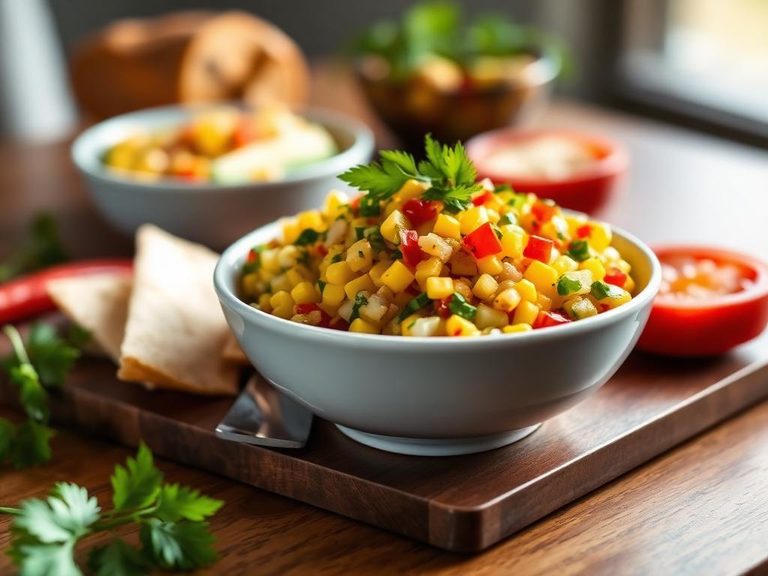
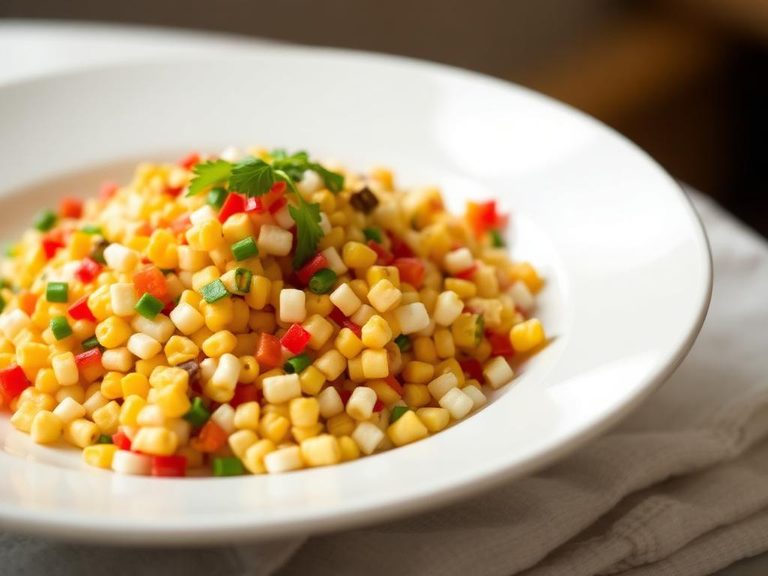
This is a vibrant, pre-mixed medley of sweet yellow corn kernels and crisp, diced red and green bell peppers, all suspended in a light, savory brine. The texture offers a satisfying contrast between the soft, popping corn and the tender-crisp peppers. Nutritionally, it's a low-calorie, high-carbohydrate side, providing a quick source of energy with minimal fat.
Calorie split: 11% protein · 84% carbs · 6% fat
↓ Full nutrition💚 Why it's loved
People love it for its effortless convenience and the sweet-savory flavor combination that instantly brightens a plate. It's a nostalgic, versatile staple that can be a side dish, salad topper, or ingredient in a quick casserole.
⚠️ Watch-outs & how to enjoy it better
The canned brine often contains significant sodium, which can be a concern for those monitoring blood pressure or fluid retention. The high-glycemic carbohydrates can cause rapid blood-sugar spikes, especially for individuals with diabetes or insulin resistance. **Tip:** Rinse the contents under cool water to reduce sodium by up to 40%. Pair it with a source of protein (like grilled chicken or beans) and healthy fat (like avocado or olive oil) to slow digestion and blunt the blood-sugar response.
Key benefits
- Low in calories and fat
- Good source of quick-release carbohydrates for energy
- Provides vitamin C from the bell peppers
- Convenient and ready-to-eat with no preparation needed
- Adds color and mild sweetness to meals
🍽️ Popular dishes


🌍 Where it's eaten
💡 Did you know?
This specific combination is a classic example of a 'frozen vegetable mix' that was first commercially canned and popularized in the United States during the mid-20th century, becoming a staple of convenience cooking.
Full nutrition (USDA data · scales with serving)
| Water | 77.5 g |
| Energy | 75.0 kcal |
| Energy | 314 kj |
| Protein | 2.3 g |
| Total lipid (fat) | 0.55 g |
| Ash | 1.4 g |
| Carbohydrate, by difference | 18.2 g |
| Calcium, Ca | 5.0 mg |
| Iron, Fe | 0.79 mg |
| Magnesium, Mg | 25.0 mg |
| Phosphorus, P | 62.0 mg |
| Potassium, K | 153 mg |
| Sodium, Na | 347 mg |
| Zinc, Zn | 0.37 mg |
| Copper, Cu | 0.06 mg |
| Manganese, Mn | 0.04 mg |
| Selenium, Se | 0.60 ug |
| Vitamin C, total ascorbic acid | 8.8 mg |
| Thiamin | 0.02 mg |
| Riboflavin | 0.08 mg |
| Niacin | 0.95 mg |
| Pantothenic acid | 0.45 mg |
| Vitamin B-6 | 0.10 mg |
| Folate, total | 34.0 ug |
| Folic acid | 0.00 ug |
| Folate, food | 34.0 ug |
| Folate, DFE | 34.0 ug |
| Vitamin B-12 | 0.00 ug |
| Vitamin A, RAE | 12.0 ug |
| Retinol | 0.00 ug |
| Vitamin A, IU | 232 iu |
| Vitamin D (D2 + D3), International Units | 0.00 iu |
| Vitamin D (D2 + D3) | 0.00 ug |
Fat & fatty acid profile (per 100g)
| Fatty acids, total saturated | 0.09 g |
| SFA 12:0 | 0.00 g |
| SFA 14:0 | 0.00 g |
| SFA 16:0 | 0.08 g |
| SFA 18:0 | 0.01 g |
| Fatty acids, total monounsaturated | 0.16 g |
| MUFA 16:1 | 0.00 g |
| MUFA 18:1 | 0.16 g |
| Fatty acids, total polyunsaturated | 0.26 g |
| PUFA 18:2 | 0.25 g |
| PUFA 18:3 | 0.01 g |
| Fatty acids, total trans | 0.00 g |
| Cholesterol | 0.00 mg |
Amino acid profile (per 100g)
| Tryptophan | 0.02 g |
| Threonine | 0.09 g |
| Isoleucine | 0.09 g |
| Leucine | 0.25 g |
| Lysine | 0.10 g |
| Methionine | 0.05 g |
| Cystine | 0.02 g |
| Phenylalanine | 0.11 g |
| Tyrosine | 0.09 g |
| Valine | 0.13 g |
| Arginine | 0.10 g |
| Histidine | 0.06 g |
| Alanine | 0.21 g |
| Aspartic acid | 0.18 g |
| Glutamic acid | 0.45 g |
| Glycine | 0.09 g |
| Proline | 0.21 g |
| Serine | 0.11 g |
FAQ
Is this the same as 'Mexicorn'?
Yes, 'Mexicorn' is a popular brand name for a very similar canned product containing corn and red and green peppers, often with a slightly seasoned brine. The terms are frequently used interchangeably.
Can I eat this straight from the can?
Yes, it is fully cooked and safe to eat cold. However, most people prefer to heat it briefly in a saucepan or microwave to enhance the flavors and warm it through as a side dish.
What's the best way to use up leftovers?
Stir leftovers into scrambled eggs or an omelet, mix into a cold pasta salad, fold into a quick quesadilla with cheese, or use as a topping for baked potatoes.
Nutrient density (calculated · NRF9.3)
Nutrient Rich Foods index: beneficial nutrients (protein, fiber, vitamins, minerals) minus saturated fat, added sugar & sodium, per 100 kcal.
NRF9.3 index — Fulgoni, Keast & Drewnowski, 2009. Computed from USDA nutrients.
Weight-loss friendliness (composite index)
Energy density 0.75 kcal/g · 12% calories from protein · 0.0 g fiber · 0.0 g sugar per 100 g.
Composite of energy density (Rolls et al., 1999), protein & fiber satiety, minus sugar. A calculated heuristic — ranks satiety-per-calorie, not a clinical measure.
Dietary load (calculated from USDA values)
Potential renal acid load. Positive = acid-forming, negative = alkaline-forming.
Sodium-to-potassium ratio: 2.27 (lower is better — aim for ≤ 1)
Sodium:potassium per WHO potassium guidance. Computed from USDA nutrients.