

Clams, raw
Common food
Raw clams are briny, oceanic bivalves with a plump, tender texture that ranges from slightly chewy to buttery depending on the species. Their flavor is a clean, sweet-salty essence of the sea, often described as more nuanced than oysters. Nutritionally, they are a powerhouse of lean protein and essential minerals, particularly vitamin B12 and iron, with minimal fat and carbohydrates.
Calorie split: 72% protein · 18% carbs · 11% fat
↓ Full nutrition💚 Why it's loved
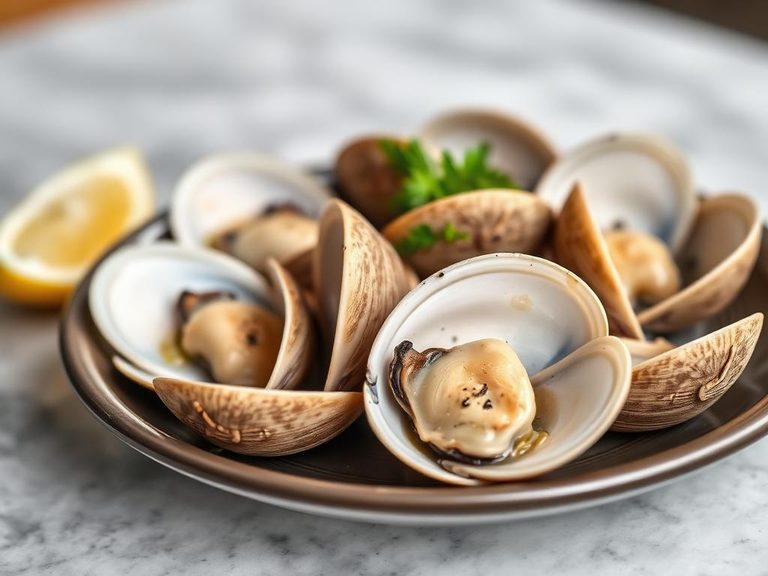
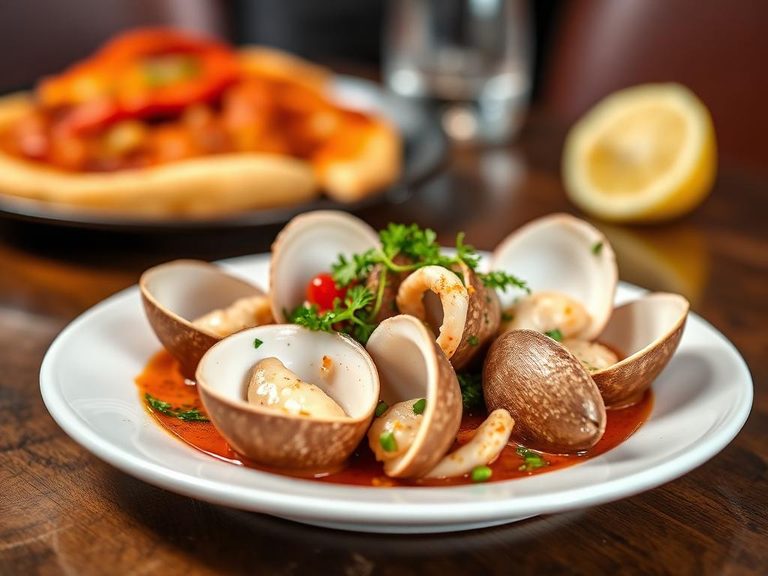
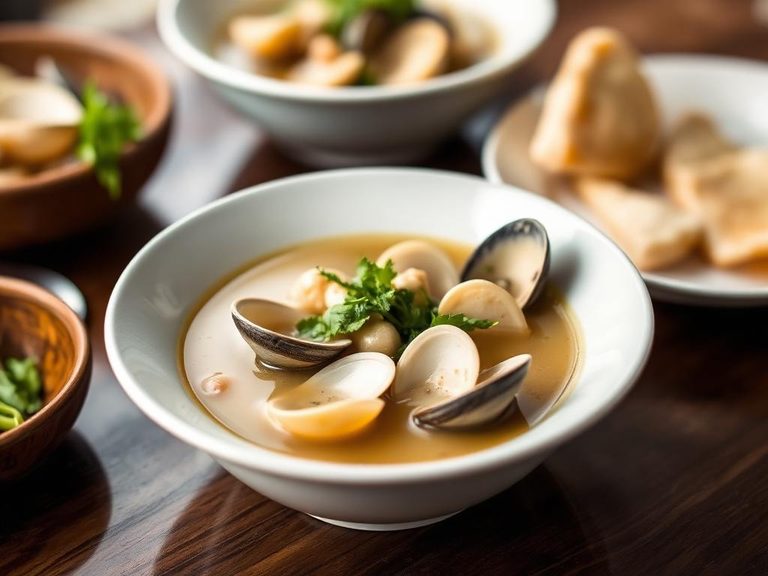
People love raw clams for their intense, fresh-from-the-ocean brininess and satisfyingly plump texture, which can be a more accessible introduction to raw shellfish than oysters. Their versatility allows them to be enjoyed simply on the half-shell with a squeeze of lemon or incorporated into a wide array of cooked dishes.
⚠️ Watch-outs & how to enjoy it better
Raw shellfish, including clams, carry a risk of foodborne illness from bacteria or viruses, so they should be sourced from reputable, well-chilled purveyors and consumed very fresh. They are also high in sodium and are a common allergen; those with shellfish allergies must avoid them entirely. To mitigate sodium, pair them with unsalted sides and use acidic garnishes like lemon or vinegar to enhance flavor without adding salt.
Key benefits
- Excellent source of high-quality, lean protein.
- Rich in vitamin B12, crucial for nerve function and red blood cell formation.
- Provides significant iron, important for oxygen transport in the blood.
- Low in calories and contains virtually no fat or sugar.
- Good source of selenium, an antioxidant mineral.
🍽️ Popular dishes
🌍 Where it's eaten
💡 Did you know?
Clams are filter feeders, and a single adult clam can filter up to 19 liters (5 gallons) of water per day, helping to clarify and clean their aquatic environment.
Full nutrition (USDA data · scales with serving)
| Water | 79.0 g |
| Energy | 86.0 kcal |
| Protein | 14.7 g |
| Total lipid (fat) | 0.96 g |
| Carbohydrate, by difference | 3.6 g |
| Fiber, total dietary | 0.00 g |
| Total Sugars | 0.00 g |
| Calcium, Ca | 39.0 mg |
| Iron, Fe | 1.6 mg |
| Magnesium, Mg | 19.0 mg |
| Phosphorus, P | 198 mg |
| Potassium, K | 46.0 mg |
| Sodium, Na | 56.0 mg |
| Zinc, Zn | 0.51 mg |
| Copper, Cu | 0.05 mg |
| Selenium, Se | 30.6 ug |
| Vitamin C, total ascorbic acid | 0.00 mg |
| Thiamin | 0.01 mg |
| Riboflavin | 0.04 mg |
| Niacin | 0.35 mg |
| Vitamin B-6 | 0.01 mg |
| Folate, total | 5.0 ug |
| Folic acid | 0.00 ug |
| Folate, food | 5.0 ug |
| Folate, DFE | 5.0 ug |
| Choline, total | 65.0 mg |
| Vitamin B-12 | 11.3 ug |
| Vitamin B-12, added | 0.00 ug |
| Vitamin A, RAE | 90.0 ug |
| Retinol | 90.0 ug |
| Carotene, beta | 0.00 ug |
| Carotene, alpha | 0.00 ug |
| Cryptoxanthin, beta | 0.00 ug |
| Lycopene | 0.00 ug |
| Lutein + zeaxanthin | 0.00 ug |
| Vitamin E (alpha-tocopherol) | 0.68 mg |
| Vitamin E, added | 0.00 mg |
| Vitamin D (D2 + D3) | 0.00 ug |
| Vitamin K (phylloquinone) | 0.20 ug |
| Alcohol, ethyl | 0.00 g |
| Caffeine | 0.00 mg |
| Theobromine | 0.00 mg |
Fat & fatty acid profile (per 100g)
| Fatty acids, total saturated | 0.19 g |
| SFA 4:0 | 0.00 g |
| SFA 6:0 | 0.00 g |
| SFA 8:0 | 0.00 g |
| SFA 10:0 | 0.00 g |
| SFA 12:0 | 0.00 g |
| SFA 14:0 | 0.01 g |
| SFA 16:0 | 0.11 g |
| SFA 18:0 | 0.05 g |
| Fatty acids, total monounsaturated | 0.12 g |
| MUFA 16:1 | 0.02 g |
| MUFA 18:1 | 0.06 g |
| MUFA 20:1 | 0.01 g |
| MUFA 22:1 | 0.00 g |
| Fatty acids, total polyunsaturated | 0.19 g |
| PUFA 18:2 | 0.04 g |
| PUFA 18:3 | 0.01 g |
| PUFA 18:4 | 0.00 g |
| PUFA 20:4 | 0.01 g |
| PUFA 20:5 n-3 (EPA) | 0.04 g |
| PUFA 22:5 n-3 (DPA) | 0.01 g |
| PUFA 22:6 n-3 (DHA) | 0.06 g |
| Cholesterol | 30.0 mg |
FAQ
How do I know if a raw clam is safe to eat?
Before eating, tap the shell. If it's open, it should close firmly when tapped; if it doesn't, it's likely dead and should be discarded. After steaming or cooking, discard any clams that did not open.
What's the difference between raw and cooked clams nutritionally?
Cooking primarily affects texture and safety. The core nutritional profile (protein, minerals) remains similar, but some heat-sensitive vitamins like B12 may be slightly reduced. Cooking also makes the clam's minerals more bioavailable.
Can I eat the clam liquor (the juice in the shell)?
Yes, the clam liquor is highly prized for its concentrated, briny flavor. It's often sipped directly from the shell or used as a base for sauces and soups. Ensure the clams are very fresh if consuming raw.
Nutrient density (calculated · NRF9.3)
Nutrient Rich Foods index: beneficial nutrients (protein, fiber, vitamins, minerals) minus saturated fat, added sugar & sodium, per 100 kcal.
NRF9.3 index — Fulgoni, Keast & Drewnowski, 2009. Computed from USDA nutrients.
Weight-loss friendliness (composite index)
Energy density 0.86 kcal/g · 68% calories from protein · 0.0 g fiber · 0.0 g sugar per 100 g.
Composite of energy density (Rolls et al., 1999), protein & fiber satiety, minus sugar. A calculated heuristic — ranks satiety-per-calorie, not a clinical measure.
Dietary load (calculated from USDA values)
Potential renal acid load. Positive = acid-forming, negative = alkaline-forming.
Sodium-to-potassium ratio: 1.22 (lower is better — aim for ≤ 1)
Sodium:potassium per WHO potassium guidance. Computed from USDA nutrients.