

Cereals ready-to-eat, POST, HONEY BUNCHES OF OATS, pecan bunches
Whole food · Breakfast Cereals

Photo: Wikipedia
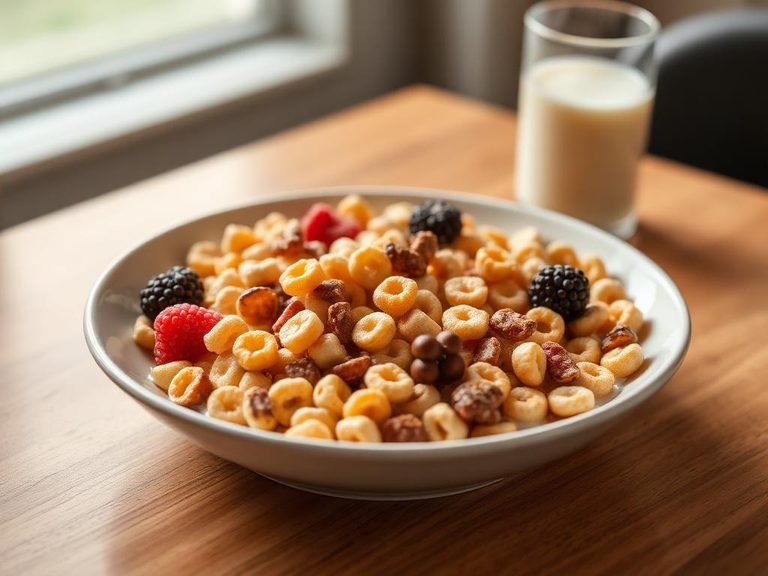
A crunchy, golden cereal of toasted oat flakes and pecan clusters, sweetened with a honey drizzle. The texture is a satisfying mix of crisp flakes and buttery, nutty pecan bunches. It delivers a solid 5.2g of fiber per 100g, supporting digestive health.
Calorie split: 7% protein · 81% carbs · 12% fat
↓ Full nutrition💚 Why it's loved
People love the addictive combination of sweet honey, toasted oats, and rich, buttery pecans. It's a versatile breakfast staple that's equally good with cold milk, sprinkled on yogurt, or eaten dry as a snack.
⚠️ Watch-outs & how to enjoy it better
The high sugar content (21.9g per 100g) can cause a rapid blood-sugar spike, especially on an empty stomach. To counteract this, pair it with a source of protein or fat like Greek yogurt, milk, or a handful of nuts, and practice portion control. Pecans are tree nuts, a common allergen.
Key benefits
- Good source of dietary fiber (5.2g per 100g)
- Provides plant-based protein (7g per 100g)
- Quick, convenient source of energy (399 kcal per 100g)
- Contains whole grain oats
- Pecans add healthy monounsaturated fats
🍽️ Popular dishes

🌍 Where it's eaten
💡 Did you know?
The 'bunches' in the name refer to the cereal's signature clusters, which are formed by coating oats and pecans with a honey-sugar syrup and baking them until they clump together.
Full nutrition (USDA data · scales with serving)
| Water | 2.9 g |
| Energy | 399 kcal |
| Energy | 1670 kj |
| Protein | 7.0 g |
| Total lipid (fat) | 5.4 g |
| Ash | 2.7 g |
| Carbohydrate, by difference | 82.0 g |
| Fiber, total dietary | 5.2 g |
| Total Sugars | 21.9 g |
| Calcium, Ca | 19.0 mg |
| Iron, Fe | 15.5 mg |
| Magnesium, Mg | 36.0 mg |
| Phosphorus, P | 140 mg |
| Potassium, K | 177 mg |
| Sodium, Na | 483 mg |
| Zinc, Zn | 1.0 mg |
| Copper, Cu | 0.14 mg |
| Selenium, Se | 17.3 ug |
| Vitamin C, total ascorbic acid | 0.20 mg |
| Thiamin | 1.3 mg |
| Riboflavin | 1.5 mg |
| Niacin | 17.2 mg |
| Vitamin B-6 | 1.7 mg |
| Folate, total | 690 ug |
| Folic acid | 671 ug |
| Folate, food | 19.0 ug |
| Folate, DFE | 1159 ug |
| Choline, total | 18.6 mg |
| Vitamin B-12 | 5.2 ug |
| Vitamin B-12, added | 5.2 ug |
| Vitamin A, RAE | 748 ug |
| Retinol | 743 ug |
| Carotene, beta | 50.0 ug |
| Carotene, alpha | 32.0 ug |
| Cryptoxanthin, beta | 0.00 ug |
| Vitamin A, IU | 2586 iu |
| Lycopene | 0.00 ug |
| Lutein + zeaxanthin | 787 ug |
| Vitamin E (alpha-tocopherol) | 0.50 mg |
| Vitamin E, added | 0.00 mg |
| Vitamin D (D2 + D3), International Units | 138 iu |
| Vitamin D (D2 + D3) | 3.4 ug |
| Vitamin D3 (cholecalciferol) | 3.4 ug |
| Vitamin K (phylloquinone) | 1.4 ug |
| Alcohol, ethyl | 0.00 g |
| Caffeine | 0.00 mg |
| Theobromine | 0.00 mg |
Fat & fatty acid profile (per 100g)
| Fatty acids, total saturated | 0.70 g |
| SFA 4:0 | 0.00 g |
| SFA 6:0 | 0.00 g |
| SFA 8:0 | 0.00 g |
| SFA 10:0 | 0.00 g |
| SFA 12:0 | 0.00 g |
| SFA 14:0 | 0.00 g |
| SFA 16:0 | 0.56 g |
| SFA 18:0 | 0.13 g |
| Fatty acids, total monounsaturated | 2.7 g |
| MUFA 16:1 | 0.01 g |
| MUFA 18:1 | 2.7 g |
| MUFA 20:1 | 0.01 g |
| MUFA 22:1 | 0.00 g |
| Fatty acids, total polyunsaturated | 1.7 g |
| PUFA 18:2 | 1.6 g |
| PUFA 18:3 | 0.09 g |
| PUFA 18:4 | 0.00 g |
| PUFA 20:4 | 0.00 g |
| PUFA 20:5 n-3 (EPA) | 0.00 g |
| PUFA 22:5 n-3 (DPA) | 0.00 g |
| PUFA 22:6 n-3 (DHA) | 0.00 g |
| Fatty acids, total trans | 0.00 g |
| Cholesterol | 0.00 mg |
FAQ
Is this cereal gluten-free?
While oats are naturally gluten-free, this product is made in a facility that likely processes wheat. It is not certified gluten-free and may contain trace amounts. Those with celiac disease or severe gluten sensitivity should avoid it.
How does it compare nutritionally to other sweet cereals?
Compared to many sweetened cereals, it offers more fiber and protein due to the whole oats and pecans. However, its sugar content is still high, so it's best enjoyed as an occasional treat or part of a balanced meal.
Can I eat this cereal on a weight-loss diet?
It can fit in moderation, but its calorie density (399 kcal per 100g) and sugar content require strict portion control. A measured 1-cup serving (about 59g) with low-fat milk and added fruit is a more diet-friendly approach.
Nutrient density (calculated · NRF9.3)
Nutrient Rich Foods index: beneficial nutrients (protein, fiber, vitamins, minerals) minus saturated fat, added sugar & sodium, per 100 kcal.
NRF9.3 index — Fulgoni, Keast & Drewnowski, 2009. Computed from USDA nutrients.
Weight-loss friendliness (composite index)
Energy density 3.99 kcal/g · 7% calories from protein · 5.2 g fiber · 21.9 g sugar per 100 g.
Composite of energy density (Rolls et al., 1999), protein & fiber satiety, minus sugar. A calculated heuristic — ranks satiety-per-calorie, not a clinical measure.
Dietary load (calculated from USDA values)
Potential renal acid load. Positive = acid-forming, negative = alkaline-forming.
Sodium-to-potassium ratio: 2.73 (lower is better — aim for ≤ 1)
Sodium:potassium per WHO potassium guidance. Computed from USDA nutrients.