

Cabbage with ham hocks
Common food

Photo: Wikipedia
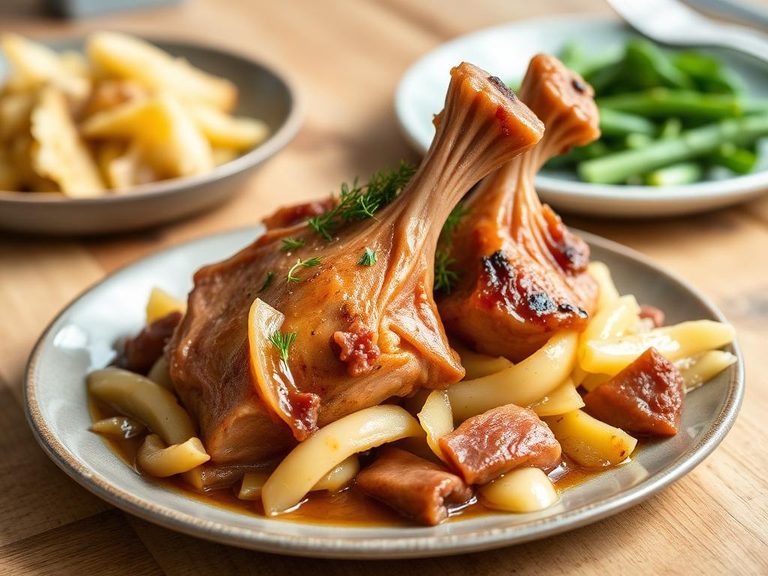
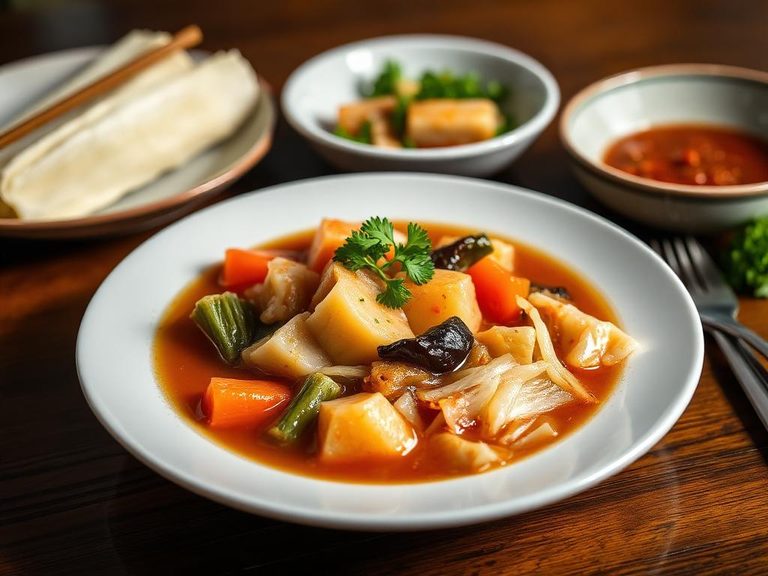
Cabbage with ham hocks is a hearty, savory dish where tender, slow-cooked cabbage absorbs the rich, smoky, and salty flavors from the pork. The cabbage becomes silky and slightly sweet, providing a soft, yielding texture that contrasts with the meaty, gelatinous ham hock. Nutritionally, it's a low-calorie, high-protein meal that delivers substantial fiber and minerals from the cabbage.
Calorie split: 42% protein · 27% carbs · 31% fat
↓ Full nutrition💚 Why it's loved
People love it for the deep, comforting umami flavor that develops as the smoky pork infuses the mild cabbage, creating a simple yet profoundly satisfying one-pot meal. It's a versatile, economical dish that stretches a small amount of meat to feed many, often evoking nostalgic family cooking traditions.
⚠️ Watch-outs & how to enjoy it better
The dish can be high in sodium due to the cured ham hocks, which may be a concern for those monitoring blood pressure. To mitigate this, you can soak the ham hocks in cold water for a few hours before cooking, or choose low-sodium varieties, and avoid adding extra salt. The fat content, while flavorful, might be reduced by skimming the broth or using leaner smoked turkey legs as an alternative.
Key benefits
- High in protein for muscle maintenance
- Good source of dietary fiber for digestion
- Rich in Vitamin K and Vitamin C from cabbage
- Contains collagen and minerals from ham hocks
- Low in calories per 100g serving
🍽️ Popular dishes
🌍 Where it's eaten
💡 Did you know?
The gelatinous liquid released from the ham hocks during slow cooking is essentially a rich, flavorful bone broth, which is why the dish often thickens and becomes more luxurious upon cooling.
Full nutrition (USDA data · scales with serving)
| Water | 83.5 g |
| Energy | 75.0 kcal |
| Protein | 7.8 g |
| Total lipid (fat) | 2.6 g |
| Carbohydrate, by difference | 4.9 g |
| Fiber, total dietary | 1.7 g |
| Total Sugars | 2.7 g |
| Calcium, Ca | 32.0 mg |
| Iron, Fe | 0.43 mg |
| Magnesium, Mg | 17.0 mg |
| Phosphorus, P | 106 mg |
| Potassium, K | 255 mg |
| Sodium, Na | 344 mg |
| Zinc, Zn | 0.89 mg |
| Copper, Cu | 0.05 mg |
| Selenium, Se | 9.3 ug |
| Vitamin C, total ascorbic acid | 23.8 mg |
| Thiamin | 0.18 mg |
| Riboflavin | 0.11 mg |
| Niacin | 2.2 mg |
| Vitamin B-6 | 0.22 mg |
| Folate, total | 26.0 ug |
| Folic acid | 0.00 ug |
| Folate, food | 26.0 ug |
| Folate, DFE | 26.0 ug |
| Choline, total | 35.3 mg |
| Vitamin B-12 | 0.17 ug |
| Vitamin B-12, added | 0.00 ug |
| Vitamin A, RAE | 5.0 ug |
| Retinol | 2.0 ug |
| Carotene, beta | 28.0 ug |
| Carotene, alpha | 22.0 ug |
| Cryptoxanthin, beta | 0.00 ug |
| Lycopene | 0.00 ug |
| Lutein + zeaxanthin | 20.0 ug |
| Vitamin E (alpha-tocopherol) | 0.20 mg |
| Vitamin E, added | 0.00 mg |
| Vitamin D (D2 + D3) | 0.30 ug |
| Vitamin K (phylloquinone) | 41.2 ug |
| Alcohol, ethyl | 0.00 g |
| Caffeine | 0.00 mg |
| Theobromine | 0.00 mg |
Fat & fatty acid profile (per 100g)
| Fatty acids, total saturated | 0.81 g |
| SFA 4:0 | 0.00 g |
| SFA 6:0 | 0.00 g |
| SFA 8:0 | 0.00 g |
| SFA 10:0 | 0.00 g |
| SFA 12:0 | 0.00 g |
| SFA 14:0 | 0.03 g |
| SFA 16:0 | 0.52 g |
| SFA 18:0 | 0.25 g |
| Fatty acids, total monounsaturated | 1.1 g |
| MUFA 16:1 | 0.06 g |
| MUFA 18:1 | 1.0 g |
| MUFA 20:1 | 0.02 g |
| MUFA 22:1 | 0.00 g |
| Fatty acids, total polyunsaturated | 0.35 g |
| PUFA 18:2 | 0.30 g |
| PUFA 18:3 | 0.01 g |
| PUFA 18:4 | 0.00 g |
| PUFA 20:4 | 0.02 g |
| PUFA 20:5 n-3 (EPA) | 0.00 g |
| PUFA 22:5 n-3 (DPA) | 0.00 g |
| PUFA 22:6 n-3 (DHA) | 0.00 g |
| Cholesterol | 20.0 mg |
FAQ
How do you cook cabbage with ham hocks to make it tender?
The key is low and slow cooking. Typically, you simmer the ham hocks in water or broth for 1-2 hours until the meat starts to pull from the bone, then add the sliced cabbage and continue simmering for another 30-45 minutes until the cabbage is completely tender and has absorbed the flavors.
Can I make this dish without a ham hock?
Yes. You can substitute with smoked turkey legs, bacon, smoked sausage, or even smoked tofu for a vegetarian version. The goal is to add a smoky, savory element to flavor the cabbage.
What cuts of cabbage are best for this recipe?
Green cabbage is most traditional due to its sturdy leaves that hold up well to long cooking. Savoy cabbage is a good alternative for a more delicate texture, while red cabbage will change the color of the dish but adds a nice tang.
Nutrient density (calculated · NRF9.3)
Nutrient Rich Foods index: beneficial nutrients (protein, fiber, vitamins, minerals) minus saturated fat, added sugar & sodium, per 100 kcal.
NRF9.3 index — Fulgoni, Keast & Drewnowski, 2009. Computed from USDA nutrients.
Weight-loss friendliness (composite index)
Energy density 0.75 kcal/g · 41% calories from protein · 1.7 g fiber · 2.7 g sugar per 100 g.
Composite of energy density (Rolls et al., 1999), protein & fiber satiety, minus sugar. A calculated heuristic — ranks satiety-per-calorie, not a clinical measure.
Dietary load (calculated from USDA values)
Potential renal acid load. Positive = acid-forming, negative = alkaline-forming.
Sodium-to-potassium ratio: 1.35 (lower is better — aim for ≤ 1)
Sodium:potassium per WHO potassium guidance. Computed from USDA nutrients.