

Wheat flour, white, all-purpose, enriched, calcium-fortified
Whole food · Cereal Grains and Pasta
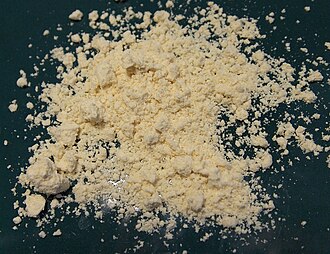
Photo: Wikipedia
This is the workhorse of the kitchen: a finely milled, bleached powder with a neutral, slightly sweet flavor and a soft, powdery texture. Nutritionally, it's a dense source of energy, delivering over 360 calories and 76 grams of carbohydrates per 100 grams, while being fortified with calcium and enriched with B vitamins and iron. It forms the structural backbone of countless baked goods, from fluffy breads to tender cakes.
Calorie split: 12% protein · 86% carbs · 2% fat
↓ Full nutrition💚 Why it's loved
People love it for its incredible versatility and reliability—it's the blank canvas that can become a crusty baguette, a fluffy pancake, or a delicate pastry. Its mild, neutral flavor allows it to absorb other ingredients, making it the foundation of comfort foods and celebrations worldwide.
⚠️ Watch-outs & how to enjoy it better
It can cause rapid blood-sugar spikes due to its high glycemic index and refined nature, and it's a common allergen (gluten). To counteract this, pair it with protein (like eggs or nuts) or healthy fats (like avocado or olive oil) to slow digestion, choose whole-grain blends when possible, and practice portion control by using it as a component of a balanced meal rather than the main event.
Key benefits
- Enriched with iron and B vitamins (thiamin, riboflavin, niacin, folic acid) to prevent nutrient deficiencies.
- Fortified with calcium to support bone health.
- Provides a quick, dense source of energy from complex carbohydrates.
- Acts as a versatile, neutral base for a vast array of global cuisines and recipes.
- Contains a moderate amount of protein (10g per 100g) for building and repairing tissues.
🍽️ Popular dishes





🌍 Where it's eaten
💡 Did you know?
The 'enrichment' process, mandated in the U.S. since 1941, replaces nutrients lost during milling—specifically, it adds back four B vitamins and iron, and often folic acid, which has helped reduce neural tube defects in newborns by up to 25%.
Full nutrition (USDA data · scales with serving)
| Water | 11.9 g |
| Energy | 364 kcal |
| Energy | 1523 kj |
| Protein | 10.3 g |
| Total lipid (fat) | 0.98 g |
| Ash | 0.47 g |
| Carbohydrate, by difference | 76.3 g |
| Fiber, total dietary | 2.7 g |
| Calcium, Ca | 252 mg |
| Iron, Fe | 4.6 mg |
| Magnesium, Mg | 22.0 mg |
| Phosphorus, P | 108 mg |
| Potassium, K | 107 mg |
| Sodium, Na | 2.0 mg |
| Zinc, Zn | 0.70 mg |
| Copper, Cu | 0.14 mg |
| Manganese, Mn | 0.68 mg |
| Vitamin C, total ascorbic acid | 0.00 mg |
| Thiamin | 0.79 mg |
| Riboflavin | 0.49 mg |
| Niacin | 5.9 mg |
| Pantothenic acid | 0.44 mg |
| Vitamin B-6 | 0.04 mg |
| Folate, total | 183 ug |
| Folic acid | 154 ug |
| Folate, food | 29.0 ug |
| Folate, DFE | 291 ug |
| Vitamin B-12 | 0.00 ug |
| Vitamin A, RAE | 0.00 ug |
| Retinol | 0.00 ug |
| Vitamin A, IU | 0.00 iu |
| Vitamin E (alpha-tocopherol) | 0.06 mg |
| Vitamin D (D2 + D3), International Units | 0.00 iu |
| Vitamin D (D2 + D3) | 0.00 ug |
Fat & fatty acid profile (per 100g)
| Fatty acids, total saturated | 0.15 g |
| SFA 16:0 | 0.15 g |
| SFA 18:0 | 0.01 g |
| Fatty acids, total monounsaturated | 0.09 g |
| MUFA 18:1 | 0.09 g |
| Fatty acids, total polyunsaturated | 0.41 g |
| PUFA 18:2 | 0.39 g |
| PUFA 18:3 | 0.02 g |
| Cholesterol | 0.00 mg |
Amino acid profile (per 100g)
| Tryptophan | 0.13 g |
| Threonine | 0.28 g |
| Isoleucine | 0.36 g |
| Leucine | 0.71 g |
| Lysine | 0.23 g |
| Methionine | 0.18 g |
| Cystine | 0.22 g |
| Phenylalanine | 0.52 g |
| Tyrosine | 0.31 g |
| Valine | 0.41 g |
| Arginine | 0.42 g |
| Histidine | 0.23 g |
| Alanine | 0.33 g |
| Aspartic acid | 0.43 g |
| Glutamic acid | 3.5 g |
| Glycine | 0.37 g |
| Proline | 1.2 g |
| Serine | 0.52 g |
FAQ
What's the difference between all-purpose flour and bread flour?
All-purpose flour has a moderate protein content (about 10-12%), making it suitable for most recipes. Bread flour has a higher protein content (12-14%), which creates more gluten for chewier, structured breads.
Why is it called 'enriched'?
It's enriched because manufacturers add back nutrients (like iron, B vitamins, and folic acid) that are lost during the refining process of removing the bran and germ.
Can I use this flour for thickening sauces?
Yes, it's a common thickener. To avoid lumps, make a 'roux' by cooking the flour with an equal amount of fat (like butter) before gradually whisking in liquid.
Nutrient density (calculated · NRF9.3)
Nutrient Rich Foods index: beneficial nutrients (protein, fiber, vitamins, minerals) minus saturated fat, added sugar & sodium, per 100 kcal.
NRF9.3 index — Fulgoni, Keast & Drewnowski, 2009. Computed from USDA nutrients.
Weight-loss friendliness (composite index)
Energy density 3.64 kcal/g · 11% calories from protein · 2.7 g fiber · 0.0 g sugar per 100 g.
Composite of energy density (Rolls et al., 1999), protein & fiber satiety, minus sugar. A calculated heuristic — ranks satiety-per-calorie, not a clinical measure.
Dietary load (calculated from USDA values)
Potential renal acid load. Positive = acid-forming, negative = alkaline-forming.
Sodium-to-potassium ratio: 0.02 (lower is better — aim for ≤ 1)
Sodium:potassium per WHO potassium guidance. Computed from USDA nutrients.