

Stewed potatoes with tomatoes
Common food
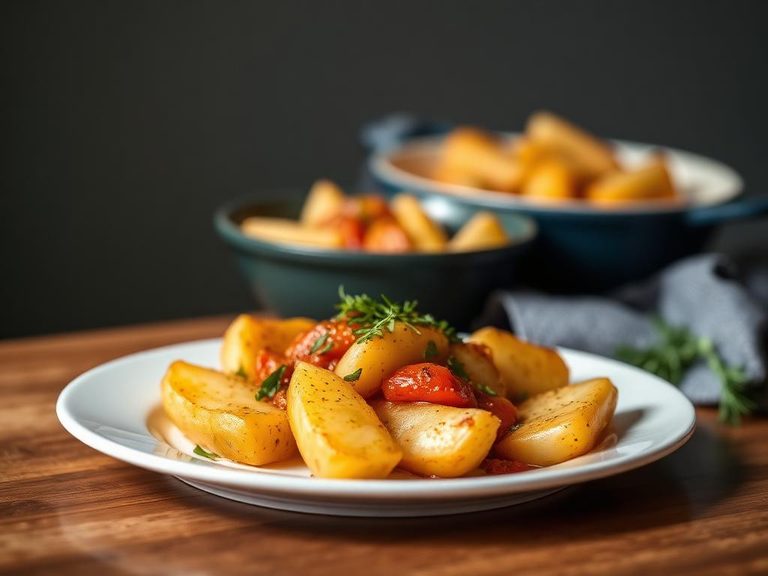
Stewed potatoes with tomatoes is a comforting, rustic dish where tender potato chunks are slow-cooked in a savory, slightly acidic tomato sauce until they absorb the rich, tangy flavors. The texture is soft and yielding, with the potatoes becoming creamy while the tomatoes break down into a luscious, pulpy base. Nutritionally, it's a low-calorie, plant-based staple that provides a good balance of complex carbohydrates, fiber, and a modest amount of fat for satiety.
Calorie split: 8% protein · 59% carbs · 34% fat
↓ Full nutrition💚 Why it's loved
People love this dish for its simple, hearty flavor that feels like a warm hug, often evoking memories of home cooking and family meals. Its versatility allows it to be served as a side dish, a main course with bread, or a base for adding proteins like eggs or cheese.
⚠️ Watch-outs & how to enjoy it better
The dish can be high in sodium if prepared with canned tomatoes or added salt, which may concern those monitoring blood pressure. To counteract this, use low-sodium canned tomatoes or fresh tomatoes, and season with herbs like oregano or basil instead of extra salt. Additionally, the high carbohydrate content from potatoes may cause blood sugar spikes in some individuals; pairing it with a source of protein (like beans or chicken) or healthy fat (like olive oil) can help moderate glycemic response.
Key benefits
- Low in calories and fat, suitable for weight management.
- Good source of dietary fiber for digestive health.
- Provides complex carbohydrates for sustained energy.
- Contains vitamin C from tomatoes, supporting immune function.
- Naturally gluten-free and vegan.
🍽️ Popular dishes
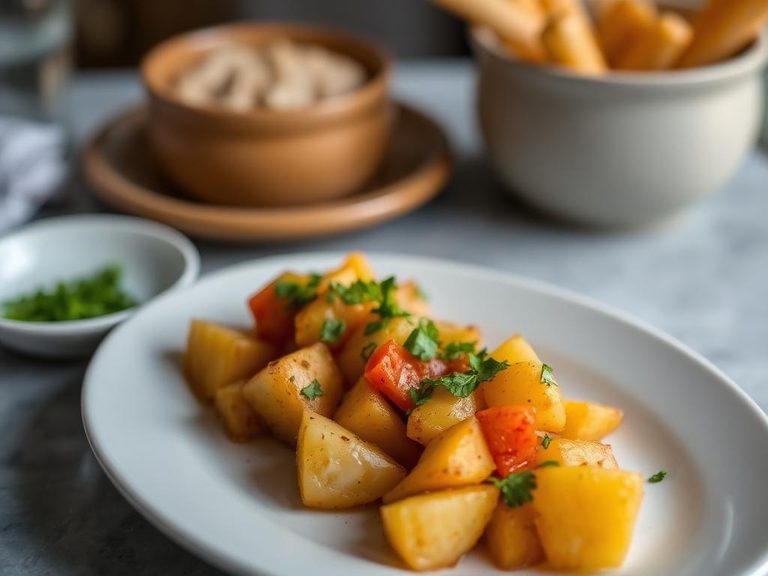
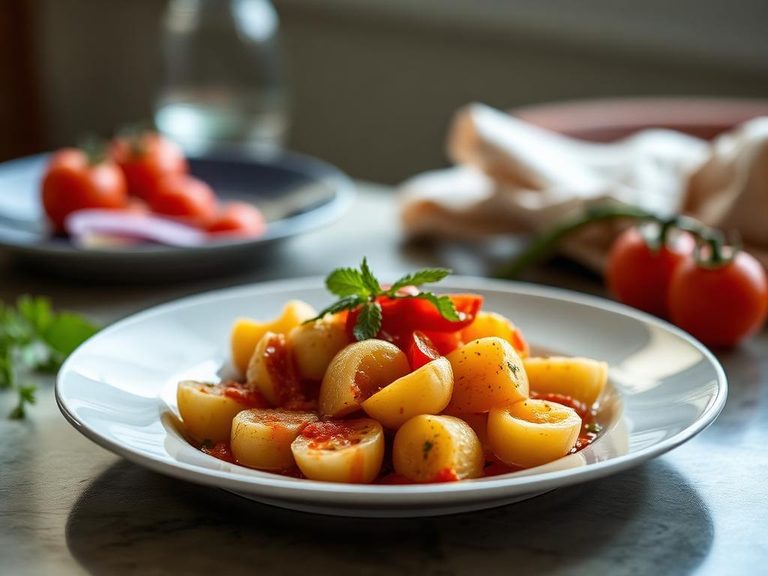
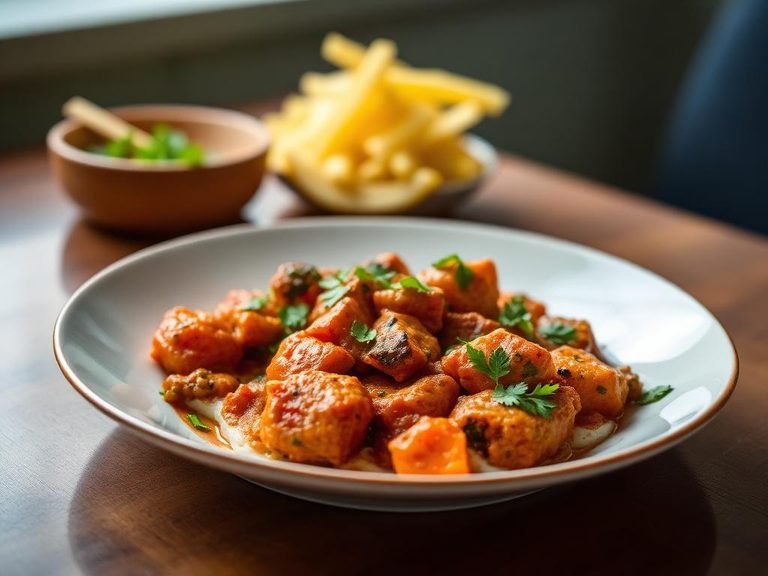
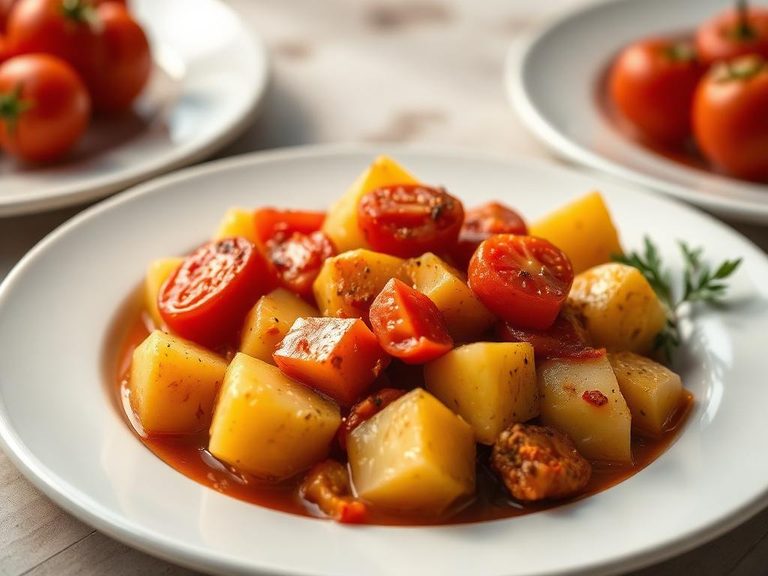
🌍 Where it's eaten
💡 Did you know?
In Spain, the dish 'Patatas a la Riojana' is traditionally made with chorizo, but the tomato-potato base alone dates back to the 16th century after tomatoes were introduced from the Americas.
Full nutrition (USDA data · scales with serving)
| Water | 80.9 g |
| Energy | 87.0 kcal |
| Protein | 1.7 g |
| Total lipid (fat) | 3.3 g |
| Carbohydrate, by difference | 12.9 g |
| Fiber, total dietary | 1.9 g |
| Total Sugars | 1.7 g |
| Calcium, Ca | 10.0 mg |
| Iron, Fe | 0.36 mg |
| Magnesium, Mg | 20.0 mg |
| Phosphorus, P | 47.0 mg |
| Potassium, K | 386 mg |
| Sodium, Na | 146 mg |
| Zinc, Zn | 0.32 mg |
| Copper, Cu | 0.09 mg |
| Selenium, Se | 0.00 ug |
| Vitamin C, total ascorbic acid | 15.1 mg |
| Thiamin | 0.05 mg |
| Riboflavin | 0.03 mg |
| Niacin | 1.1 mg |
| Vitamin B-6 | 0.12 mg |
| Folate, total | 13.0 ug |
| Folic acid | 0.00 ug |
| Folate, food | 13.0 ug |
| Folate, DFE | 13.0 ug |
| Choline, total | 10.4 mg |
| Vitamin B-12 | 0.00 ug |
| Vitamin B-12, added | 0.00 ug |
| Vitamin A, RAE | 13.0 ug |
| Retinol | 0.00 ug |
| Carotene, beta | 145 ug |
| Carotene, alpha | 32.0 ug |
| Cryptoxanthin, beta | 0.00 ug |
| Lycopene | 825 ug |
| Lutein + zeaxanthin | 45.0 ug |
| Vitamin E (alpha-tocopherol) | 0.76 mg |
| Vitamin E, added | 0.00 mg |
| Vitamin D (D2 + D3) | 0.00 ug |
| Vitamin K (phylloquinone) | 6.5 ug |
| Alcohol, ethyl | 0.00 g |
| Caffeine | 0.00 mg |
| Theobromine | 0.00 mg |
Fat & fatty acid profile (per 100g)
| Fatty acids, total saturated | 0.43 g |
| SFA 4:0 | 0.00 g |
| SFA 6:0 | 0.00 g |
| SFA 8:0 | 0.00 g |
| SFA 10:0 | 0.00 g |
| SFA 12:0 | 0.00 g |
| SFA 14:0 | 0.00 g |
| SFA 16:0 | 0.31 g |
| SFA 18:0 | 0.09 g |
| Fatty acids, total monounsaturated | 1.3 g |
| MUFA 16:1 | 0.01 g |
| MUFA 18:1 | 1.3 g |
| MUFA 20:1 | 0.02 g |
| MUFA 22:1 | 0.00 g |
| Fatty acids, total polyunsaturated | 1.2 g |
| PUFA 18:2 | 1.1 g |
| PUFA 18:3 | 0.14 g |
| PUFA 18:4 | 0.00 g |
| PUFA 20:4 | 0.00 g |
| PUFA 20:5 n-3 (EPA) | 0.00 g |
| PUFA 22:5 n-3 (DPA) | 0.00 g |
| PUFA 22:6 n-3 (DHA) | 0.00 g |
| Cholesterol | 0.00 mg |
FAQ
Can I make this dish ahead of time?
Yes, stewed potatoes with tomatoes actually taste better after resting, as the flavors meld together. Store in an airtight container in the refrigerator for up to 3 days.
Is this dish suitable for a low-carb diet?
Not typically, as potatoes are high in carbohydrates. However, you can reduce the portion size or substitute some potatoes with lower-carb vegetables like zucchini or cauliflower.
How can I add more protein to this dish?
You can add beans (like chickpeas or white beans), lentils, or diced chicken or sausage during cooking to boost protein content without altering the base flavor significantly.
Nutrient density (calculated · NRF9.3)
Nutrient Rich Foods index: beneficial nutrients (protein, fiber, vitamins, minerals) minus saturated fat, added sugar & sodium, per 100 kcal.
NRF9.3 index — Fulgoni, Keast & Drewnowski, 2009. Computed from USDA nutrients.
Weight-loss friendliness (composite index)
Energy density 0.87 kcal/g · 8% calories from protein · 1.9 g fiber · 1.7 g sugar per 100 g.
Composite of energy density (Rolls et al., 1999), protein & fiber satiety, minus sugar. A calculated heuristic — ranks satiety-per-calorie, not a clinical measure.
Dietary load (calculated from USDA values)
Potential renal acid load. Positive = acid-forming, negative = alkaline-forming.
Sodium-to-potassium ratio: 0.38 (lower is better — aim for ≤ 1)
Sodium:potassium per WHO potassium guidance. Computed from USDA nutrients.