

Roll with meat and/or shrimp, vegetables and rice paper, not fried
Common food

Photo: Wikipedia
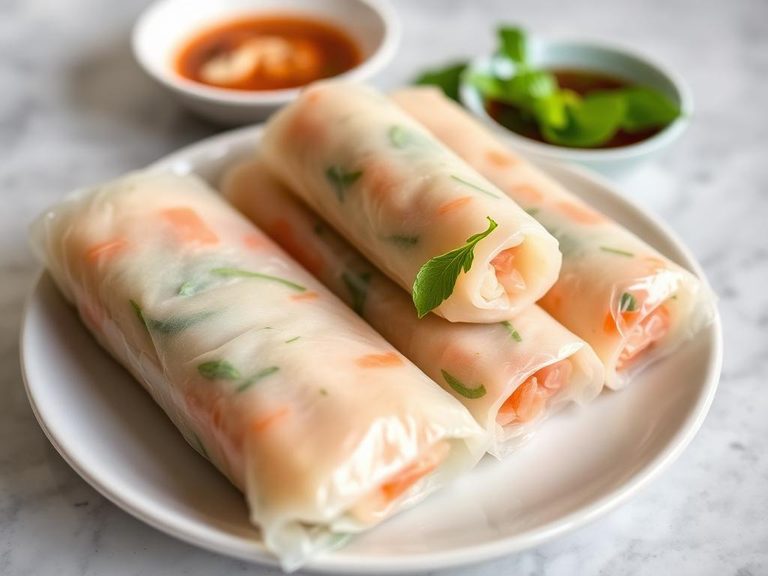
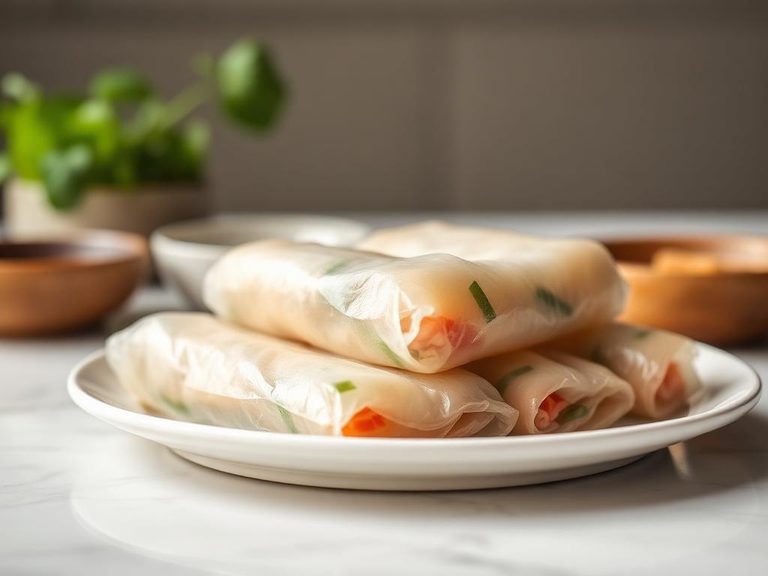
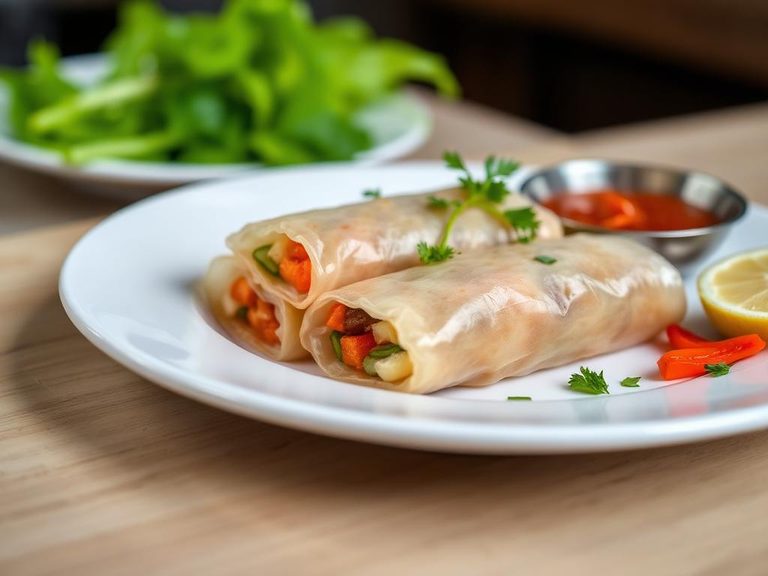
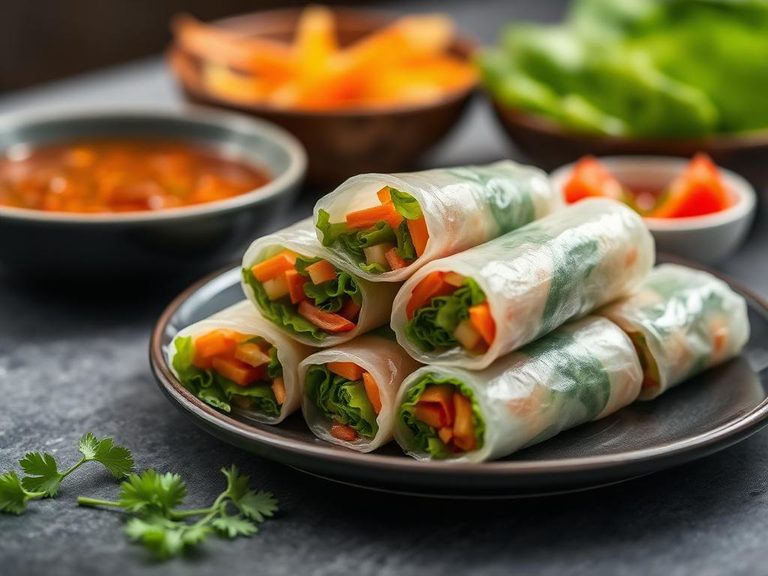
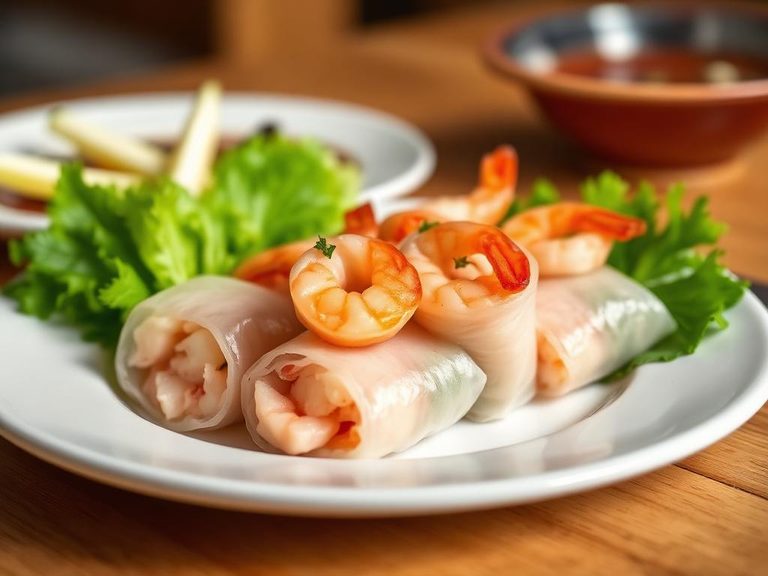
A fresh, non-fried rice paper roll (often called a summer roll or gỏi cuốn) is a translucent, chewy wrapper encasing a vibrant mix of herbs, vermicelli noodles, and protein like shrimp or pork. Its texture is delightfully soft and slightly sticky, offering a clean, bright bite that highlights the freshness of its fillings. Nutritionally, it's a light, low-fat option, with the rice paper providing mostly simple carbohydrates for quick energy.
Calorie split: 20% protein · 60% carbs · 21% fat
↓ Full nutrition💚 Why it's loved
People adore it for the refreshing contrast of cool, crisp vegetables and tender protein against the soft, chewy rice paper. It's a beloved street food and party appetizer in Vietnamese cuisine, celebrated for its lightness and ability to showcase fresh, herbaceous flavors.
⚠️ Watch-outs & how to enjoy it better
The primary downside is its high glycemic load from the rice paper and vermicelli, which can cause a rapid blood-sugar spike, especially if eaten alone. The dipping sauces (like hoisin-peanut or nước chấm) are often high in sodium and sugar. To counteract this, pair the roll with a protein-rich or fatty dip (like a full-fat peanut sauce) and fill it generously with fiber-rich vegetables to slow carbohydrate absorption.
Key benefits
- Low in fat, especially compared to fried spring rolls
- High in fresh herbs, providing vitamins and antioxidants
- Lean protein from shrimp or pork supports muscle maintenance
- Light and hydrating due to high water content in fillings
- Customizable with a wide variety of vegetables
🍽️ Popular dishes
🌍 Where it's eaten
💡 Did you know?
The rice paper wrapper, called 'bánh tráng', is traditionally made by spreading a rice flour batter onto a cloth stretched over a steaming pot, then sun-drying the resulting thin sheet.
Full nutrition (USDA data · scales with serving)
| Water | 72.5 g |
| Energy | 112 kcal |
| Protein | 5.7 g |
| Total lipid (fat) | 2.6 g |
| Carbohydrate, by difference | 17.2 g |
| Fiber, total dietary | 1.9 g |
| Total Sugars | 3.9 g |
| Calcium, Ca | 34.0 mg |
| Iron, Fe | 0.58 mg |
| Magnesium, Mg | 32.0 mg |
| Phosphorus, P | 88.0 mg |
| Potassium, K | 208 mg |
| Sodium, Na | 395 mg |
| Zinc, Zn | 0.64 mg |
| Copper, Cu | 0.14 mg |
| Selenium, Se | 6.8 ug |
| Vitamin C, total ascorbic acid | 7.5 mg |
| Thiamin | 0.07 mg |
| Riboflavin | 0.08 mg |
| Niacin | 1.7 mg |
| Vitamin B-6 | 0.14 mg |
| Folate, total | 41.0 ug |
| Folic acid | 0.00 ug |
| Folate, food | 41.0 ug |
| Folate, DFE | 41.0 ug |
| Choline, total | 24.9 mg |
| Vitamin B-12 | 0.19 ug |
| Vitamin B-12, added | 0.00 ug |
| Vitamin A, RAE | 234 ug |
| Retinol | 10.0 ug |
| Carotene, beta | 2239 ug |
| Carotene, alpha | 912 ug |
| Cryptoxanthin, beta | 3.0 ug |
| Lycopene | 0.00 ug |
| Lutein + zeaxanthin | 163 ug |
| Vitamin E (alpha-tocopherol) | 0.72 mg |
| Vitamin E, added | 0.00 mg |
| Vitamin D (D2 + D3) | 0.00 ug |
| Vitamin K (phylloquinone) | 28.7 ug |
| Alcohol, ethyl | 0.00 g |
| Caffeine | 0.00 mg |
| Theobromine | 0.00 mg |
Fat & fatty acid profile (per 100g)
| Fatty acids, total saturated | 0.46 g |
| SFA 4:0 | 0.00 g |
| SFA 6:0 | 0.00 g |
| SFA 8:0 | 0.00 g |
| SFA 10:0 | 0.00 g |
| SFA 12:0 | 0.00 g |
| SFA 14:0 | 0.00 g |
| SFA 16:0 | 0.26 g |
| SFA 18:0 | 0.07 g |
| Fatty acids, total monounsaturated | 1.2 g |
| MUFA 16:1 | 0.01 g |
| MUFA 18:1 | 1.2 g |
| MUFA 20:1 | 0.03 g |
| MUFA 22:1 | 0.00 g |
| Fatty acids, total polyunsaturated | 0.58 g |
| PUFA 18:2 | 0.52 g |
| PUFA 18:3 | 0.02 g |
| PUFA 18:4 | 0.00 g |
| PUFA 20:4 | 0.01 g |
| PUFA 20:5 n-3 (EPA) | 0.01 g |
| PUFA 22:5 n-3 (DPA) | 0.00 g |
| PUFA 22:6 n-3 (DHA) | 0.01 g |
| Cholesterol | 22.0 mg |
FAQ
Why is my rice paper roll falling apart?
The wrapper is likely too dry or overfilled. Dip it in warm water for just 2-3 seconds until pliable, not mushy. Place fillings in the lower third, fold the sides in tightly, and roll firmly but gently, like a burrito.
Can I make these ahead of time?
They are best assembled just before eating, as the rice paper will harden or become gummy in the fridge. If you must prep ahead, wrap each roll individually in a slightly damp paper towel and plastic wrap, and consume within a few hours.
What's the difference between a summer roll and a spring roll?
Summer rolls use fresh, soft rice paper and are not cooked after assembly. Spring rolls typically use a wheat-based wrapper and are deep-fried until crispy.
Nutrient density (calculated · NRF9.3)
Nutrient Rich Foods index: beneficial nutrients (protein, fiber, vitamins, minerals) minus saturated fat, added sugar & sodium, per 100 kcal.
NRF9.3 index — Fulgoni, Keast & Drewnowski, 2009. Computed from USDA nutrients.
Weight-loss friendliness (composite index)
Energy density 1.12 kcal/g · 20% calories from protein · 1.9 g fiber · 3.9 g sugar per 100 g.
Composite of energy density (Rolls et al., 1999), protein & fiber satiety, minus sugar. A calculated heuristic — ranks satiety-per-calorie, not a clinical measure.
Dietary load (calculated from USDA values)
Potential renal acid load. Positive = acid-forming, negative = alkaline-forming.
Sodium-to-potassium ratio: 1.90 (lower is better — aim for ≤ 1)
Sodium:potassium per WHO potassium guidance. Computed from USDA nutrients.