

Rice paper
Common food
Rice paper is a delicate, translucent edible wrapper made from rice flour and water, often with a touch of tapioca starch for pliability. When dry, it's brittle and papery, but it transforms into a soft, slightly chewy, and pliable sheet upon a quick soak in warm water. Nutritionally, it's a low-fat, high-carb vehicle, primarily serving as a neutral-flavored canvas for other ingredients.
Calorie split: 7% protein · 90% carbs · 3% fat
↓ Full nutrition💚 Why it's loved
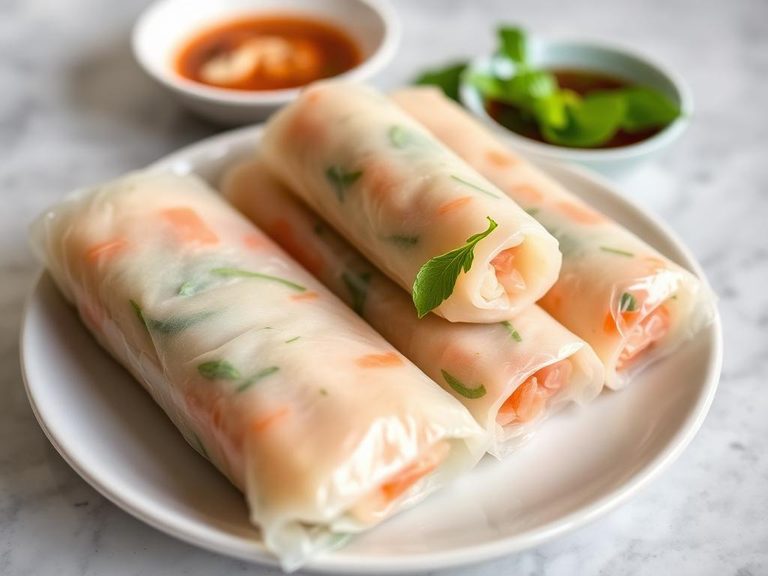
People love rice paper for its incredible versatility and the fresh, clean taste it brings to dishes. It's the essential, chewy vessel for Vietnamese spring rolls, allowing the vibrant flavors of herbs, vegetables, and proteins to shine through.
⚠️ Watch-outs & how to enjoy it better
As a high-glycemic, low-fiber carbohydrate, rice paper can cause rapid blood-sugar spikes if eaten alone. To counteract this, always pair rolls with a protein (shrimp, tofu, pork) and healthy fats (avocado, peanut sauce), and fill them generously with fiber-rich vegetables like lettuce, herbs, and julienned carrots.
Key benefits
- Gluten-free alternative to wheat-based wrappers
- Low in fat and contains no cholesterol
- Provides a quick source of energy from carbohydrates
- Versatile base for fresh, low-cook meals
- Lightweight and shelf-stable for easy storage
🍽️ Popular dishes
🌍 Where it's eaten
💡 Did you know?
The traditional method of making rice paper involved steaming a rice batter onto a cloth stretched over a pot, then sun-drying the resulting sheet on bamboo frames.
Full nutrition (USDA data · scales with serving)
| Water | 19.6 g |
| Energy | 323 kcal |
| Protein | 5.9 g |
| Total lipid (fat) | 1.1 g |
| Carbohydrate, by difference | 72.3 g |
| Fiber, total dietary | 0.50 g |
| Total Sugars | 0.27 g |
| Calcium, Ca | 7.0 mg |
| Iron, Fe | 0.27 mg |
| Magnesium, Mg | 20.0 mg |
| Phosphorus, P | 80.0 mg |
| Potassium, K | 64.0 mg |
| Sodium, Na | 314 mg |
| Zinc, Zn | 1.0 mg |
| Copper, Cu | 0.18 mg |
| Selenium, Se | 4.5 ug |
| Vitamin C, total ascorbic acid | 0.00 mg |
| Thiamin | 0.08 mg |
| Riboflavin | 0.00 mg |
| Niacin | 1.1 mg |
| Vitamin B-6 | 0.04 mg |
| Folate, total | 14.0 ug |
| Folic acid | 0.00 ug |
| Folate, food | 14.0 ug |
| Folate, DFE | 14.0 ug |
| Choline, total | 5.0 mg |
| Vitamin B-12 | 0.00 ug |
| Vitamin B-12, added | 0.00 ug |
| Vitamin A, RAE | 0.00 ug |
| Retinol | 0.00 ug |
| Carotene, beta | 0.00 ug |
| Carotene, alpha | 0.00 ug |
| Cryptoxanthin, beta | 0.00 ug |
| Lycopene | 0.00 ug |
| Lutein + zeaxanthin | 0.00 ug |
| Vitamin E (alpha-tocopherol) | 0.09 mg |
| Vitamin E, added | 0.00 mg |
| Vitamin D (D2 + D3) | 0.00 ug |
| Vitamin K (phylloquinone) | 0.00 ug |
| Alcohol, ethyl | 0.00 g |
| Caffeine | 0.00 mg |
| Theobromine | 0.00 mg |
Fat & fatty acid profile (per 100g)
| Fatty acids, total saturated | 0.33 g |
| SFA 4:0 | 0.00 g |
| SFA 6:0 | 0.00 g |
| SFA 8:0 | 0.00 g |
| SFA 10:0 | 0.00 g |
| SFA 12:0 | 0.00 g |
| SFA 14:0 | 0.01 g |
| SFA 16:0 | 0.29 g |
| SFA 18:0 | 0.02 g |
| Fatty acids, total monounsaturated | 0.38 g |
| MUFA 16:1 | 0.00 g |
| MUFA 18:1 | 0.37 g |
| MUFA 20:1 | 0.00 g |
| MUFA 22:1 | 0.00 g |
| Fatty acids, total polyunsaturated | 0.32 g |
| PUFA 18:2 | 0.27 g |
| PUFA 18:3 | 0.06 g |
| PUFA 18:4 | 0.00 g |
| PUFA 20:4 | 0.00 g |
| PUFA 20:5 n-3 (EPA) | 0.00 g |
| PUFA 22:5 n-3 (DPA) | 0.00 g |
| PUFA 22:6 n-3 (DHA) | 0.00 g |
| Cholesterol | 0.00 mg |
FAQ
How do you prevent rice paper from tearing when rolling?
Don't over-soak it. Dip in warm water for just 3-5 seconds until it's pliable but still slightly firm; it will continue to soften as you roll. Work on a damp surface to prevent sticking.
Can rice paper be fried?
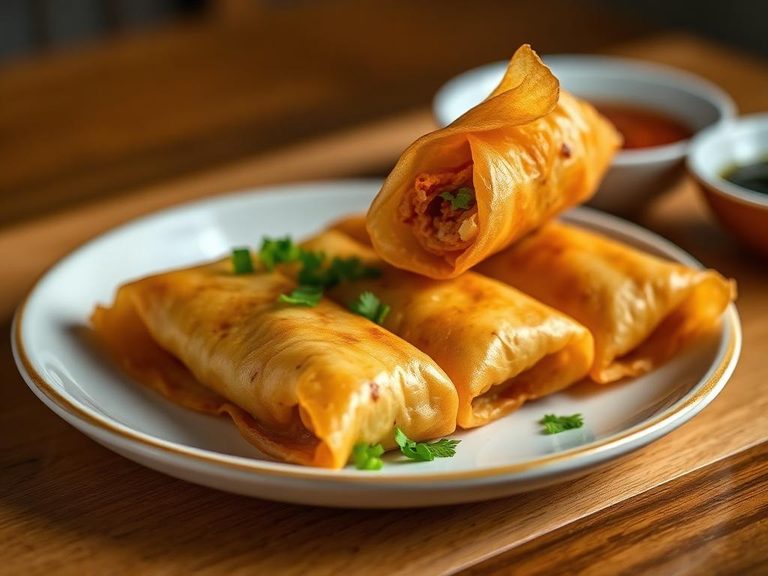
Yes. After rolling, it can be deep-fried or pan-fried to make crispy spring rolls like chả giò. The texture transforms from chewy to shatteringly crisp.
Is rice paper gluten-free?
Authentic rice paper made solely from rice flour and water is gluten-free. However, always check labels, as some commercial brands may add wheat flour or other additives.
Nutrient density (calculated · NRF9.3)
Nutrient Rich Foods index: beneficial nutrients (protein, fiber, vitamins, minerals) minus saturated fat, added sugar & sodium, per 100 kcal.
NRF9.3 index — Fulgoni, Keast & Drewnowski, 2009. Computed from USDA nutrients.
Weight-loss friendliness (composite index)
Energy density 3.23 kcal/g · 7% calories from protein · 0.5 g fiber · 0.3 g sugar per 100 g.
Composite of energy density (Rolls et al., 1999), protein & fiber satiety, minus sugar. A calculated heuristic — ranks satiety-per-calorie, not a clinical measure.
Dietary load (calculated from USDA values)
Potential renal acid load. Positive = acid-forming, negative = alkaline-forming.
Sodium-to-potassium ratio: 4.91 (lower is better — aim for ≤ 1)
Sodium:potassium per WHO potassium guidance. Computed from USDA nutrients.