

Ramen bowl, vegetarian with egg
Common food

Photo: Wikipedia
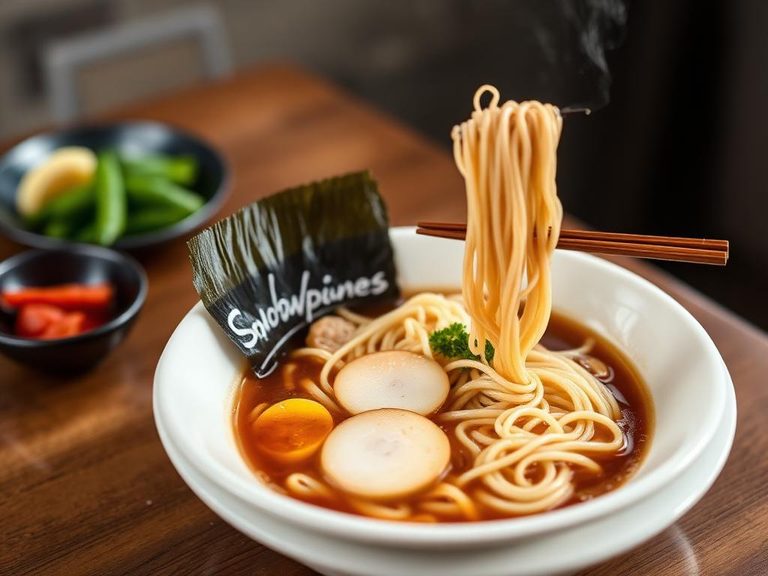
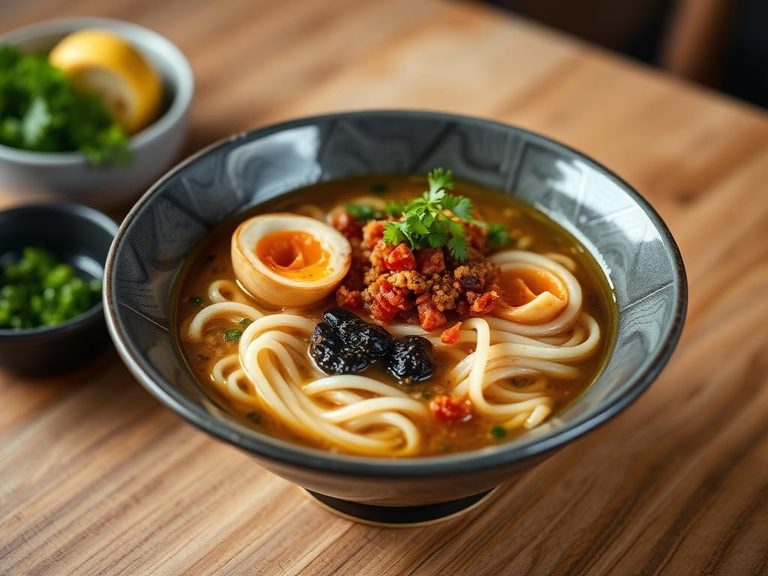
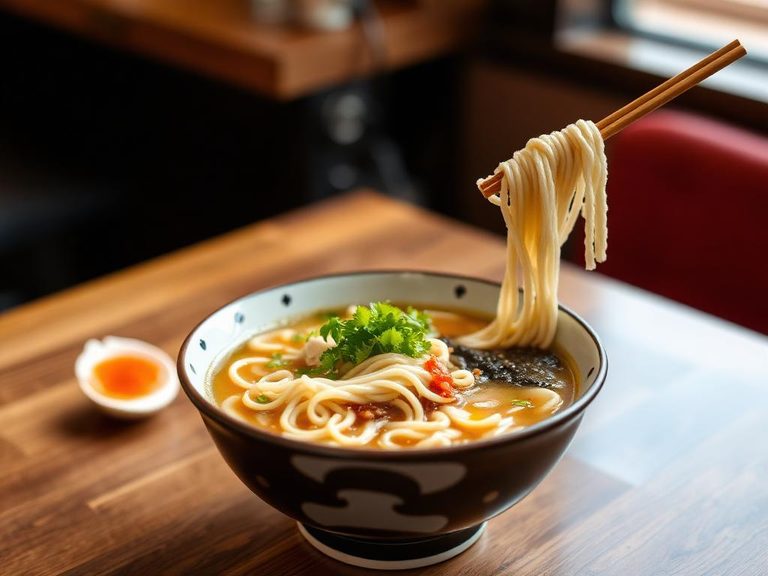
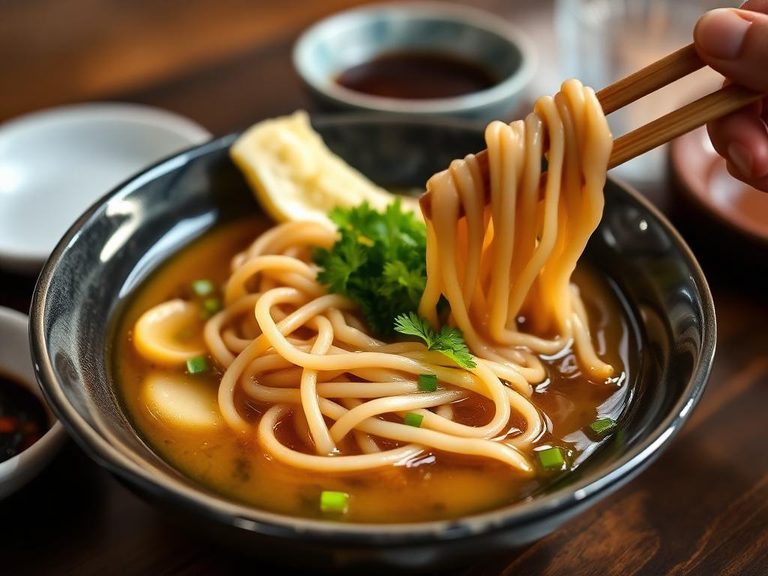
A comforting bowl of vegetarian ramen features springy wheat noodles in a savory broth, often topped with a perfectly soft-boiled egg. The egg adds a rich, creamy yolk that contrasts with the umami broth and chewy noodles. At just 112 kcal per 100g, it's a surprisingly light yet satisfying meal, with the egg boosting the protein content.
Calorie split: 17% protein · 51% carbs · 32% fat
↓ Full nutrition💚 Why it's loved
People love it for the harmonious balance of savory, umami broth, satisfying chewy noodles, and the rich, creamy egg. It's a versatile comfort food that can be customized with countless toppings and is deeply rooted in Japanese culinary culture.
⚠️ Watch-outs & how to enjoy it better
The sodium content in the broth can be very high, which is a concern for those monitoring salt intake. The refined wheat noodles can cause a rapid blood-sugar spike. To counteract, choose a low-sodium broth base, add extra vegetables for fiber, and consider pairing with a side salad to slow digestion.
Key benefits
- Good source of complete protein from the egg
- Provides energy from complex carbohydrates in noodles
- Contains essential vitamins and minerals from the egg yolk
- Low in fat compared to many ramen variations
- Can be a satisfying, portion-controlled meal
🍽️ Popular dishes
🌍 Where it's eaten
💡 Did you know?
The perfect ramen egg, called 'ajitsuke tamago,' is marinated in a soy sauce and mirin mixture after boiling, which seasons the white and gives the yolk its signature jammy, custard-like texture.
Full nutrition (USDA data · scales with serving)
| Water | 75.9 g |
| Energy | 112 kcal |
| Protein | 4.8 g |
| Total lipid (fat) | 4.0 g |
| Carbohydrate, by difference | 14.1 g |
| Fiber, total dietary | 1.0 g |
| Total Sugars | 0.51 g |
| Calcium, Ca | 31.0 mg |
| Iron, Fe | 0.97 mg |
| Magnesium, Mg | 14.0 mg |
| Phosphorus, P | 59.0 mg |
| Potassium, K | 71.0 mg |
| Sodium, Na | 322 mg |
| Zinc, Zn | 0.46 mg |
| Copper, Cu | 0.07 mg |
| Selenium, Se | 15.8 ug |
| Vitamin C, total ascorbic acid | 2.8 mg |
| Thiamin | 0.14 mg |
| Riboflavin | 0.11 mg |
| Niacin | 0.85 mg |
| Vitamin B-6 | 0.05 mg |
| Folate, total | 50.0 ug |
| Folic acid | 29.0 ug |
| Folate, food | 22.0 ug |
| Folate, DFE | 70.0 ug |
| Choline, total | 40.4 mg |
| Vitamin B-12 | 0.10 ug |
| Vitamin B-12, added | 0.00 ug |
| Vitamin A, RAE | 30.0 ug |
| Retinol | 18.0 ug |
| Carotene, beta | 143 ug |
| Carotene, alpha | 0.00 ug |
| Cryptoxanthin, beta | 1.0 ug |
| Lycopene | 0.00 ug |
| Lutein + zeaxanthin | 105 ug |
| Vitamin E (alpha-tocopherol) | 0.56 mg |
| Vitamin E, added | 0.00 mg |
| Vitamin D (D2 + D3) | 0.20 ug |
| Vitamin K (phylloquinone) | 13.4 ug |
| Alcohol, ethyl | 0.00 g |
| Caffeine | 0.00 mg |
| Theobromine | 0.00 mg |
Fat & fatty acid profile (per 100g)
| Fatty acids, total saturated | 0.75 g |
| SFA 4:0 | 0.00 g |
| SFA 6:0 | 0.00 g |
| SFA 8:0 | 0.00 g |
| SFA 10:0 | 0.00 g |
| SFA 12:0 | 0.00 g |
| SFA 14:0 | 0.01 g |
| SFA 16:0 | 0.55 g |
| SFA 18:0 | 0.17 g |
| Fatty acids, total monounsaturated | 1.4 g |
| MUFA 16:1 | 0.03 g |
| MUFA 18:1 | 1.4 g |
| MUFA 20:1 | 0.01 g |
| MUFA 22:1 | 0.00 g |
| Fatty acids, total polyunsaturated | 1.4 g |
| PUFA 18:2 | 1.2 g |
| PUFA 18:3 | 0.14 g |
| PUFA 18:4 | 0.00 g |
| PUFA 20:4 | 0.00 g |
| PUFA 20:5 n-3 (EPA) | 0.00 g |
| PUFA 22:5 n-3 (DPA) | 0.00 g |
| PUFA 22:6 n-3 (DHA) | 0.00 g |
| Cholesterol | 41.0 mg |
FAQ
Is vegetarian ramen with egg still considered vegetarian?
Yes, it is considered ovo-vegetarian, as it includes eggs but no meat or fish products. The broth must also be made without animal-derived ingredients like bonito or pork.
How can I make the broth less salty?
Use a low-sodium vegetable broth as the base and season with soy sauce or miso paste to taste. You can also dilute a commercial ramen seasoning packet with more water or unsalted broth.
What's the best way to cook the egg for ramen?
Bring water to a boil, gently lower in a fridge-cold egg, and cook for exactly 6.5 to 7 minutes for a jammy yolk. Immediately transfer to an ice bath to stop cooking, then peel and marinate if desired.
Nutrient density (calculated · NRF9.3)
Nutrient Rich Foods index: beneficial nutrients (protein, fiber, vitamins, minerals) minus saturated fat, added sugar & sodium, per 100 kcal.
NRF9.3 index — Fulgoni, Keast & Drewnowski, 2009. Computed from USDA nutrients.
Weight-loss friendliness (composite index)
Energy density 1.12 kcal/g · 17% calories from protein · 1.0 g fiber · 0.5 g sugar per 100 g.
Composite of energy density (Rolls et al., 1999), protein & fiber satiety, minus sugar. A calculated heuristic — ranks satiety-per-calorie, not a clinical measure.
Dietary load (calculated from USDA values)
Potential renal acid load. Positive = acid-forming, negative = alkaline-forming.
Sodium-to-potassium ratio: 4.54 (lower is better — aim for ≤ 1)
Sodium:potassium per WHO potassium guidance. Computed from USDA nutrients.