

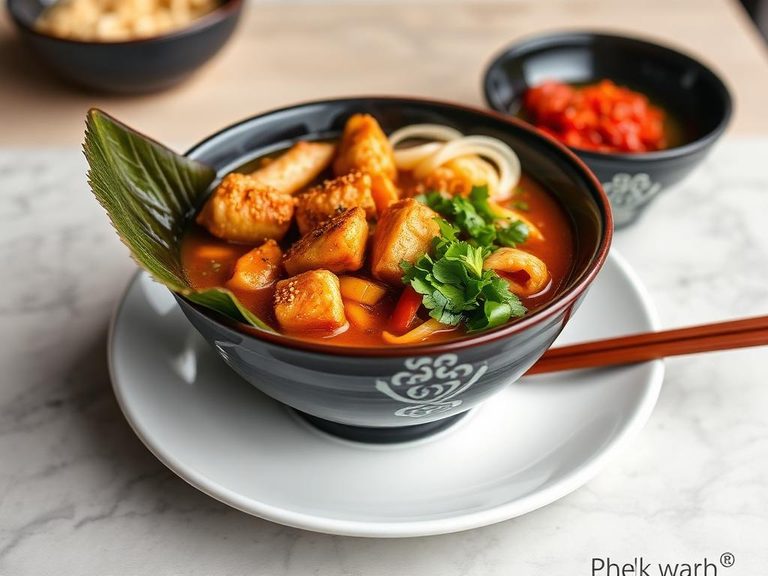
Ramen bowl with meat and egg
Common food
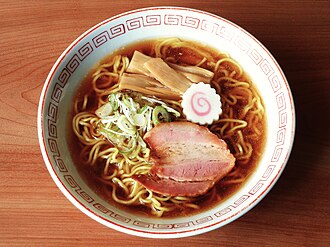
Photo: Wikipedia
A steaming bowl of ramen features springy wheat noodles swimming in a savory, umami-rich broth, topped with tender slices of meat and a perfectly soft-boiled egg. The dish offers a satisfying contrast of textures, from the chewy noodles to the silky egg yolk. Despite its rich flavor, a standard serving is relatively moderate in calories, providing a good source of protein from the meat and egg.
Calorie split: 23% protein · 44% carbs · 33% fat
↓ Full nutrition💚 Why it's loved
People love ramen for its deep, complex umami flavor and the comforting ritual of slurping hot noodles. It's a versatile dish that serves as a quick meal, a late-night snack, or a gourmet experience, deeply woven into Japanese food culture.
⚠️ Watch-outs & how to enjoy it better
The broth is often very high in sodium, which can be a concern for those monitoring salt intake. The wheat noodles are a source of gluten, and the dish can cause a blood-sugar spike due to its refined carbohydrate content. To counteract this, pair it with extra vegetables for fiber, choose a lighter broth if possible, and be mindful of portion size.
Key benefits
- Good source of protein for muscle maintenance
- Provides complex carbohydrates for energy
- Contains essential minerals from the broth and toppings
- Can be a balanced meal with protein, carbs, and fats
- Broth can be hydrating and comforting
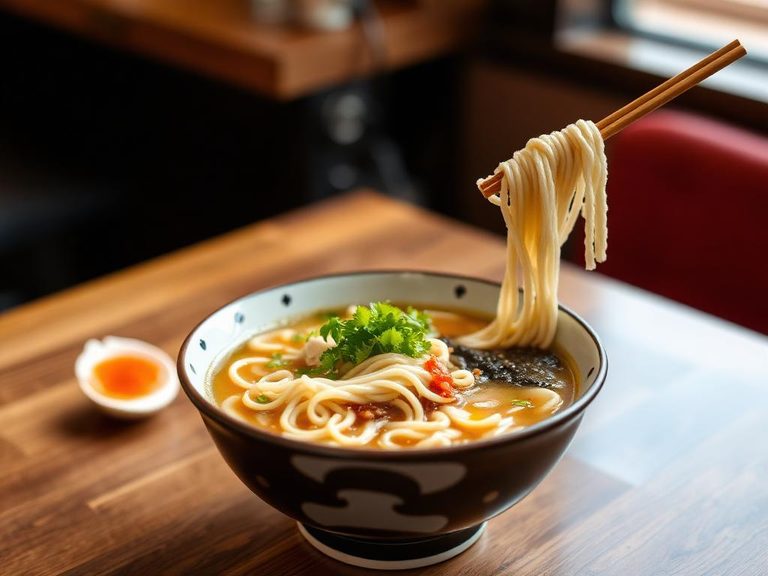
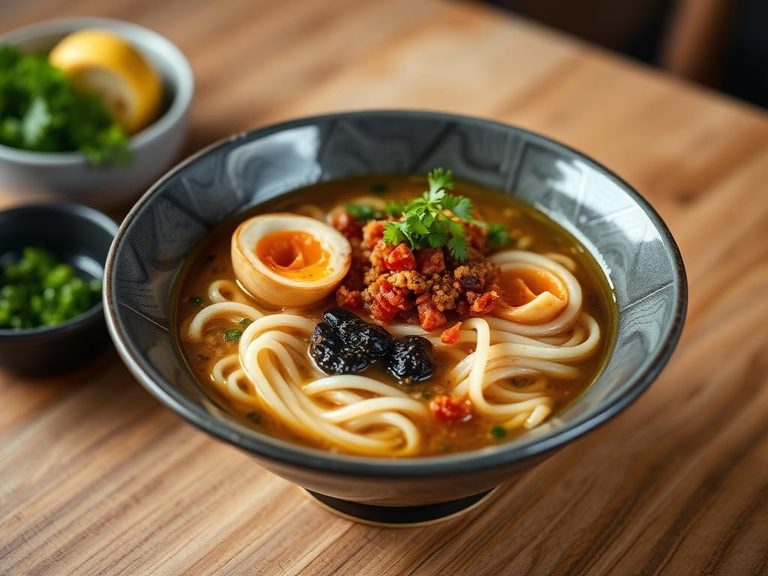
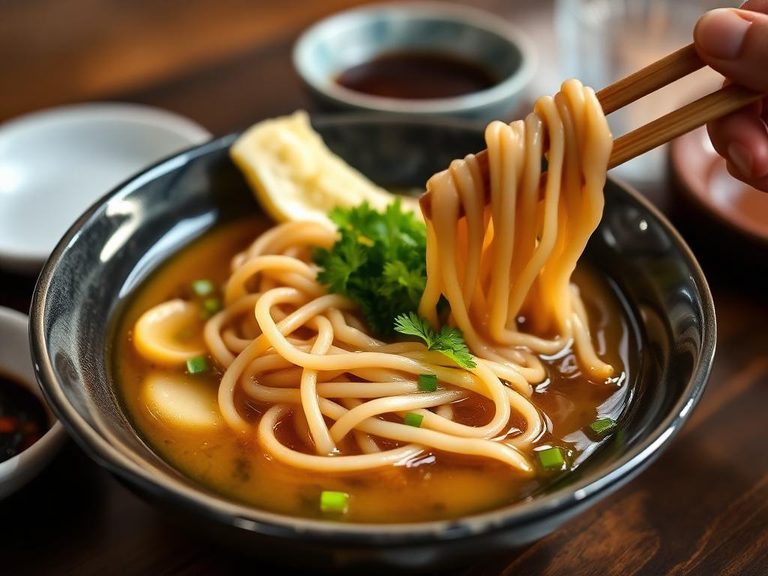
🍽️ Popular dishes

🌍 Where it's eaten
💡 Did you know?
The word 'ramen' is a Japanese borrowing of the Chinese word 'lamian,' which refers to a specific type of hand-pulled noodle.
Full nutrition (USDA data · scales with serving)
| Water | 73.2 g |
| Energy | 127 kcal |
| Protein | 7.1 g |
| Total lipid (fat) | 4.6 g |
| Carbohydrate, by difference | 13.9 g |
| Fiber, total dietary | 0.90 g |
| Total Sugars | 0.42 g |
| Calcium, Ca | 18.0 mg |
| Iron, Fe | 0.98 mg |
| Magnesium, Mg | 14.0 mg |
| Phosphorus, P | 79.0 mg |
| Potassium, K | 96.0 mg |
| Sodium, Na | 333 mg |
| Zinc, Zn | 0.72 mg |
| Copper, Cu | 0.06 mg |
| Selenium, Se | 18.3 ug |
| Vitamin C, total ascorbic acid | 2.8 mg |
| Thiamin | 0.14 mg |
| Riboflavin | 0.13 mg |
| Niacin | 1.5 mg |
| Vitamin B-6 | 0.10 mg |
| Folate, total | 46.0 ug |
| Folic acid | 29.0 ug |
| Folate, food | 17.0 ug |
| Folate, DFE | 66.0 ug |
| Choline, total | 48.2 mg |
| Vitamin B-12 | 0.32 ug |
| Vitamin B-12, added | 0.00 ug |
| Vitamin A, RAE | 31.0 ug |
| Retinol | 19.0 ug |
| Carotene, beta | 143 ug |
| Carotene, alpha | 0.00 ug |
| Cryptoxanthin, beta | 1.0 ug |
| Lycopene | 0.00 ug |
| Lutein + zeaxanthin | 105 ug |
| Vitamin E (alpha-tocopherol) | 0.60 mg |
| Vitamin E, added | 0.00 mg |
| Vitamin D (D2 + D3) | 0.30 ug |
| Vitamin K (phylloquinone) | 13.4 ug |
| Alcohol, ethyl | 0.00 g |
| Caffeine | 0.00 mg |
| Theobromine | 0.00 mg |
Fat & fatty acid profile (per 100g)
| Fatty acids, total saturated | 1.1 g |
| SFA 4:0 | 0.00 g |
| SFA 6:0 | 0.00 g |
| SFA 8:0 | 0.00 g |
| SFA 10:0 | 0.00 g |
| SFA 12:0 | 0.00 g |
| SFA 14:0 | 0.03 g |
| SFA 16:0 | 0.73 g |
| SFA 18:0 | 0.25 g |
| Fatty acids, total monounsaturated | 1.8 g |
| MUFA 16:1 | 0.08 g |
| MUFA 18:1 | 1.7 g |
| MUFA 20:1 | 0.02 g |
| MUFA 22:1 | 0.00 g |
| Fatty acids, total polyunsaturated | 1.2 g |
| PUFA 18:2 | 1.1 g |
| PUFA 18:3 | 0.11 g |
| PUFA 18:4 | 0.00 g |
| PUFA 20:4 | 0.01 g |
| PUFA 20:5 n-3 (EPA) | 0.00 g |
| PUFA 22:5 n-3 (DPA) | 0.00 g |
| PUFA 22:6 n-3 (DHA) | 0.01 g |
| Cholesterol | 53.0 mg |
FAQ
Is ramen healthy?
Ramen can be part of a balanced diet. Its nutritional value depends heavily on the broth (sodium content) and toppings. Choosing a broth with less salt and adding vegetables can make it a more nutritious meal.
What makes ramen noodles chewy?
The signature chewy texture comes from kansui, an alkaline mineral water used in the dough. It gives the noodles their yellow color and springy bite.
Can I make ramen at home easily?
Yes, you can make a simplified version at home using dried or fresh noodles, a quality broth (store-bought is fine), and your choice of protein and vegetables. It's a great way to control ingredients and sodium.
Nutrient density (calculated · NRF9.3)
Nutrient Rich Foods index: beneficial nutrients (protein, fiber, vitamins, minerals) minus saturated fat, added sugar & sodium, per 100 kcal.
NRF9.3 index — Fulgoni, Keast & Drewnowski, 2009. Computed from USDA nutrients.
Weight-loss friendliness (composite index)
Energy density 1.27 kcal/g · 22% calories from protein · 0.9 g fiber · 0.4 g sugar per 100 g.
Composite of energy density (Rolls et al., 1999), protein & fiber satiety, minus sugar. A calculated heuristic — ranks satiety-per-calorie, not a clinical measure.
Dietary load (calculated from USDA values)
Potential renal acid load. Positive = acid-forming, negative = alkaline-forming.
Sodium-to-potassium ratio: 3.47 (lower is better — aim for ≤ 1)
Sodium:potassium per WHO potassium guidance. Computed from USDA nutrients.