

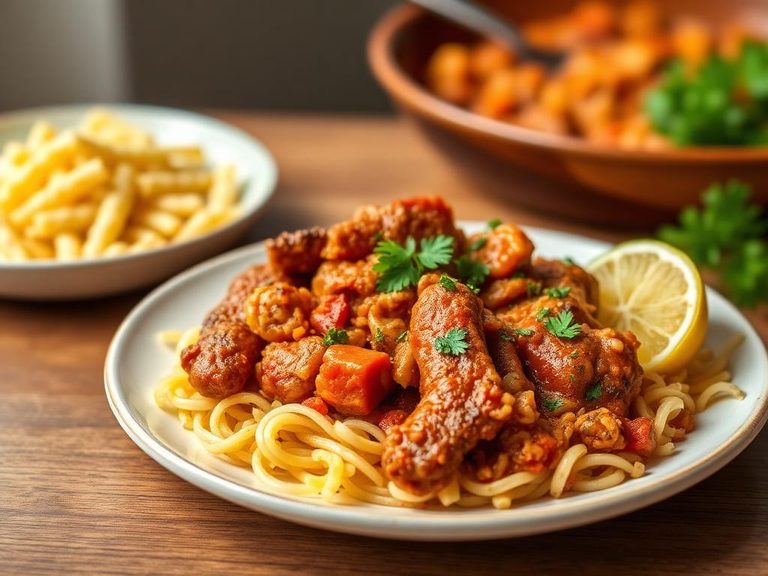
Jambalaya with meat and rice
Common food

Photo: Wikipedia
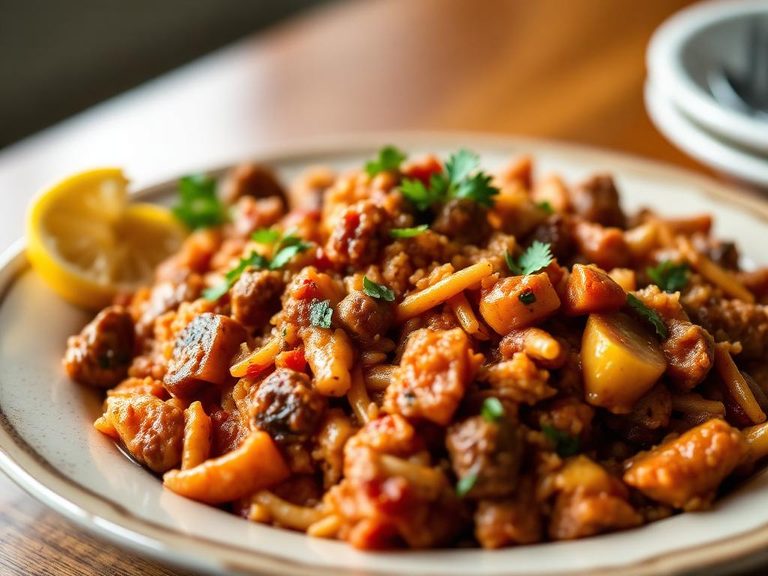
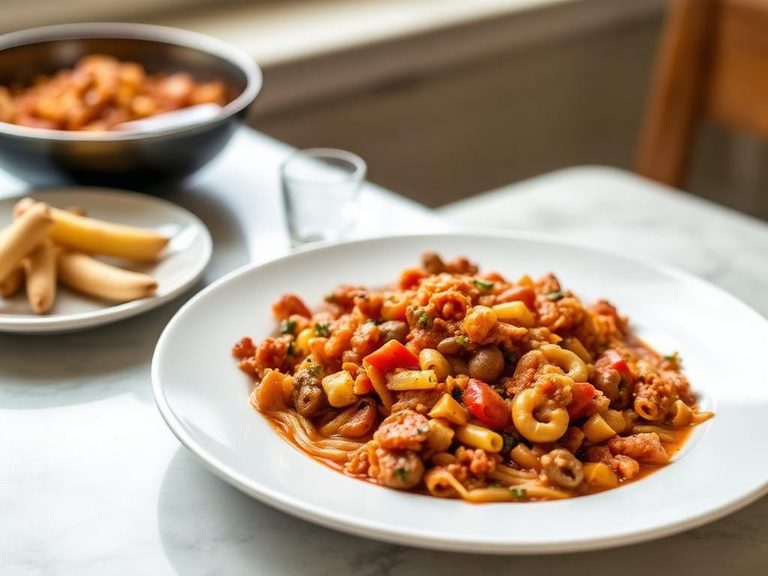
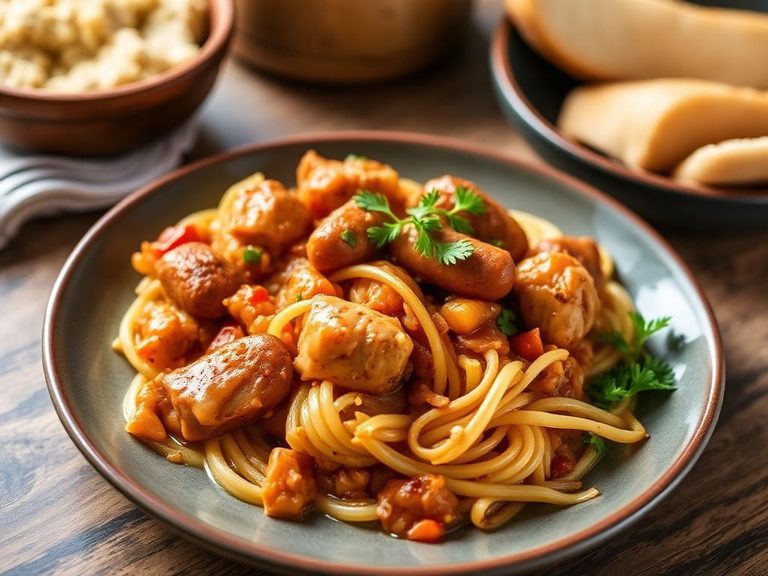
Jambalaya is a hearty, one-pot Creole and Cajun rice dish where meat, seafood, and vegetables are simmered together with rice in a rich, spiced broth. The texture is a satisfying blend of tender meat, fluffy rice, and soft vegetables, all infused with a deep, savory flavor from the 'holy trinity' of onions, celery, and bell peppers. Nutritionally, it's a balanced meal offering a good amount of protein and moderate fat per serving.
Calorie split: 34% protein · 21% carbs · 44% fat
↓ Full nutrition💚 Why it's loved
People love jambalaya for its deep, layered flavors and the way it brings together a variety of ingredients into a cohesive, comforting meal. It's a beloved staple of Louisiana culture, often served at gatherings and celebrations, making it a dish that's as much about community as it is about taste.
⚠️ Watch-outs & how to enjoy it better
Jambalaya can be high in sodium, especially if made with processed meats like andouille sausage or using pre-made seasoning mixes, which may be a concern for those watching their salt intake. To counteract this, use low-sodium broth, limit added salt, and opt for fresh, unprocessed meats and homemade spice blends. Additionally, the dish is often made with white rice, which can cause blood-sugar spikes; pairing it with extra vegetables or using brown rice can help mitigate this.
Key benefits
- Provides a balanced mix of protein, carbs, and fats in one dish.
- Rich in savory, complex flavors from the 'holy trinity' and spices.
- A complete, hearty meal that is filling and satisfying.
- The rice and meat combination offers sustained energy.
- Versatile and can be adapted with various meats or seafood.
🍽️ Popular dishes
🌍 Where it's eaten
💡 Did you know?
The name 'jambalaya' is believed to derive from the Provençal French word 'jambalaia,' meaning a rice-based dish, but it also has roots in the West African word 'jambon,' meaning ham, reflecting the dish's multicultural heritage.
Full nutrition (USDA data · scales with serving)
| Water | 68.3 g |
| Energy | 161 kcal |
| Protein | 13.8 g |
| Total lipid (fat) | 8.0 g |
| Carbohydrate, by difference | 8.7 g |
| Fiber, total dietary | 0.70 g |
| Total Sugars | 0.94 g |
| Calcium, Ca | 24.0 mg |
| Iron, Fe | 1.1 mg |
| Magnesium, Mg | 19.0 mg |
| Phosphorus, P | 136 mg |
| Potassium, K | 240 mg |
| Sodium, Na | 379 mg |
| Zinc, Zn | 1.1 mg |
| Copper, Cu | 0.08 mg |
| Selenium, Se | 14.2 ug |
| Vitamin C, total ascorbic acid | 7.2 mg |
| Thiamin | 0.22 mg |
| Riboflavin | 0.15 mg |
| Niacin | 4.4 mg |
| Vitamin B-6 | 0.23 mg |
| Folate, total | 22.0 ug |
| Folic acid | 13.0 ug |
| Folate, food | 9.0 ug |
| Folate, DFE | 31.0 ug |
| Choline, total | 41.8 mg |
| Vitamin B-12 | 0.32 ug |
| Vitamin B-12, added | 0.00 ug |
| Vitamin A, RAE | 8.0 ug |
| Retinol | 3.0 ug |
| Carotene, beta | 64.0 ug |
| Carotene, alpha | 1.0 ug |
| Cryptoxanthin, beta | 2.0 ug |
| Lycopene | 439 ug |
| Lutein + zeaxanthin | 41.0 ug |
| Vitamin E (alpha-tocopherol) | 0.77 mg |
| Vitamin E, added | 0.00 mg |
| Vitamin D (D2 + D3) | 0.20 ug |
| Vitamin K (phylloquinone) | 4.0 ug |
| Alcohol, ethyl | 0.00 g |
| Caffeine | 0.00 mg |
| Theobromine | 0.00 mg |
Fat & fatty acid profile (per 100g)
| Fatty acids, total saturated | 2.2 g |
| SFA 4:0 | 0.00 g |
| SFA 6:0 | 0.00 g |
| SFA 8:0 | 0.00 g |
| SFA 10:0 | 0.00 g |
| SFA 12:0 | 0.00 g |
| SFA 14:0 | 0.07 g |
| SFA 16:0 | 1.5 g |
| SFA 18:0 | 0.59 g |
| Fatty acids, total monounsaturated | 3.3 g |
| MUFA 16:1 | 0.26 g |
| MUFA 18:1 | 3.0 g |
| MUFA 20:1 | 0.05 g |
| MUFA 22:1 | 0.00 g |
| Fatty acids, total polyunsaturated | 1.6 g |
| PUFA 18:2 | 1.4 g |
| PUFA 18:3 | 0.11 g |
| PUFA 18:4 | 0.00 g |
| PUFA 20:4 | 0.03 g |
| PUFA 20:5 n-3 (EPA) | 0.00 g |
| PUFA 22:5 n-3 (DPA) | 0.00 g |
| PUFA 22:6 n-3 (DHA) | 0.00 g |
| Cholesterol | 58.0 mg |
FAQ
What is the difference between Cajun and Creole jambalaya?
Cajun jambalaya, often called 'brown jambalaya,' typically doesn't include tomatoes and gets its color from browning the meat and vegetables. Creole jambalaya, or 'red jambalaya,' includes tomatoes and is more common in New Orleans.
Can jambalaya be made with seafood?
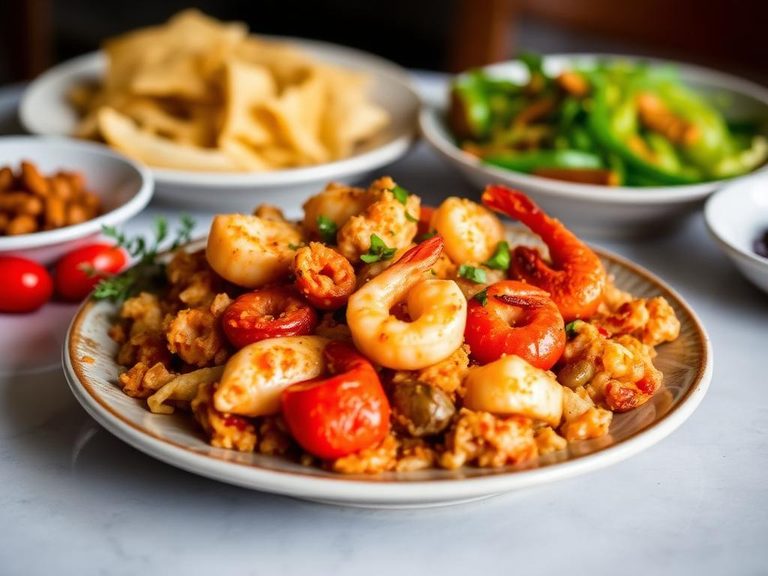
Yes, seafood jambalaya is a popular variation that often includes shrimp, crawfish, or crab, and is especially common in coastal areas of Louisiana.
Is jambalaya gluten-free?
Traditional jambalaya is naturally gluten-free as it's made with rice, meat, and vegetables. However, always check for hidden gluten in pre-made seasonings or sausages.
Nutrient density (calculated · NRF9.3)
Nutrient Rich Foods index: beneficial nutrients (protein, fiber, vitamins, minerals) minus saturated fat, added sugar & sodium, per 100 kcal.
NRF9.3 index — Fulgoni, Keast & Drewnowski, 2009. Computed from USDA nutrients.
Weight-loss friendliness (composite index)
Energy density 1.61 kcal/g · 34% calories from protein · 0.7 g fiber · 0.9 g sugar per 100 g.
Composite of energy density (Rolls et al., 1999), protein & fiber satiety, minus sugar. A calculated heuristic — ranks satiety-per-calorie, not a clinical measure.
Dietary load (calculated from USDA values)
Potential renal acid load. Positive = acid-forming, negative = alkaline-forming.
Sodium-to-potassium ratio: 1.58 (lower is better — aim for ≤ 1)
Sodium:potassium per WHO potassium guidance. Computed from USDA nutrients.