

Infant formula, MEAD JOHNSON, ENFAMIL, Infant, ready-to-feed, with ARA and DHA
Whole food · Baby Foods

Photo: Wikipedia
This is a sterile, ready-to-feed liquid infant formula designed for newborns and infants, offering complete nutrition without preparation. It has a smooth, creamy, and slightly sweet taste and texture, formulated to closely mimic human breast milk. Nutritionally, it provides a balanced mix of proteins, fats, and carbohydrates, with added DHA and ARA for brain and eye development.
Calorie split: 8% protein · 46% carbs · 46% fat
↓ Full nutrition💚 Why it's loved
Parents and caregivers love the absolute convenience and peace of mind it offers, especially during sleep-deprived nights or on the go. The consistent taste and texture are trusted by many infants, making feeding times more predictable and less stressful.
⚠️ Watch-outs & how to enjoy it better
The primary downsides are its high cost compared to powdered formulas and its environmental impact due to single-use packaging. It is not suitable for infants with galactosemia or cow's milk protein allergy. A concrete tip is to recycle the plastic containers where facilities exist and to consult a pediatrician before use if there are any known allergies or metabolic conditions.
Key benefits
- Ready-to-feed format requires no mixing or water, ensuring perfect concentration and sterility.
- Contains DHA and ARA, important long-chain polyunsaturated fatty acids for cognitive and visual development.
- Provides a complete and balanced source of nutrition for infants who are not breastfed.
- Formulated to be gentle on an infant's developing digestive system.
- Convenient for nighttime feedings, travel, or use in childcare settings.
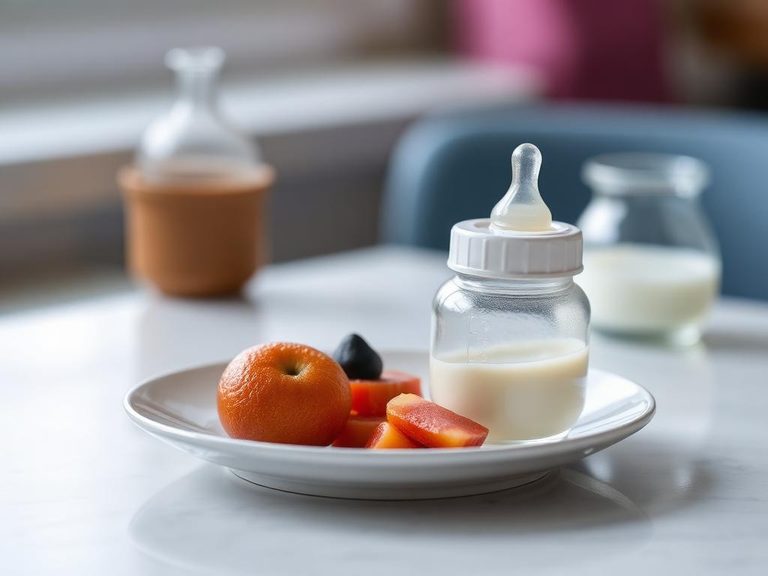
🍽️ Popular dishes
🌍 Where it's eaten
💡 Did you know?
The 'ready-to-feed' liquid format is the gold standard for sterility in infant formula, often used in hospital neonatal units for premature or vulnerable infants.
Full nutrition (USDA data · scales with serving)
| Water | 87.0 g |
| Energy | 68.0 kcal |
| Energy | 285 kj |
| Protein | 1.3 g |
| Total lipid (fat) | 3.5 g |
| Ash | 0.33 g |
| Carbohydrate, by difference | 7.9 g |
| Fiber, total dietary | 0.00 g |
| Total Sugars | 7.0 g |
| Calcium, Ca | 51.0 mg |
| Iron, Fe | 1.2 mg |
| Magnesium, Mg | 5.0 mg |
| Phosphorus, P | 28.0 mg |
| Potassium, K | 71.0 mg |
| Sodium, Na | 18.0 mg |
| Zinc, Zn | 0.66 mg |
| Copper, Cu | 0.05 mg |
| Manganese, Mn | 0.01 mg |
| Selenium, Se | 1.8 ug |
| Vitamin C, total ascorbic acid | 7.9 mg |
| Thiamin | 0.05 mg |
| Riboflavin | 0.09 mg |
| Niacin | 0.66 mg |
| Pantothenic acid | 0.33 mg |
| Vitamin B-6 | 0.04 mg |
| Folate, total | 11.0 ug |
| Folic acid | 11.0 ug |
| Folate, food | 0.00 ug |
| Folate, DFE | 18.0 ug |
| Choline, total | 15.7 mg |
| Vitamin B-12 | 0.19 ug |
| Vitamin B-12, added | 0.20 ug |
| Vitamin A, RAE | 59.0 ug |
| Retinol | 59.0 ug |
| Carotene, beta | 0.00 ug |
| Carotene, alpha | 0.00 ug |
| Cryptoxanthin, beta | 0.00 ug |
| Vitamin A, IU | 197 iu |
| Lycopene | 0.00 ug |
| Lutein + zeaxanthin | 0.00 ug |
| Vitamin E (alpha-tocopherol) | 0.59 mg |
| Vitamin E, added | 0.59 mg |
| Vitamin D (D2 + D3), International Units | 39.0 iu |
| Vitamin D (D2 + D3) | 1.0 ug |
| Vitamin K (phylloquinone) | 5.9 ug |
| Alcohol, ethyl | 0.00 g |
| Caffeine | 0.00 mg |
| Theobromine | 0.00 mg |
Fat & fatty acid profile (per 100g)
| Fatty acids, total saturated | 1.5 g |
| SFA 4:0 | 0.00 g |
| SFA 6:0 | 0.01 g |
| SFA 8:0 | 0.06 g |
| SFA 10:0 | 0.04 g |
| SFA 12:0 | 0.31 g |
| SFA 14:0 | 0.14 g |
| SFA 16:0 | 0.77 g |
| SFA 18:0 | 0.13 g |
| Fatty acids, total monounsaturated | 1.2 g |
| MUFA 16:1 | 0.01 g |
| MUFA 18:1 | 1.2 g |
| MUFA 20:1 | 0.01 g |
| MUFA 22:1 | 0.00 g |
| Fatty acids, total polyunsaturated | 0.65 g |
| PUFA 18:2 | 0.52 g |
| PUFA 18:3 | 0.05 g |
| PUFA 18:4 | 0.00 g |
| PUFA 20:4 | 0.02 g |
| PUFA 20:5 n-3 (EPA) | 0.00 g |
| PUFA 22:5 n-3 (DPA) | 0.00 g |
| PUFA 22:6 n-3 (DHA) | 0.01 g |
| Cholesterol | 2.0 mg |
FAQ
Why is it more expensive than powdered formula?
The cost reflects the additional processing for sterility, the convenience of the pre-measured liquid, and the packaging in individual bottles or cartons.
Can I use this after the 'use-by' date?
No. For an infant's safety, you should strictly adhere to the use-by date printed on the container, as sterility and nutritional integrity cannot be guaranteed after that point.
Is the sugar content (7g per 100g) too high?
The sugar is primarily lactose, the natural carbohydrate found in breast milk, which is the ideal energy source for infants. It is not added table sugar and is part of a nutritionally complete formula.
Nutrient density (calculated · NRF9.3)
Nutrient Rich Foods index: beneficial nutrients (protein, fiber, vitamins, minerals) minus saturated fat, added sugar & sodium, per 100 kcal.
NRF9.3 index — Fulgoni, Keast & Drewnowski, 2009. Computed from USDA nutrients.
Weight-loss friendliness (composite index)
Energy density 0.68 kcal/g · 8% calories from protein · 0.0 g fiber · 7.0 g sugar per 100 g.
Composite of energy density (Rolls et al., 1999), protein & fiber satiety, minus sugar. A calculated heuristic — ranks satiety-per-calorie, not a clinical measure.
Dietary load (calculated from USDA values)
Potential renal acid load. Positive = acid-forming, negative = alkaline-forming.
Sodium-to-potassium ratio: 0.25 (lower is better — aim for ≤ 1)
Sodium:potassium per WHO potassium guidance. Computed from USDA nutrients.