

Hamburger slider
Common food

Photo: Wikipedia
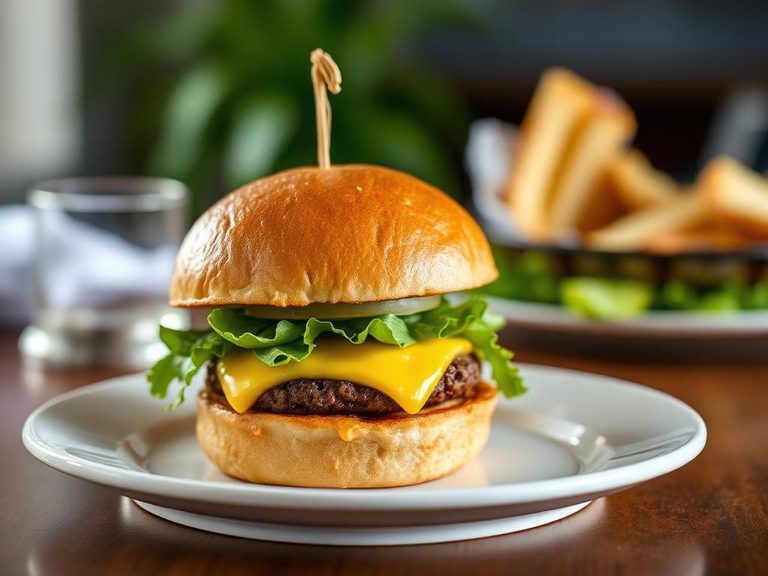
A hamburger slider is a miniature, often two-to-three-bite version of the classic American cheeseburger, typically served on a soft, small bun. It delivers a concentrated burst of savory beef, melted cheese, and tangy pickles or sauce in a perfectly portioned, handheld package. Nutritionally, it's a dense source of protein and fat, making it a satisfying but calorie-rich treat.
Calorie split: 25% protein · 28% carbs · 47% fat
↓ Full nutrition💚 Why it's loved
People adore sliders for their perfect balance of juicy, savory beef, soft bun, and customizable toppings in a fun, shareable size. They evoke a sense of casual American nostalgia and are the ultimate crowd-pleaser at gatherings, allowing for variety without the commitment of a full burger.
⚠️ Watch-outs & how to enjoy it better
Sliders can be high in sodium and saturated fat, and the refined white bun may cause a quick blood-sugar spike. To counteract this, opt for a whole-grain bun, add fiber-rich toppings like lettuce and tomato, and pair with a side salad or roasted vegetables instead of fries.
Key benefits
- High in protein for muscle maintenance and satiety.
- Provides essential nutrients like iron and B12 from beef.
- Offers a convenient, portion-controlled indulgence.
- Highly customizable with various toppings and sauces.
- A classic social food perfect for sharing and parties.
🍽️ Popular dishes

🌍 Where it's eaten
💡 Did you know?
The 'slider' name is widely believed to have originated at White Castle in the 1920s, where the small, square burgers were said to be so juicy they 'slid' right down.
Full nutrition (USDA data · scales with serving)
| Water | 46.1 g |
| Energy | 288 kcal |
| Protein | 17.8 g |
| Total lipid (fat) | 14.7 g |
| Carbohydrate, by difference | 19.7 g |
| Fiber, total dietary | 0.70 g |
| Total Sugars | 2.9 g |
| Calcium, Ca | 63.0 mg |
| Iron, Fe | 2.8 mg |
| Magnesium, Mg | 21.0 mg |
| Phosphorus, P | 145 mg |
| Potassium, K | 232 mg |
| Sodium, Na | 349 mg |
| Zinc, Zn | 3.2 mg |
| Copper, Cu | 0.09 mg |
| Selenium, Se | 23.7 ug |
| Vitamin C, total ascorbic acid | 0.50 mg |
| Thiamin | 0.23 mg |
| Riboflavin | 0.22 mg |
| Niacin | 4.8 mg |
| Vitamin B-6 | 0.29 mg |
| Folate, total | 50.0 ug |
| Folic acid | 21.0 ug |
| Folate, food | 29.0 ug |
| Folate, DFE | 64.0 ug |
| Choline, total | 50.8 mg |
| Vitamin B-12 | 1.7 ug |
| Vitamin B-12, added | 0.00 ug |
| Vitamin A, RAE | 0.00 ug |
| Retinol | 0.00 ug |
| Carotene, beta | 0.00 ug |
| Carotene, alpha | 0.00 ug |
| Cryptoxanthin, beta | 0.00 ug |
| Lycopene | 0.00 ug |
| Lutein + zeaxanthin | 2.0 ug |
| Vitamin E (alpha-tocopherol) | 0.11 mg |
| Vitamin E, added | 0.00 mg |
| Vitamin D (D2 + D3) | 0.10 ug |
| Vitamin K (phylloquinone) | 3.3 ug |
| Alcohol, ethyl | 0.00 g |
| Caffeine | 0.00 mg |
| Theobromine | 0.00 mg |
Fat & fatty acid profile (per 100g)
| Fatty acids, total saturated | 5.6 g |
| SFA 4:0 | 0.00 g |
| SFA 6:0 | 0.00 g |
| SFA 8:0 | 0.00 g |
| SFA 10:0 | 0.00 g |
| SFA 12:0 | 0.00 g |
| SFA 14:0 | 0.42 g |
| SFA 16:0 | 3.2 g |
| SFA 18:0 | 1.8 g |
| Fatty acids, total monounsaturated | 5.9 g |
| MUFA 16:1 | 0.42 g |
| MUFA 18:1 | 5.4 g |
| MUFA 20:1 | 0.03 g |
| MUFA 22:1 | 0.00 g |
| Fatty acids, total polyunsaturated | 1.1 g |
| PUFA 18:2 | 0.98 g |
| PUFA 18:3 | 0.10 g |
| PUFA 18:4 | 0.00 g |
| PUFA 20:4 | 0.00 g |
| PUFA 20:5 n-3 (EPA) | 0.00 g |
| PUFA 22:5 n-3 (DPA) | 0.01 g |
| PUFA 22:6 n-3 (DHA) | 0.00 g |
| Cholesterol | 51.0 mg |
FAQ
What's the difference between a slider and a regular hamburger?
A slider is significantly smaller, typically 2-3 ounces of cooked meat, and is designed to be eaten in a few bites. It often has a simpler topping profile and is served on a smaller, softer bun.
Are sliders healthier than regular hamburgers?
Not necessarily. While smaller in size, sliders are often more calorie-dense per gram due to a higher ratio of bun and toppings to meat. A single slider can be comparable to half a regular burger in calories.
What are the best toppings for sliders?
Classic toppings include American cheese, pickles, onions, and ketchup or mustard. For a gourmet twist, try caramelized onions, sriracha mayo, or a slice of avocado.
Nutrient density (calculated · NRF9.3)
Nutrient Rich Foods index: beneficial nutrients (protein, fiber, vitamins, minerals) minus saturated fat, added sugar & sodium, per 100 kcal.
NRF9.3 index — Fulgoni, Keast & Drewnowski, 2009. Computed from USDA nutrients.
Weight-loss friendliness (composite index)
Energy density 2.88 kcal/g · 25% calories from protein · 0.7 g fiber · 2.9 g sugar per 100 g.
Composite of energy density (Rolls et al., 1999), protein & fiber satiety, minus sugar. A calculated heuristic — ranks satiety-per-calorie, not a clinical measure.
Dietary load (calculated from USDA values)
Potential renal acid load. Positive = acid-forming, negative = alkaline-forming.
Sodium-to-potassium ratio: 1.50 (lower is better — aim for ≤ 1)
Sodium:potassium per WHO potassium guidance. Computed from USDA nutrients.