

Frozen mocha coffee drink, nonfat
Common food

Photo: Wikipedia
This is a light, icy, and creamy coffee beverage, typically blended with ice and a sweetener for a smooth, slushy texture. It delivers a bold coffee flavor with a noticeable sweetness, all while remaining remarkably low in calories and fat. The primary source of its energy comes from its significant sugar content, which provides a quick, sweet lift.
Calorie split: 10% protein · 88% carbs · 1% fat
↓ Full nutrition💚 Why it's loved
People love it as a sweet, indulgent-tasting treat that feels like a dessert but is much lighter. It's a popular go-to for a quick, refreshing caffeine pick-me-up, especially in warm weather or as an afternoon slump-buster.
⚠️ Watch-outs & how to enjoy it better
The high sugar content (12.24g per 100g) can lead to a rapid blood sugar spike followed by a crash, potentially increasing hunger. Those monitoring their sugar intake, managing diabetes, or prone to dental issues should be cautious. To counteract this, pair it with a source of protein or healthy fat (like a handful of nuts or a cheese stick) to slow sugar absorption, or opt for a smaller portion.
Key benefits
- Very low in calories (59 kcal per 100g)
- Extremely low in fat (0.08g per 100g)
- Provides a quick source of energy from carbohydrates
- Offers a convenient, refreshing coffee flavor
- Nonfat formulation reduces saturated fat intake
🍽️ Popular dishes

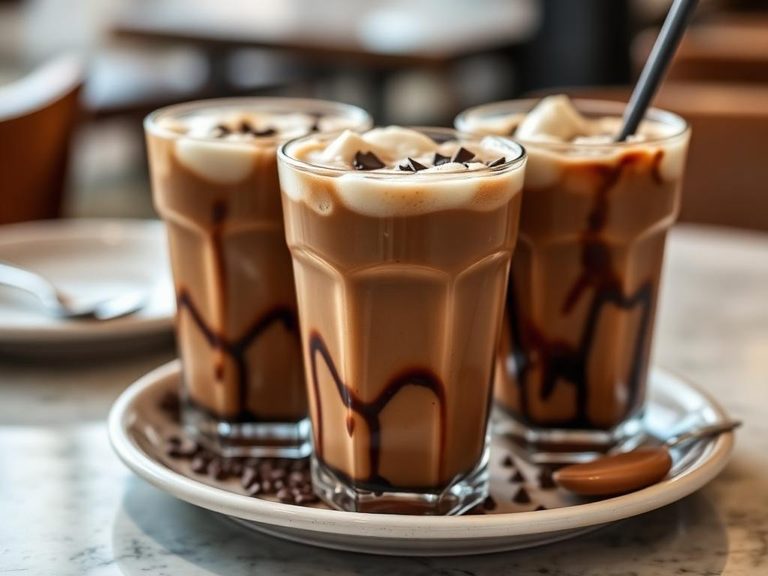



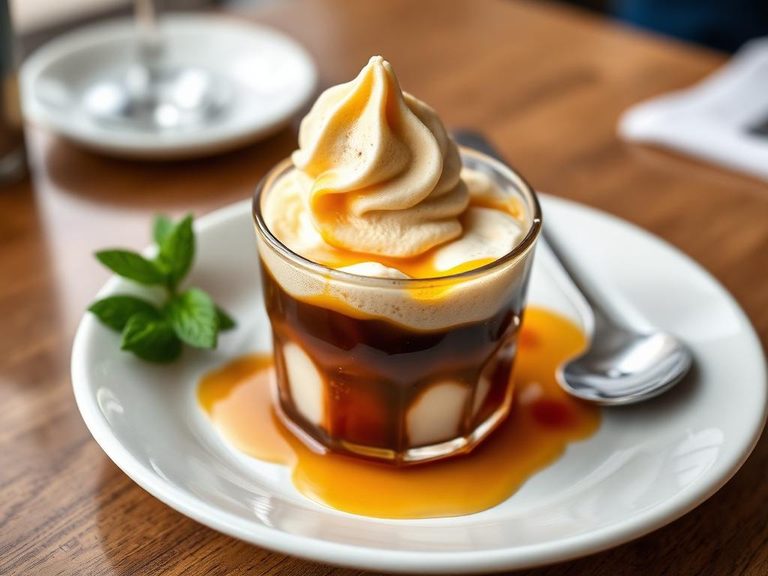
🌍 Where it's eaten
💡 Did you know?
The 'frappé' style of shaking or blending coffee with ice was popularized in Greece in the 1950s after a Nescafé representative accidentally created the foamy drink at a trade fair.
Full nutrition (USDA data · scales with serving)
| Water | 84.8 g |
| Energy | 59.0 kcal |
| Protein | 1.5 g |
| Total lipid (fat) | 0.08 g |
| Carbohydrate, by difference | 13.1 g |
| Fiber, total dietary | 0.00 g |
| Total Sugars | 12.2 g |
| Calcium, Ca | 60.0 mg |
| Iron, Fe | 0.02 mg |
| Magnesium, Mg | 21.0 mg |
| Phosphorus, P | 54.0 mg |
| Potassium, K | 103 mg |
| Sodium, Na | 35.0 mg |
| Zinc, Zn | 0.26 mg |
| Copper, Cu | 0.04 mg |
| Selenium, Se | 1.1 ug |
| Vitamin C, total ascorbic acid | 0.00 mg |
| Thiamin | 0.03 mg |
| Riboflavin | 0.09 mg |
| Niacin | 0.85 mg |
| Vitamin B-6 | 0.03 mg |
| Folate, total | 1.0 ug |
| Folic acid | 0.00 ug |
| Folate, food | 1.0 ug |
| Folate, DFE | 1.0 ug |
| Choline, total | 8.6 mg |
| Vitamin B-12 | 0.26 ug |
| Vitamin B-12, added | 0.00 ug |
| Vitamin A, RAE | 28.0 ug |
| Retinol | 28.0 ug |
| Carotene, beta | 1.0 ug |
| Carotene, alpha | 0.00 ug |
| Cryptoxanthin, beta | 0.00 ug |
| Lycopene | 0.00 ug |
| Lutein + zeaxanthin | 0.00 ug |
| Vitamin E (alpha-tocopherol) | 0.00 mg |
| Vitamin E, added | 0.00 mg |
| Vitamin D (D2 + D3) | 0.50 ug |
| Vitamin K (phylloquinone) | 0.00 ug |
| Alcohol, ethyl | 0.00 g |
| Caffeine | 34.0 mg |
| Theobromine | 15.0 mg |
Fat & fatty acid profile (per 100g)
| Fatty acids, total saturated | 0.04 g |
| SFA 4:0 | 0.00 g |
| SFA 6:0 | 0.00 g |
| SFA 8:0 | 0.00 g |
| SFA 10:0 | 0.00 g |
| SFA 12:0 | 0.00 g |
| SFA 14:0 | 0.00 g |
| SFA 16:0 | 0.02 g |
| SFA 18:0 | 0.00 g |
| Fatty acids, total monounsaturated | 0.01 g |
| MUFA 16:1 | 0.00 g |
| MUFA 18:1 | 0.01 g |
| MUFA 20:1 | 0.00 g |
| MUFA 22:1 | 0.00 g |
| Fatty acids, total polyunsaturated | 0.02 g |
| PUFA 18:2 | 0.02 g |
| PUFA 18:3 | 0.00 g |
| PUFA 18:4 | 0.00 g |
| PUFA 20:4 | 0.00 g |
| PUFA 20:5 n-3 (EPA) | 0.00 g |
| PUFA 22:5 n-3 (DPA) | 0.00 g |
| PUFA 22:6 n-3 (DHA) | 0.00 g |
| Cholesterol | 1.0 mg |
FAQ
How is this different from a regular iced mocha?
A regular iced mocha is typically made with milk, which adds fat, protein, and calories. This nonfat frozen version replaces milk with a sweetened coffee base and ice, drastically reducing the fat content but often increasing the sugar.
Is this a good pre-workout drink?
It can provide quick energy from its sugar and a caffeine boost, but it lacks protein and electrolytes. For sustained performance, it's better paired with a more balanced snack.
Why is there no fiber?
The drink is made from filtered coffee, sugar, and water/ice, none of which contribute dietary fiber. Fiber comes from plant-based ingredients like whole fruits, vegetables, and grains.
Nutrient density (calculated · NRF9.3)
Nutrient Rich Foods index: beneficial nutrients (protein, fiber, vitamins, minerals) minus saturated fat, added sugar & sodium, per 100 kcal.
NRF9.3 index — Fulgoni, Keast & Drewnowski, 2009. Computed from USDA nutrients.
Weight-loss friendliness (composite index)
Energy density 0.59 kcal/g · 10% calories from protein · 0.0 g fiber · 12.2 g sugar per 100 g.
Composite of energy density (Rolls et al., 1999), protein & fiber satiety, minus sugar. A calculated heuristic — ranks satiety-per-calorie, not a clinical measure.
Dietary load (calculated from USDA values)
Potential renal acid load. Positive = acid-forming, negative = alkaline-forming.
Sodium-to-potassium ratio: 0.34 (lower is better — aim for ≤ 1)
Sodium:potassium per WHO potassium guidance. Computed from USDA nutrients.