

Frozen mocha coffee drink, decaffeinated, nonfat
Common food

Photo: Wikipedia
A chilled, blended coffee beverage with a rich, chocolatey mocha flavor and a smooth, icy texture. This decaffeinated, nonfat version delivers a sweet, indulgent coffeehouse experience with a light, frothy mouthfeel. It provides a quick energy boost from its 13g of sugar per 100g while remaining virtually fat-free.
Calorie split: 10% protein · 88% carbs · 1% fat
↓ Full nutrition💚 Why it's loved
People love it for the comforting, familiar combination of chocolate and coffee flavors without the jitters of caffeine. It's a popular, convenient treat that satisfies a sweet craving and offers a moment of indulgence.
⚠️ Watch-outs & how to enjoy it better
The primary concern is the high sugar content (12.3g per 100g), which can lead to blood sugar spikes and isn't ideal for those monitoring sugar intake. To counteract this, enjoy it as an occasional treat, pair it with a source of protein or healthy fat (like nuts) to slow sugar absorption, or opt for a smaller portion.
Key benefits
- Very low in fat (0.08g per 100g)
- Provides a quick source of energy from carbohydrates
- Decaffeinated option for evening enjoyment
- Light, refreshing texture for warm weather
🍽️ Popular dishes
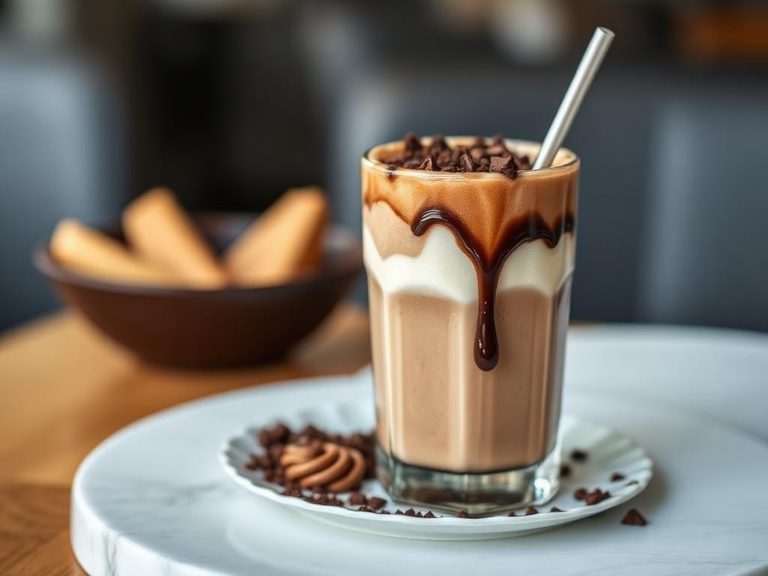


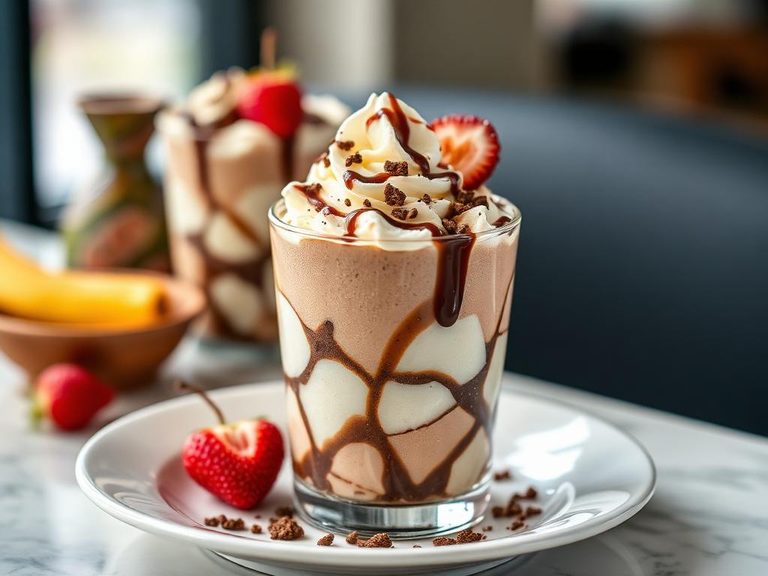

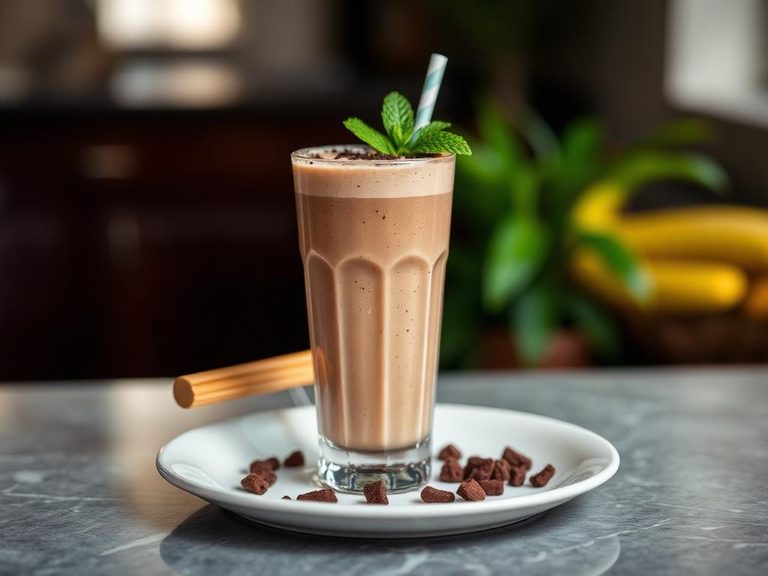
🌍 Where it's eaten
💡 Did you know?
The 'mocha' in its name doesn't just refer to chocolate; it originates from the port city of Mocha (Al Mokha) in Yemen, which was a major coffee trading center in the 15th century.
Full nutrition (USDA data · scales with serving)
| Water | 84.8 g |
| Energy | 59.0 kcal |
| Protein | 1.5 g |
| Total lipid (fat) | 0.08 g |
| Carbohydrate, by difference | 13.1 g |
| Fiber, total dietary | 0.00 g |
| Total Sugars | 12.3 g |
| Calcium, Ca | 60.0 mg |
| Iron, Fe | 0.02 mg |
| Magnesium, Mg | 21.0 mg |
| Phosphorus, P | 54.0 mg |
| Potassium, K | 103 mg |
| Sodium, Na | 35.0 mg |
| Zinc, Zn | 0.26 mg |
| Copper, Cu | 0.04 mg |
| Selenium, Se | 1.1 ug |
| Vitamin C, total ascorbic acid | 0.00 mg |
| Thiamin | 0.03 mg |
| Riboflavin | 0.09 mg |
| Niacin | 0.83 mg |
| Vitamin B-6 | 0.03 mg |
| Folate, total | 1.0 ug |
| Folic acid | 0.00 ug |
| Folate, food | 1.0 ug |
| Folate, DFE | 1.0 ug |
| Choline, total | 8.3 mg |
| Vitamin B-12 | 0.26 ug |
| Vitamin B-12, added | 0.00 ug |
| Vitamin A, RAE | 29.0 ug |
| Retinol | 29.0 ug |
| Carotene, beta | 1.0 ug |
| Carotene, alpha | 0.00 ug |
| Cryptoxanthin, beta | 0.00 ug |
| Lycopene | 0.00 ug |
| Lutein + zeaxanthin | 0.00 ug |
| Vitamin E (alpha-tocopherol) | 0.00 mg |
| Vitamin E, added | 0.00 mg |
| Vitamin D (D2 + D3) | 0.50 ug |
| Vitamin K (phylloquinone) | 0.00 ug |
| Alcohol, ethyl | 0.00 g |
| Caffeine | 2.0 mg |
| Theobromine | 15.0 mg |
Fat & fatty acid profile (per 100g)
| Fatty acids, total saturated | 0.04 g |
| SFA 4:0 | 0.00 g |
| SFA 6:0 | 0.00 g |
| SFA 8:0 | 0.00 g |
| SFA 10:0 | 0.00 g |
| SFA 12:0 | 0.00 g |
| SFA 14:0 | 0.00 g |
| SFA 16:0 | 0.02 g |
| SFA 18:0 | 0.00 g |
| Fatty acids, total monounsaturated | 0.01 g |
| MUFA 16:1 | 0.00 g |
| MUFA 18:1 | 0.01 g |
| MUFA 20:1 | 0.00 g |
| MUFA 22:1 | 0.00 g |
| Fatty acids, total polyunsaturated | 0.02 g |
| PUFA 18:2 | 0.02 g |
| PUFA 18:3 | 0.00 g |
| PUFA 18:4 | 0.00 g |
| PUFA 20:4 | 0.00 g |
| PUFA 20:5 n-3 (EPA) | 0.00 g |
| PUFA 22:5 n-3 (DPA) | 0.00 g |
| PUFA 22:6 n-3 (DHA) | 0.00 g |
| Cholesterol | 1.0 mg |
FAQ
Is this drink high in caffeine?
No, it is specifically labeled as decaffeinated, meaning the caffeine has been removed. It's a good choice for those sensitive to caffeine or wanting a coffee-flavored treat later in the day.
Why is it so low in fat?
It is made with nonfat milk or a nonfat dairy alternative, which eliminates the fat content found in whole milk or cream. The primary calories come from carbohydrates (sugars).
Can I make a healthier version at home?
Absolutely. Blend strong brewed decaf coffee with a frozen banana for creaminess, a tablespoon of unsweetened cocoa powder, a splash of nonfat milk, and a small amount of a natural sweetener like stevia or a date.
Nutrient density (calculated · NRF9.3)
Nutrient Rich Foods index: beneficial nutrients (protein, fiber, vitamins, minerals) minus saturated fat, added sugar & sodium, per 100 kcal.
NRF9.3 index — Fulgoni, Keast & Drewnowski, 2009. Computed from USDA nutrients.
Weight-loss friendliness (composite index)
Energy density 0.59 kcal/g · 10% calories from protein · 0.0 g fiber · 12.3 g sugar per 100 g.
Composite of energy density (Rolls et al., 1999), protein & fiber satiety, minus sugar. A calculated heuristic — ranks satiety-per-calorie, not a clinical measure.
Dietary load (calculated from USDA values)
Potential renal acid load. Positive = acid-forming, negative = alkaline-forming.
Sodium-to-potassium ratio: 0.34 (lower is better — aim for ≤ 1)
Sodium:potassium per WHO potassium guidance. Computed from USDA nutrients.