

Cereals ready-to-eat, POST SELECTS Blueberry Morning
Whole food · Breakfast Cereals

Photo: Wikipedia
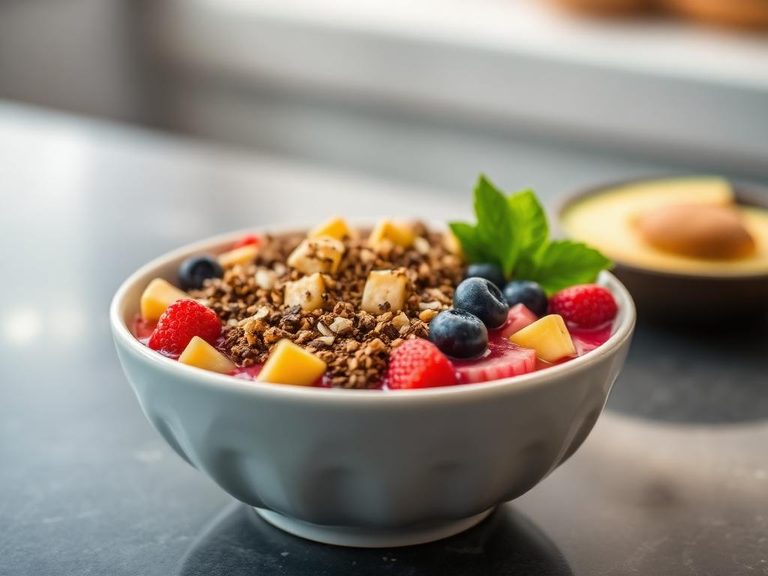
POST SELECTS Blueberry Morning is a sweet, crunchy ready-to-eat cereal featuring toasted oat clusters and blueberry-flavored pieces. It delivers a satisfying texture contrast between the airy flakes and the denser, slightly chewy berry bits, with a pronounced sweetness. Nutritionally, it is a high-carbohydrate, high-sugar option, providing a quick energy boost but with minimal protein and fat.
Calorie split: 6% protein · 82% carbs · 12% fat
↓ Full nutrition💚 Why it's loved
People love it for its nostalgic, sweet blueberry flavor and the satisfying crunch of the oat clusters, making it a comforting and easy breakfast or snack. Its versatility allows it to be enjoyed with milk, yogurt, or even as a topping for smoothies and desserts.
⚠️ Watch-outs & how to enjoy it better
The high sugar content (29.2g per 100g) can lead to blood-sugar spikes and crashes, making it a less ideal choice for those managing diabetes or seeking sustained energy. To counteract this, pair it with a source of protein (like Greek yogurt or milk) and healthy fats (like nuts or seeds) to slow sugar absorption and improve satiety.
Key benefits
- Quick source of energy from carbohydrates
- Contains dietary fiber to support digestion
- Convenient and ready-to-eat breakfast option
- Fortified with essential vitamins and minerals
- Provides a sweet, comforting flavor profile
🍽️ Popular dishes


🌍 Where it's eaten
💡 Did you know?
The blueberry pieces in many cereals are often made from a combination of dried fruit, sugar, and natural or artificial flavoring, rather than whole blueberries, to achieve a consistent taste and texture.
Full nutrition (USDA data · scales with serving)
| Water | 4.7 g |
| Energy | 395 kcal |
| Energy | 1653 kj |
| Protein | 6.5 g |
| Total lipid (fat) | 5.3 g |
| Ash | 1.8 g |
| Carbohydrate, by difference | 81.6 g |
| Fiber, total dietary | 4.7 g |
| Total Sugars | 29.2 g |
| Calcium, Ca | 41.0 mg |
| Iron, Fe | 3.3 mg |
| Magnesium, Mg | 57.0 mg |
| Phosphorus, P | 162 mg |
| Potassium, K | 195 mg |
| Sodium, Na | 341 mg |
| Zinc, Zn | 1.6 mg |
| Copper, Cu | 0.20 mg |
| Selenium, Se | 16.7 ug |
| Vitamin C, total ascorbic acid | 0.90 mg |
| Thiamin | 0.70 mg |
| Riboflavin | 0.80 mg |
| Niacin | 9.1 mg |
| Vitamin B-6 | 0.90 mg |
| Folate, total | 182 ug |
| Folic acid | 163 ug |
| Folate, food | 19.0 ug |
| Folate, DFE | 296 ug |
| Choline, total | 16.3 mg |
| Vitamin B-12 | 2.7 ug |
| Vitamin B-12, added | 2.7 ug |
| Vitamin A, RAE | 400 ug |
| Retinol | 398 ug |
| Carotene, beta | 19.0 ug |
| Carotene, alpha | 7.0 ug |
| Cryptoxanthin, beta | 0.00 ug |
| Vitamin A, IU | 1364 iu |
| Lycopene | 0.00 ug |
| Lutein + zeaxanthin | 205 ug |
| Vitamin E (alpha-tocopherol) | 1.6 mg |
| Vitamin E, added | 0.00 mg |
| Vitamin D (D2 + D3), International Units | 73.0 iu |
| Vitamin D (D2 + D3) | 1.8 ug |
| Vitamin D3 (cholecalciferol) | 1.8 ug |
| Vitamin K (phylloquinone) | 12.7 ug |
| Alcohol, ethyl | 0.00 g |
| Caffeine | 0.00 mg |
| Theobromine | 0.00 mg |
Fat & fatty acid profile (per 100g)
| Fatty acids, total saturated | 0.60 g |
| SFA 4:0 | 0.00 g |
| SFA 6:0 | 0.00 g |
| SFA 8:0 | 0.00 g |
| SFA 10:0 | 0.00 g |
| SFA 12:0 | 0.00 g |
| SFA 14:0 | 0.00 g |
| SFA 16:0 | 0.45 g |
| SFA 18:0 | 0.10 g |
| Fatty acids, total monounsaturated | 2.9 g |
| MUFA 16:1 | 0.01 g |
| MUFA 18:1 | 2.9 g |
| MUFA 20:1 | 0.02 g |
| MUFA 22:1 | 0.00 g |
| Fatty acids, total polyunsaturated | 1.5 g |
| PUFA 18:2 | 1.4 g |
| PUFA 18:3 | 0.14 g |
| PUFA 18:4 | 0.00 g |
| PUFA 20:4 | 0.00 g |
| PUFA 20:5 n-3 (EPA) | 0.00 g |
| PUFA 22:5 n-3 (DPA) | 0.00 g |
| PUFA 22:6 n-3 (DHA) | 0.00 g |
| Fatty acids, total trans | 0.00 g |
| Cholesterol | 0.00 mg |
FAQ
Is POST SELECTS Blueberry Morning a healthy breakfast option?
While it provides energy and some fiber, it is high in sugar and low in protein and fat. For a balanced breakfast, it's best paired with protein-rich foods like milk, yogurt, or eggs.
Can I eat this cereal if I'm watching my sugar intake?
Due to its high sugar content (29.2g per 100g), it may not be suitable for strict low-sugar diets. Consider portion control or choosing a lower-sugar cereal alternative.
What are the main ingredients in this cereal?
Typically, it contains whole grain oats, sugar, corn flour, blueberry pieces (often with added sugar and flavoring), and various vitamins and minerals.
Nutrient density (calculated · NRF9.3)
Nutrient Rich Foods index: beneficial nutrients (protein, fiber, vitamins, minerals) minus saturated fat, added sugar & sodium, per 100 kcal.
NRF9.3 index — Fulgoni, Keast & Drewnowski, 2009. Computed from USDA nutrients.
Weight-loss friendliness (composite index)
Energy density 3.95 kcal/g · 7% calories from protein · 4.7 g fiber · 29.2 g sugar per 100 g.
Composite of energy density (Rolls et al., 1999), protein & fiber satiety, minus sugar. A calculated heuristic — ranks satiety-per-calorie, not a clinical measure.
Dietary load (calculated from USDA values)
Potential renal acid load. Positive = acid-forming, negative = alkaline-forming.
Sodium-to-potassium ratio: 1.75 (lower is better — aim for ≤ 1)
Sodium:potassium per WHO potassium guidance. Computed from USDA nutrients.