

Carrot juice, 100%
Common food
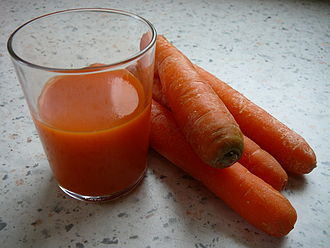
Photo: Wikipedia
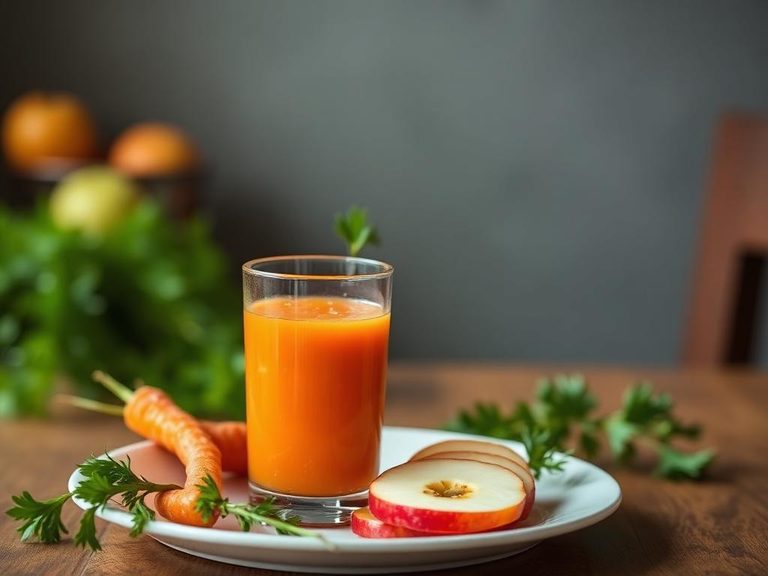
Pure carrot juice is a vibrant, sweet, and earthy liquid extracted from fresh carrots, offering a smooth, slightly pulpy texture. Its bright orange color comes from beta-carotene, a precursor to vitamin A, making it a nutrient-dense, low-calorie beverage.
Calorie split: 9% protein · 88% carbs · 3% fat
↓ Full nutrition💚 Why it's loved
People adore its naturally sweet, garden-fresh flavor that feels both indulgent and wholesome. It's a versatile base for smoothies, cocktails, and health shots, deeply rooted in juicing and wellness cultures.
⚠️ Watch-outs & how to enjoy it better
The high natural sugar content (nearly 4g per 100g) can cause blood-sugar spikes if consumed in large quantities, especially for those with insulin resistance. To counteract this, pair it with a source of protein or healthy fat (like a handful of nuts) and practice portion control.
Key benefits
- Excellent source of beta-carotene (vitamin A precursor)
- Provides potassium and vitamin K
- Low in calories and fat-free
- Contains natural sugars for quick energy
- May support eye health due to carotenoids
🍽️ Popular dishes
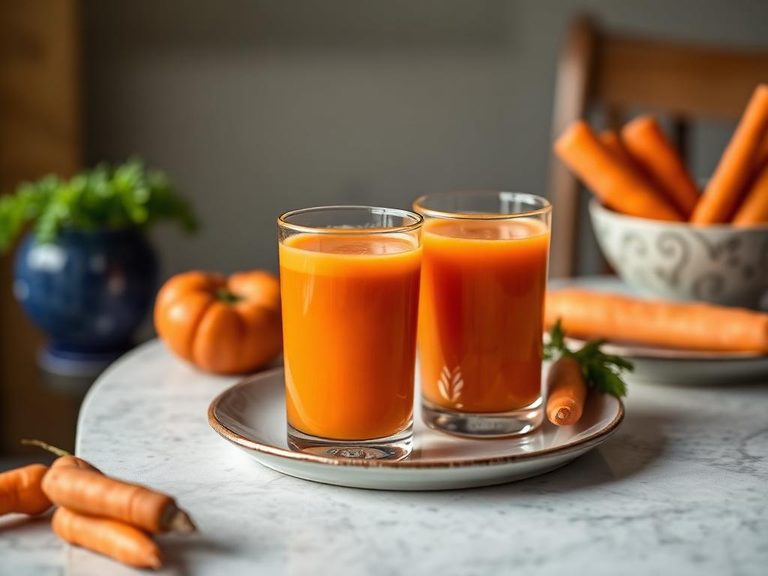
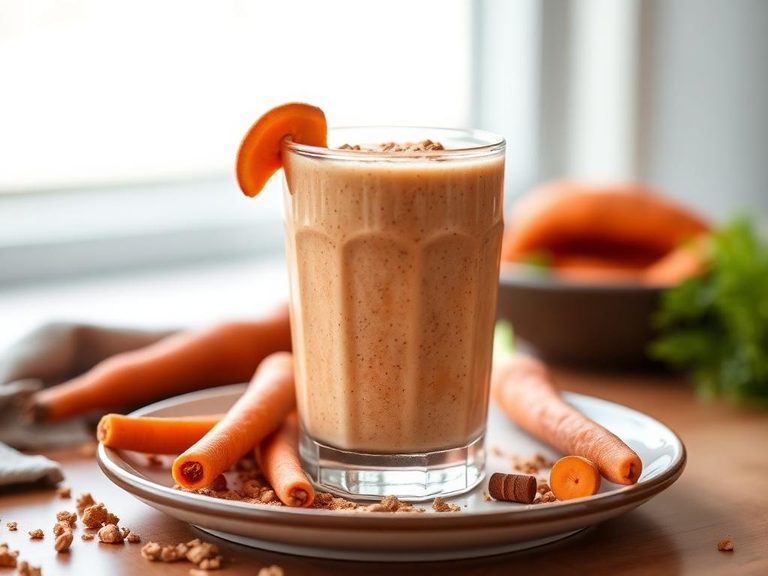

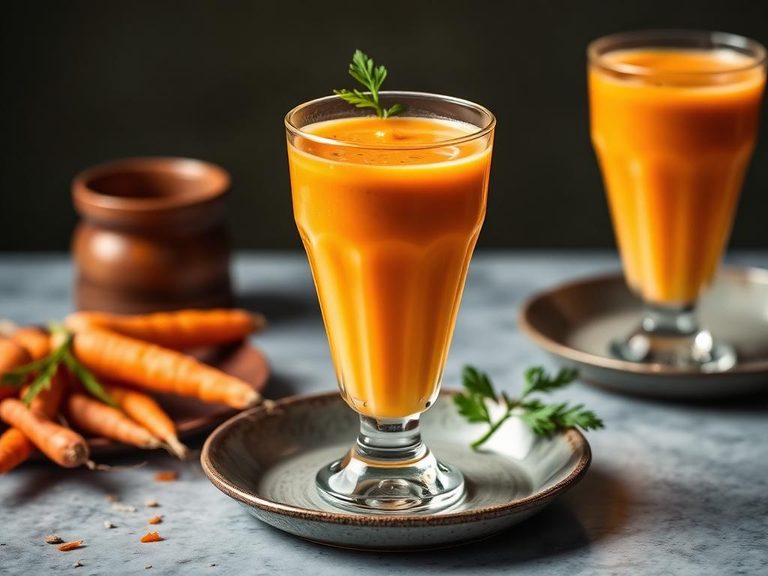
🌍 Where it's eaten
💡 Did you know?
Carrot juice was first commercially canned in the United States in the 1920s, but it gained massive popularity in the 1970s health food movement.
Full nutrition (USDA data · scales with serving)
| Water | 88.9 g |
| Energy | 40.0 kcal |
| Protein | 0.95 g |
| Total lipid (fat) | 0.15 g |
| Carbohydrate, by difference | 9.3 g |
| Fiber, total dietary | 0.80 g |
| Total Sugars | 3.9 g |
| Calcium, Ca | 24.0 mg |
| Iron, Fe | 0.46 mg |
| Magnesium, Mg | 14.0 mg |
| Phosphorus, P | 42.0 mg |
| Potassium, K | 292 mg |
| Sodium, Na | 66.0 mg |
| Zinc, Zn | 0.18 mg |
| Copper, Cu | 0.05 mg |
| Selenium, Se | 0.60 ug |
| Vitamin C, total ascorbic acid | 8.5 mg |
| Thiamin | 0.09 mg |
| Riboflavin | 0.06 mg |
| Niacin | 0.39 mg |
| Vitamin B-6 | 0.22 mg |
| Folate, total | 4.0 ug |
| Folic acid | 0.00 ug |
| Folate, food | 4.0 ug |
| Folate, DFE | 4.0 ug |
| Choline, total | 9.9 mg |
| Vitamin B-12 | 0.00 ug |
| Vitamin B-12, added | 0.00 ug |
| Vitamin A, RAE | 956 ug |
| Retinol | 0.00 ug |
| Carotene, beta | 9303 ug |
| Carotene, alpha | 4342 ug |
| Cryptoxanthin, beta | 0.00 ug |
| Lycopene | 2.0 ug |
| Lutein + zeaxanthin | 333 ug |
| Vitamin E (alpha-tocopherol) | 1.2 mg |
| Vitamin E, added | 0.00 mg |
| Vitamin D (D2 + D3) | 0.00 ug |
| Vitamin K (phylloquinone) | 15.5 ug |
| Alcohol, ethyl | 0.00 g |
| Caffeine | 0.00 mg |
| Theobromine | 0.00 mg |
Fat & fatty acid profile (per 100g)
| Fatty acids, total saturated | 0.03 g |
| SFA 4:0 | 0.00 g |
| SFA 6:0 | 0.00 g |
| SFA 8:0 | 0.00 g |
| SFA 10:0 | 0.00 g |
| SFA 12:0 | 0.00 g |
| SFA 14:0 | 0.00 g |
| SFA 16:0 | 0.02 g |
| SFA 18:0 | 0.00 g |
| Fatty acids, total monounsaturated | 0.01 g |
| MUFA 16:1 | 0.00 g |
| MUFA 18:1 | 0.01 g |
| MUFA 20:1 | 0.00 g |
| MUFA 22:1 | 0.00 g |
| Fatty acids, total polyunsaturated | 0.07 g |
| PUFA 18:2 | 0.06 g |
| PUFA 18:3 | 0.01 g |
| PUFA 18:4 | 0.00 g |
| PUFA 20:4 | 0.00 g |
| PUFA 20:5 n-3 (EPA) | 0.00 g |
| PUFA 22:5 n-3 (DPA) | 0.00 g |
| PUFA 22:6 n-3 (DHA) | 0.00 g |
| Cholesterol | 0.00 mg |
FAQ
Is carrot juice high in sugar?
Yes, it contains about 9.3g of carbohydrates (mostly natural sugars) per 100g. While these are natural sugars, consuming large amounts can affect blood glucose levels.
Can drinking carrot juice turn my skin orange?
Yes, a condition called carotenemia can occur from excessive intake of beta-carotene, causing a harmless yellow-orange skin tint, especially on palms and soles. It's reversible by reducing intake.
Is it better to juice or blend carrots?
Juicing removes most of the fiber, concentrating the sugars and nutrients. Blending retains all the fiber, which slows sugar absorption and promotes fullness. The choice depends on your health goals.
Nutrient density (calculated · NRF9.3)
Nutrient Rich Foods index: beneficial nutrients (protein, fiber, vitamins, minerals) minus saturated fat, added sugar & sodium, per 100 kcal.
NRF9.3 index — Fulgoni, Keast & Drewnowski, 2009. Computed from USDA nutrients.
Weight-loss friendliness (composite index)
Energy density 0.40 kcal/g · 10% calories from protein · 0.8 g fiber · 3.9 g sugar per 100 g.
Composite of energy density (Rolls et al., 1999), protein & fiber satiety, minus sugar. A calculated heuristic — ranks satiety-per-calorie, not a clinical measure.
Dietary load (calculated from USDA values)
Potential renal acid load. Positive = acid-forming, negative = alkaline-forming.
Sodium-to-potassium ratio: 0.23 (lower is better — aim for ≤ 1)
Sodium:potassium per WHO potassium guidance. Computed from USDA nutrients.