

Beans, baked, canned, with beef
Whole food · Legumes and Legume Products

Photo: Wikipedia
This is a hearty, savory blend of tender white beans slow-cooked in a rich, tomato-based sauce with savory ground beef. The texture is a satisfying mix of soft beans and crumbly meat, with a smoky, umami-forward flavor. It's a calorie-dense, protein-rich comfort food that delivers a solid energy boost.
Calorie split: 21% protein · 54% carbs · 25% fat
↓ Full nutrition💚 Why it's loved
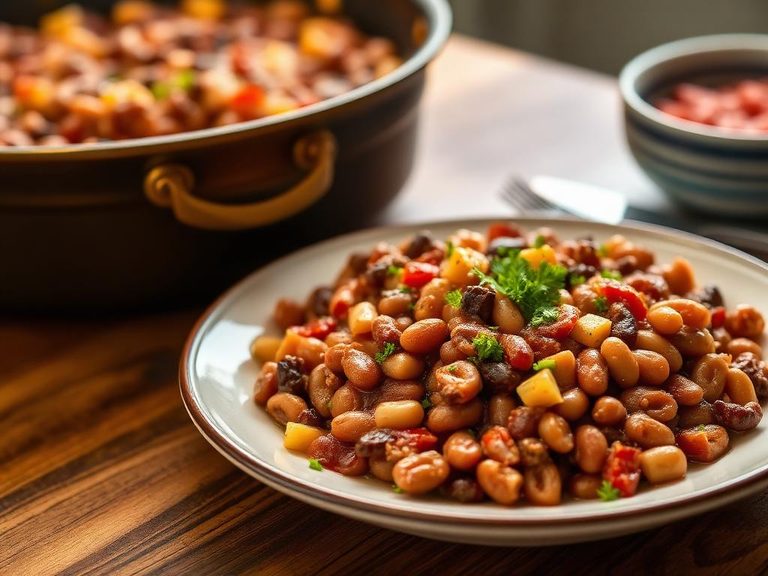
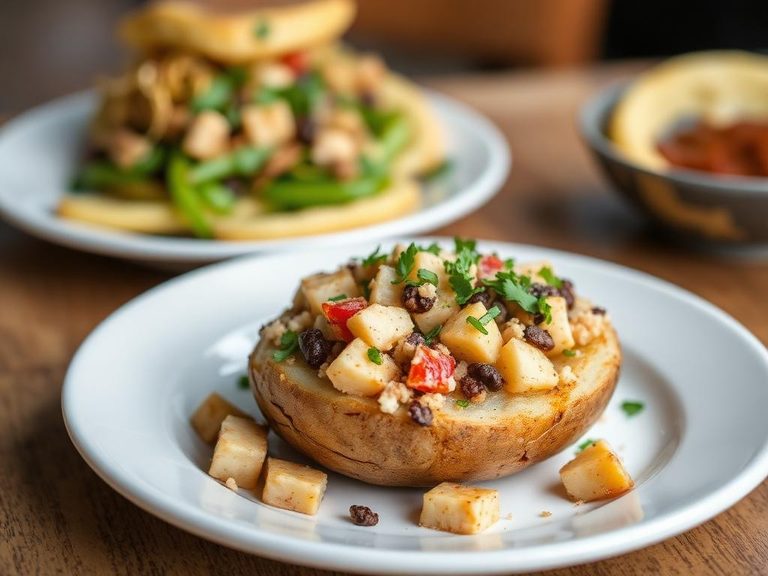
People love it for its deep, comforting flavor and effortless versatility—it's a one-pot meal that can be a quick dinner, a topping for baked potatoes, or a side for barbecue. It's a staple of American diner culture and home cooking.
⚠️ Watch-outs & how to enjoy it better
The canned version can be high in sodium, which may concern those watching blood pressure. It also contains common allergens (wheat in some sauces, legumes) and can cause digestive discomfort for some due to the beans. To counteract sodium, rinse the beans under water before mixing with the sauce, or look for low-sodium versions. Pairing it with a fresh, fiber-rich salad can aid digestion.
Key benefits
- High-quality protein from both beef and beans
- Excellent source of B vitamins, especially B12 and niacin
- Provides essential minerals like iron, zinc, and potassium
- Convenient, shelf-stable source of balanced nutrition
- Combines animal and plant proteins for a complete amino acid profile
🍽️ Popular dishes


🌍 Where it's eaten
💡 Did you know?
The iconic canned version was popularized in the 19th century by Henry Heinz, who added tomatoes to the traditional British recipe, creating the sweeter, redder style now ubiquitous in North America.
Full nutrition (USDA data · scales with serving)
| Water | 71.3 g |
| Energy | 121 kcal |
| Energy | 506 kj |
| Protein | 6.4 g |
| Total lipid (fat) | 3.5 g |
| Ash | 1.9 g |
| Carbohydrate, by difference | 16.9 g |
| Calcium, Ca | 45.0 mg |
| Iron, Fe | 1.6 mg |
| Magnesium, Mg | 25.0 mg |
| Phosphorus, P | 81.0 mg |
| Potassium, K | 320 mg |
| Sodium, Na | 475 mg |
| Zinc, Zn | 1.2 mg |
| Copper, Cu | 0.30 mg |
| Manganese, Mn | 0.60 mg |
| Selenium, Se | 9.6 ug |
| Vitamin C, total ascorbic acid | 1.8 mg |
| Thiamin | 0.05 mg |
| Riboflavin | 0.04 mg |
| Niacin | 0.94 mg |
| Pantothenic acid | 0.18 mg |
| Vitamin B-6 | 0.09 mg |
| Folate, total | 43.0 ug |
| Folic acid | 0.00 ug |
| Folate, food | 43.0 ug |
| Folate, DFE | 43.0 ug |
| Vitamin B-12 | 0.00 ug |
| Vitamin A, RAE | 11.0 ug |
| Retinol | 0.00 ug |
| Vitamin A, IU | 213 iu |
| Vitamin D (D2 + D3), International Units | 0.00 iu |
| Vitamin D (D2 + D3) | 0.00 ug |
Fat & fatty acid profile (per 100g)
| Fatty acids, total saturated | 1.7 g |
| SFA 12:0 | 0.03 g |
| SFA 14:0 | 0.12 g |
| SFA 16:0 | 0.86 g |
| SFA 18:0 | 0.62 g |
| Fatty acids, total monounsaturated | 1.4 g |
| MUFA 16:1 | 0.14 g |
| MUFA 18:1 | 1.2 g |
| MUFA 20:1 | 0.01 g |
| Fatty acids, total polyunsaturated | 0.20 g |
| PUFA 18:2 | 0.14 g |
| PUFA 18:3 | 0.05 g |
| Fatty acids, total trans | 0.00 g |
| Cholesterol | 22.0 mg |
Amino acid profile (per 100g)
| Tryptophan | 0.08 g |
| Threonine | 0.27 g |
| Isoleucine | 0.28 g |
| Leucine | 0.51 g |
| Lysine | 0.45 g |
| Methionine | 0.10 g |
| Cystine | 0.07 g |
| Phenylalanine | 0.33 g |
| Tyrosine | 0.18 g |
| Valine | 0.33 g |
| Arginine | 0.40 g |
| Histidine | 0.18 g |
| Alanine | 0.29 g |
| Aspartic acid | 0.74 g |
| Glutamic acid | 0.98 g |
| Glycine | 0.28 g |
| Proline | 0.28 g |
| Serine | 0.33 g |
FAQ
Is this the same as chili con carne?
Not exactly. While similar, baked beans with beef are typically sweeter, less spicy, and use a tomato-molasses-based sauce, whereas chili con carne is defined by chili peppers and a more savory, complex spice profile.
Can I use this as a chili base?
Absolutely. It's a fantastic shortcut. Simply add extra chili powder, cumin, diced onions, and bell peppers to create a quick, hearty chili.
Why is there often no fiber listed on the nutrition label?
This is a labeling quirk. Canned beans do contain fiber, but if the product has a very low amount per serving (less than 1g), manufacturers are not required to list it on the nutrition facts panel.
Nutrient density (calculated · NRF9.3)
Nutrient Rich Foods index: beneficial nutrients (protein, fiber, vitamins, minerals) minus saturated fat, added sugar & sodium, per 100 kcal.
NRF9.3 index — Fulgoni, Keast & Drewnowski, 2009. Computed from USDA nutrients.
Weight-loss friendliness (composite index)
Energy density 1.21 kcal/g · 21% calories from protein · 0.0 g fiber · 0.0 g sugar per 100 g.
Composite of energy density (Rolls et al., 1999), protein & fiber satiety, minus sugar. A calculated heuristic — ranks satiety-per-calorie, not a clinical measure.
Dietary load (calculated from USDA values)
Potential renal acid load. Positive = acid-forming, negative = alkaline-forming.
Sodium-to-potassium ratio: 1.48 (lower is better — aim for ≤ 1)
Sodium:potassium per WHO potassium guidance. Computed from USDA nutrients.