

Bagels, plain, unenriched, with calcium propionate (includes onion, poppy, sesame)
Whole food · Baked Products
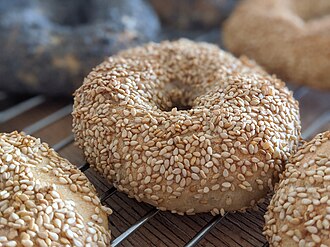
Photo: Wikipedia
A plain, unenriched bagel is a dense, chewy bread ring with a crisp, golden crust and a subtle, yeasty flavor. Its signature texture comes from being boiled before baking, creating a satisfying bite. Nutritionally, it's a significant source of carbohydrates and provides a solid 10.5g of protein per 100g, making it more substantial than many breads.
Calorie split: 16% protein · 79% carbs · 5% fat
↓ Full nutrition💚 Why it's loved
People love bagels for their uniquely dense, chewy texture and satisfying crust that holds up to hearty toppings without getting soggy. They are a versatile staple, equally at home with a schmear of cream cheese for breakfast or piled high with deli meats for lunch.
⚠️ Watch-outs & how to enjoy it better
The high carbohydrate content can lead to blood sugar spikes, especially when eaten alone. They are often high in sodium and may contain common allergens like wheat, sesame, or poppy seeds. To mitigate, pair a half-bagel with protein (egg, turkey) and healthy fat (avocado, cream cheese) to slow digestion and stabilize blood sugar.
Key benefits
- High in complex carbohydrates for sustained energy.
- Good source of plant-based protein (10.5g per 100g).
- Low in fat (1.6g per 100g).
- Provides dietary fiber (2.3g per 100g).
- Calcium propionate added as a mold inhibitor.
🍽️ Popular dishes






🌍 Where it's eaten
💡 Did you know?
The hole in the center isn't just for looks; it was traditionally created to ensure the bagel cooked evenly and quickly by increasing the surface area exposed to heat during the boiling and baking process.
Full nutrition (USDA data · scales with serving)
| Water | 32.6 g |
| Energy | 275 kcal |
| Energy | 1151 kj |
| Protein | 10.5 g |
| Total lipid (fat) | 1.6 g |
| Ash | 1.8 g |
| Carbohydrate, by difference | 53.4 g |
| Fiber, total dietary | 2.3 g |
| Calcium, Ca | 74.0 mg |
| Iron, Fe | 1.4 mg |
| Magnesium, Mg | 29.0 mg |
| Phosphorus, P | 96.0 mg |
| Potassium, K | 101 mg |
| Sodium, Na | 534 mg |
| Zinc, Zn | 0.88 mg |
| Copper, Cu | 0.16 mg |
| Manganese, Mn | 0.54 mg |
| Vitamin C, total ascorbic acid | 0.00 mg |
| Thiamin | 0.16 mg |
| Riboflavin | 0.05 mg |
| Niacin | 1.8 mg |
| Pantothenic acid | 0.36 mg |
| Vitamin B-6 | 0.05 mg |
| Folate, total | 22.0 ug |
| Folic acid | 0.00 ug |
| Folate, food | 22.0 ug |
| Folate, DFE | 22.0 ug |
| Vitamin B-12 | 0.00 ug |
| Vitamin A, RAE | 0.00 ug |
| Retinol | 0.00 ug |
| Vitamin A, IU | 0.00 iu |
Fat & fatty acid profile (per 100g)
| Fatty acids, total saturated | 0.22 g |
| SFA 12:0 | 0.00 g |
| SFA 16:0 | 0.21 g |
| SFA 18:0 | 0.01 g |
| Fatty acids, total monounsaturated | 0.13 g |
| MUFA 16:1 | 0.01 g |
| MUFA 18:1 | 0.12 g |
| Fatty acids, total polyunsaturated | 0.70 g |
| PUFA 18:2 | 0.66 g |
| PUFA 18:3 | 0.04 g |
| Cholesterol | 0.00 mg |
Amino acid profile (per 100g)
| Tryptophan | 0.12 g |
| Threonine | 0.30 g |
| Isoleucine | 0.40 g |
| Leucine | 0.73 g |
| Lysine | 0.25 g |
| Methionine | 0.19 g |
| Cystine | 0.23 g |
| Phenylalanine | 0.52 g |
| Tyrosine | 0.30 g |
| Valine | 0.46 g |
| Arginine | 0.38 g |
| Histidine | 0.23 g |
| Alanine | 0.35 g |
| Aspartic acid | 0.48 g |
| Glutamic acid | 3.5 g |
| Glycine | 0.37 g |
| Proline | 1.2 g |
| Serine | 0.51 g |
FAQ
Why is a bagel chewy?
The chewy texture is created by boiling the shaped dough in water (often with malt or honey) before baking. This gelatinizes the starches on the surface, forming a crust that traps steam inside, leading to a dense, chewy interior.
Are bagels a good source of fiber?
A plain, unenriched bagel contains about 2.3g of fiber per 100g, which is moderate. For higher fiber, look for whole wheat or multigrain varieties, and pair with fiber-rich toppings like avocado or vegetables.
What does 'unenriched' mean for a bagel?
It means the flour used has not had specific nutrients (like iron, B vitamins, and folic acid) added back after processing, unlike 'enriched' flour. The nutritional profile is closer to the original grain.
Nutrient density (calculated · NRF9.3)
Nutrient Rich Foods index: beneficial nutrients (protein, fiber, vitamins, minerals) minus saturated fat, added sugar & sodium, per 100 kcal.
NRF9.3 index — Fulgoni, Keast & Drewnowski, 2009. Computed from USDA nutrients.
Weight-loss friendliness (composite index)
Energy density 2.75 kcal/g · 15% calories from protein · 2.3 g fiber · 0.0 g sugar per 100 g.
Composite of energy density (Rolls et al., 1999), protein & fiber satiety, minus sugar. A calculated heuristic — ranks satiety-per-calorie, not a clinical measure.
Dietary load (calculated from USDA values)
Potential renal acid load. Positive = acid-forming, negative = alkaline-forming.
Sodium-to-potassium ratio: 5.29 (lower is better — aim for ≤ 1)
Sodium:potassium per WHO potassium guidance. Computed from USDA nutrients.