

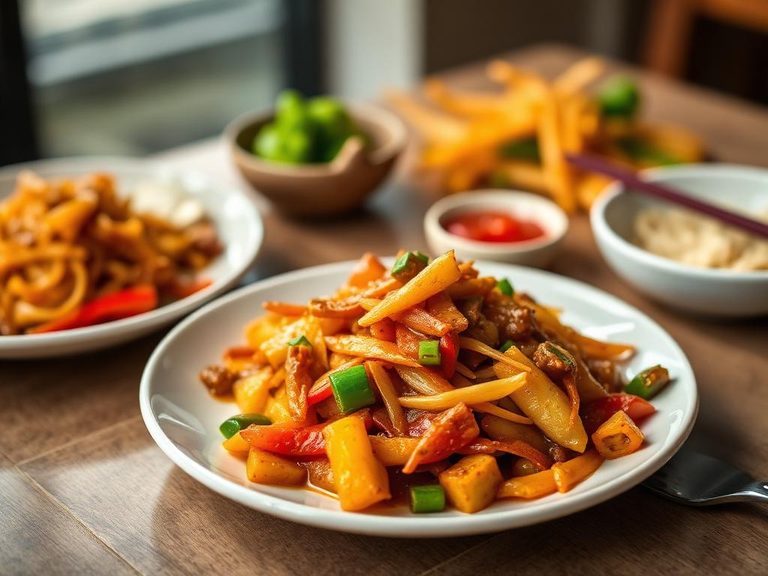
Asian stir fry vegetables, cooked, no added fat
Common food

Photo: Wikipedia
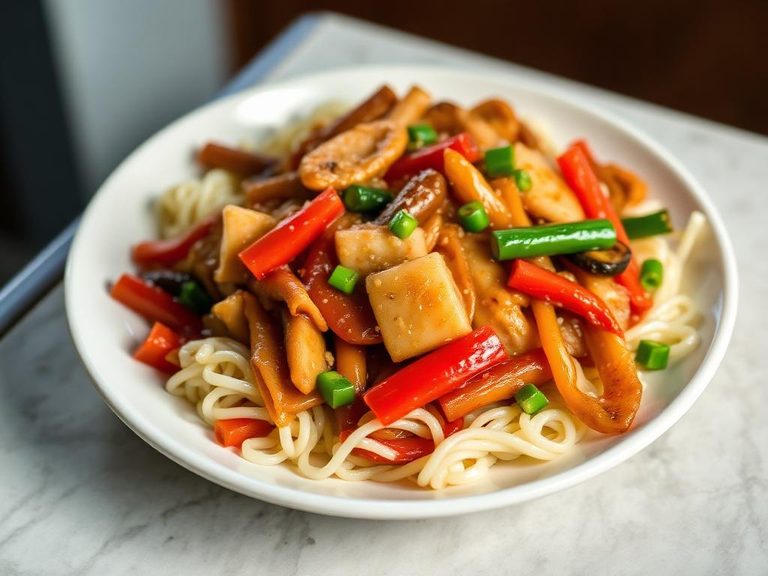
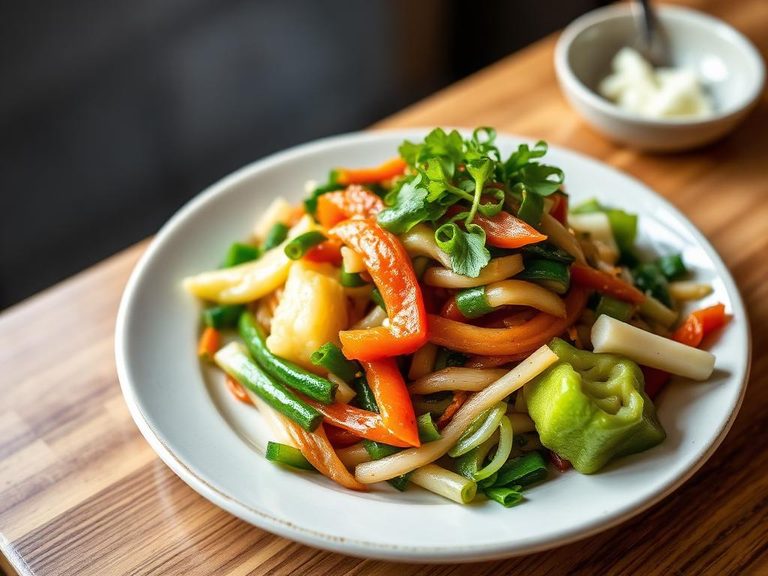
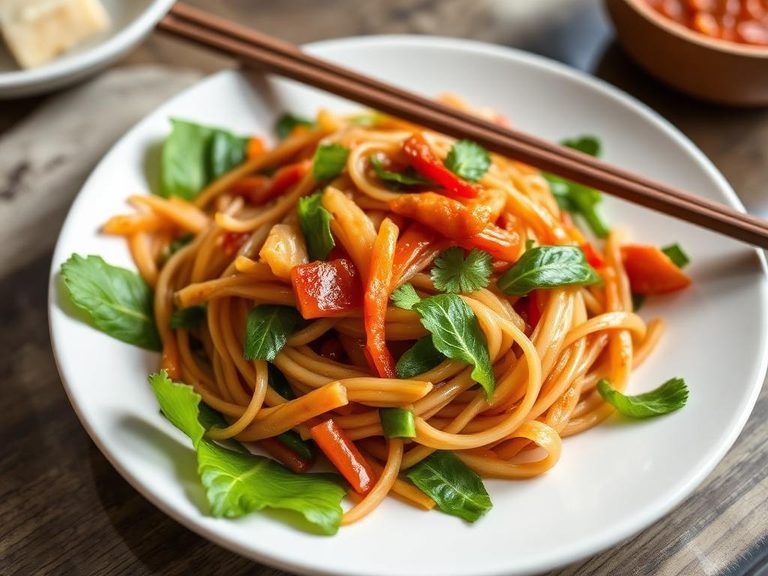
A vibrant medley of crisp-tender vegetables like bok choy, snap peas, and bell peppers, flash-cooked in a hot wok to retain their bright color and satisfying crunch. This simple preparation highlights the natural, clean sweetness of the vegetables with a subtle, savory depth from the cooking process. It's an exceptionally low-calorie, high-fiber side dish that delivers a powerhouse of vitamins and minerals.
Calorie split: 16% protein · 78% carbs · 5% fat
↓ Full nutrition💚 Why it's loved
People love it for its satisfying textural contrast—the crisp snap of vegetables against a tender bite—and its ability to absorb the flavors of any sauce or seasoning it's paired with. It's a cornerstone of balanced, home-style Asian cooking, representing freshness and simplicity.
⚠️ Watch-outs & how to enjoy it better
The main concern is the potential for high sodium content if prepared with soy sauce or other salty condiments, which can be an issue for those monitoring blood pressure. To counteract this, use low-sodium tamari, flavor with aromatics like ginger and garlic, and pair with unsalted proteins. Some individuals may also experience digestive discomfort from cruciferous vegetables (like broccoli or cabbage) often included; steaming them lightly before stir-frying can help.
Key benefits
- Extremely low in calories and fat, making it ideal for weight management.
- High in dietary fiber, which supports digestive health and promotes fullness.
- Rich in micronutrients like Vitamin C, Vitamin K, and potassium from diverse vegetables.
- A versatile, low-carb base that can be paired with numerous proteins and sauces.
🍽️ Popular dishes

🌍 Where it's eaten
💡 Did you know?
The 'wok hei' or 'breath of the wok'—that elusive, smoky sear from a seasoned wok at extreme heat—is so prized in Cantonese cooking that it can't be perfectly replicated in a home kitchen, making restaurant stir-fries uniquely flavorful.
Full nutrition (USDA data · scales with serving)
| Water | 86.8 g |
| Energy | 50.0 kcal |
| Protein | 2.1 g |
| Total lipid (fat) | 0.30 g |
| Carbohydrate, by difference | 9.9 g |
| Fiber, total dietary | 2.9 g |
| Total Sugars | 3.6 g |
| Calcium, Ca | 36.0 mg |
| Iron, Fe | 1.0 mg |
| Magnesium, Mg | 18.0 mg |
| Phosphorus, P | 49.0 mg |
| Potassium, K | 251 mg |
| Sodium, Na | 141 mg |
| Zinc, Zn | 0.40 mg |
| Copper, Cu | 0.08 mg |
| Selenium, Se | 0.80 ug |
| Vitamin C, total ascorbic acid | 36.3 mg |
| Thiamin | 0.06 mg |
| Riboflavin | 0.10 mg |
| Niacin | 0.79 mg |
| Vitamin B-6 | 0.18 mg |
| Folate, total | 35.0 ug |
| Folic acid | 0.00 ug |
| Folate, food | 35.0 ug |
| Folate, DFE | 35.0 ug |
| Choline, total | 17.3 mg |
| Vitamin B-12 | 0.00 ug |
| Vitamin B-12, added | 0.00 ug |
| Vitamin A, RAE | 226 ug |
| Retinol | 0.00 ug |
| Carotene, beta | 2279 ug |
| Carotene, alpha | 874 ug |
| Cryptoxanthin, beta | 1.0 ug |
| Lycopene | 0.00 ug |
| Lutein + zeaxanthin | 504 ug |
| Vitamin E (alpha-tocopherol) | 0.48 mg |
| Vitamin E, added | 0.00 mg |
| Vitamin D (D2 + D3) | 0.00 ug |
| Vitamin K (phylloquinone) | 38.3 ug |
| Alcohol, ethyl | 0.00 g |
| Caffeine | 0.00 mg |
| Theobromine | 0.00 mg |
Fat & fatty acid profile (per 100g)
| Fatty acids, total saturated | 0.05 g |
| SFA 4:0 | 0.00 g |
| SFA 6:0 | 0.00 g |
| SFA 8:0 | 0.00 g |
| SFA 10:0 | 0.00 g |
| SFA 12:0 | 0.00 g |
| SFA 14:0 | 0.00 g |
| SFA 16:0 | 0.04 g |
| SFA 18:0 | 0.01 g |
| Fatty acids, total monounsaturated | 0.02 g |
| MUFA 16:1 | 0.00 g |
| MUFA 18:1 | 0.02 g |
| MUFA 20:1 | 0.00 g |
| MUFA 22:1 | 0.00 g |
| Fatty acids, total polyunsaturated | 0.09 g |
| PUFA 18:2 | 0.08 g |
| PUFA 18:3 | 0.01 g |
| PUFA 18:4 | 0.00 g |
| PUFA 20:4 | 0.00 g |
| PUFA 20:5 n-3 (EPA) | 0.00 g |
| PUFA 22:5 n-3 (DPA) | 0.00 g |
| PUFA 22:6 n-3 (DHA) | 0.00 g |
| Cholesterol | 0.00 mg |
FAQ
Why do my stir-fry vegetables get soggy instead of crisp?
The key is high heat and not overcrowding the wok. Cook in small batches, ensure vegetables are dry, and toss constantly for a short time (2-3 minutes). A hot wok creates steam quickly, searing the exterior while keeping the inside crisp.
Is this a good option for a low-carb diet?
Yes, it's an excellent low-carb, high-fiber side. The carbohydrate content comes primarily from complex carbs in the vegetables themselves, which are digested slowly. Just be mindful of any added sugary sauces.
Can I reheat leftovers without ruining the texture?
Reheating will soften the vegetables further. For best results, reheat quickly in a very hot pan or wok for 30-60 seconds just to warm through, rather than microwaving, which tends to steam and make them mushy.
Nutrient density (calculated · NRF9.3)
Nutrient Rich Foods index: beneficial nutrients (protein, fiber, vitamins, minerals) minus saturated fat, added sugar & sodium, per 100 kcal.
NRF9.3 index — Fulgoni, Keast & Drewnowski, 2009. Computed from USDA nutrients.
Weight-loss friendliness (composite index)
Energy density 0.50 kcal/g · 17% calories from protein · 2.9 g fiber · 3.6 g sugar per 100 g.
Composite of energy density (Rolls et al., 1999), protein & fiber satiety, minus sugar. A calculated heuristic — ranks satiety-per-calorie, not a clinical measure.
Dietary load (calculated from USDA values)
Potential renal acid load. Positive = acid-forming, negative = alkaline-forming.
Sodium-to-potassium ratio: 0.56 (lower is better — aim for ≤ 1)
Sodium:potassium per WHO potassium guidance. Computed from USDA nutrients.