

Asian stir fry vegetables, cooked, fat added
Common food

Photo: Wikipedia
A vibrant medley of crisp-tender vegetables like broccoli, bell peppers, and snap peas, stir-fried to a glossy finish with a light coating of oil. It offers a satisfying crunch with a savory, umami-rich flavor from garlic, ginger, and soy-based sauces. Nutritionally, it's a low-calorie, high-fiber side dish that delivers a spectrum of vitamins and minerals.
Calorie split: 11% protein · 53% carbs · 35% fat
↓ Full nutrition💚 Why it's loved
People adore it for its perfect balance of textures—crunchy, tender, and juicy—and its ability to soak up complex, savory sauces. It's a beloved, versatile staple in Asian cuisine that can be customized with any seasonal vegetable or protein.
⚠️ Watch-outs & how to enjoy it better
The added oil and common use of high-sodium sauces (like soy or oyster sauce) can increase calorie and salt intake. To counteract this, use low-sodium sauces, measure oil carefully (or use a spray), and pair with a lean protein like tofu or chicken to enhance satiety and balance the meal.
Key benefits
- Excellent source of dietary fiber for digestive health.
- Low in calories but high in volume, aiding satiety.
- Rich in antioxidants like vitamin C from peppers and broccoli.
- Provides a good mix of micronutrients from diverse vegetables.
- Quick to prepare, making healthy eating accessible.
🍽️ Popular dishes
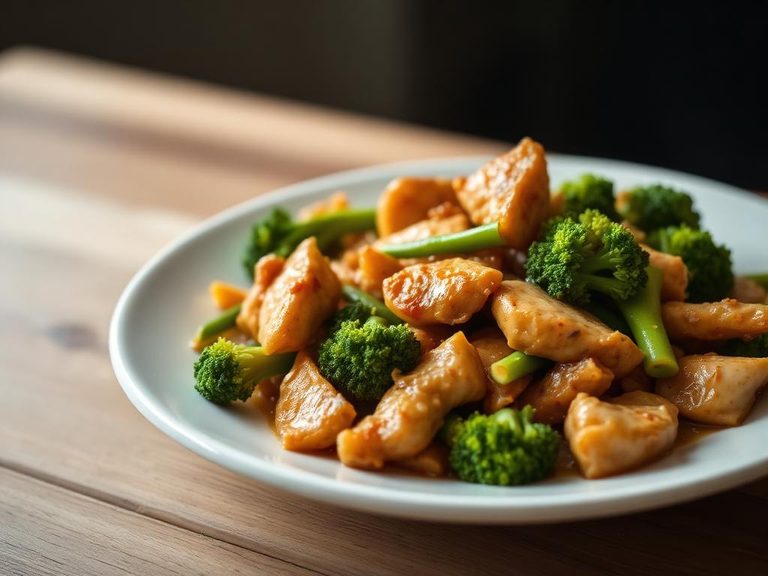

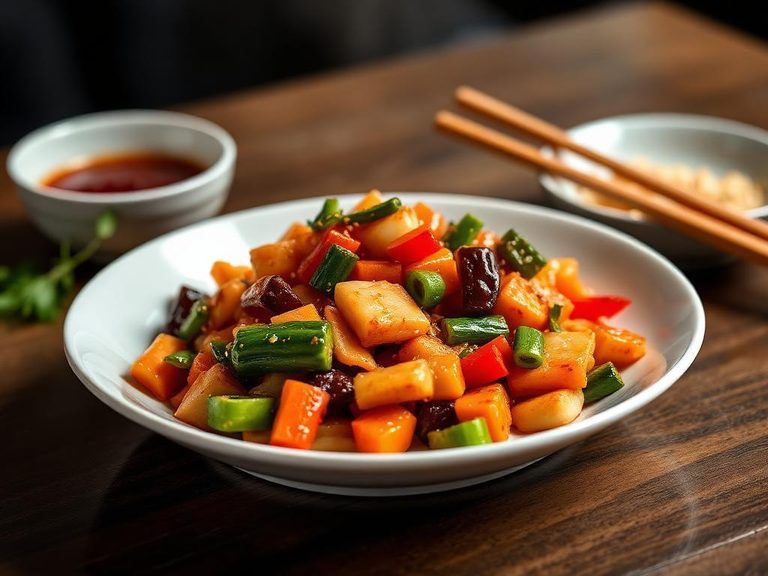
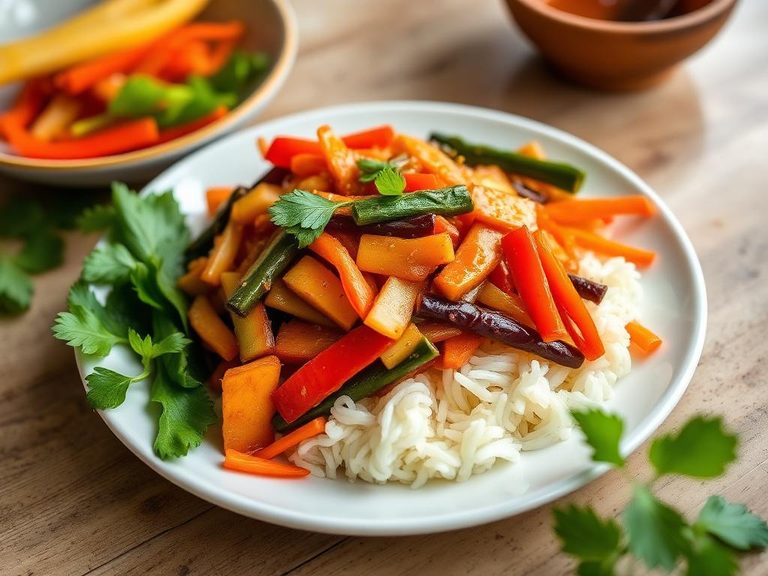
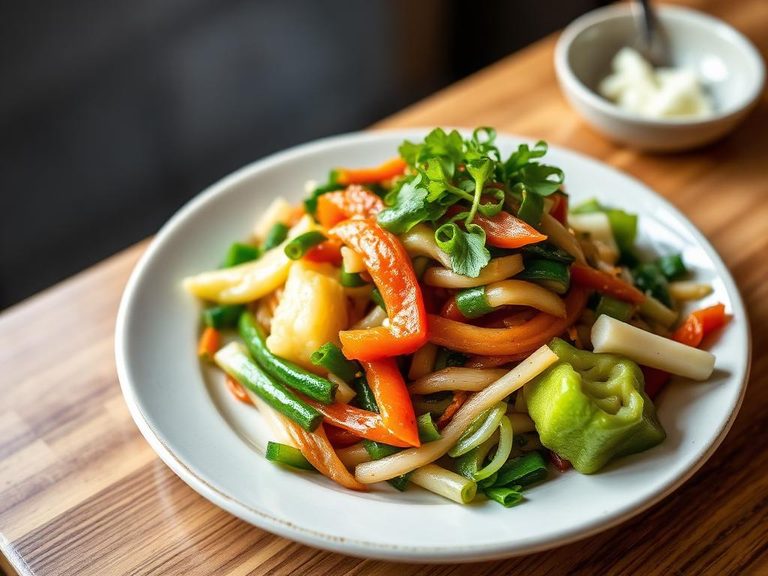
🌍 Where it's eaten
💡 Did you know?
The 'wok hei' or 'breath of the wok'—that elusive, smoky sear prized in Cantonese stir-fries—requires temperatures exceeding 1,200°F (650°C), which home stoves rarely achieve.
Full nutrition (USDA data · scales with serving)
| Water | 84.6 g |
| Energy | 71.0 kcal |
| Protein | 2.0 g |
| Total lipid (fat) | 2.8 g |
| Carbohydrate, by difference | 9.7 g |
| Fiber, total dietary | 2.8 g |
| Total Sugars | 3.5 g |
| Calcium, Ca | 35.0 mg |
| Iron, Fe | 1.0 mg |
| Magnesium, Mg | 17.0 mg |
| Phosphorus, P | 47.0 mg |
| Potassium, K | 244 mg |
| Sodium, Na | 146 mg |
| Zinc, Zn | 0.38 mg |
| Copper, Cu | 0.08 mg |
| Selenium, Se | 0.80 ug |
| Vitamin C, total ascorbic acid | 35.3 mg |
| Thiamin | 0.05 mg |
| Riboflavin | 0.09 mg |
| Niacin | 0.77 mg |
| Vitamin B-6 | 0.19 mg |
| Folate, total | 34.0 ug |
| Folic acid | 0.00 ug |
| Folate, food | 34.0 ug |
| Folate, DFE | 34.0 ug |
| Choline, total | 17.0 mg |
| Vitamin B-12 | 0.00 ug |
| Vitamin B-12, added | 0.00 ug |
| Vitamin A, RAE | 231 ug |
| Retinol | 11.0 ug |
| Carotene, beta | 2218 ug |
| Carotene, alpha | 848 ug |
| Cryptoxanthin, beta | 1.0 ug |
| Lycopene | 0.00 ug |
| Lutein + zeaxanthin | 489 ug |
| Vitamin E (alpha-tocopherol) | 0.85 mg |
| Vitamin E, added | 0.00 mg |
| Vitamin D (D2 + D3) | 0.00 ug |
| Vitamin K (phylloquinone) | 39.3 ug |
| Alcohol, ethyl | 0.00 g |
| Caffeine | 0.00 mg |
| Theobromine | 0.00 mg |
Fat & fatty acid profile (per 100g)
| Fatty acids, total saturated | 0.71 g |
| SFA 4:0 | 0.02 g |
| SFA 6:0 | 0.01 g |
| SFA 8:0 | 0.01 g |
| SFA 10:0 | 0.02 g |
| SFA 12:0 | 0.02 g |
| SFA 14:0 | 0.07 g |
| SFA 16:0 | 0.40 g |
| SFA 18:0 | 0.14 g |
| Fatty acids, total monounsaturated | 0.92 g |
| MUFA 16:1 | 0.01 g |
| MUFA 18:1 | 0.89 g |
| MUFA 20:1 | 0.01 g |
| MUFA 22:1 | 0.00 g |
| Fatty acids, total polyunsaturated | 0.81 g |
| PUFA 18:2 | 0.72 g |
| PUFA 18:3 | 0.10 g |
| PUFA 18:4 | 0.00 g |
| PUFA 20:4 | 0.00 g |
| PUFA 20:5 n-3 (EPA) | 0.00 g |
| PUFA 22:5 n-3 (DPA) | 0.00 g |
| PUFA 22:6 n-3 (DHA) | 0.00 g |
| Cholesterol | 2.0 mg |
FAQ
Why do my stir-fry vegetables get soggy instead of crisp?
The key is high heat and not overcrowding the pan. Cook in batches if needed, and ensure vegetables are dry before they hit the hot oil. Add harder vegetables (like carrots) before softer ones (like bell peppers).
Is frozen stir-fry mix as nutritious as fresh?
Yes, often more so. Vegetables are typically flash-frozen at peak ripeness, which preserves vitamins better than fresh produce that has traveled long distances. The texture may be slightly softer after cooking.
How can I reduce the sodium in my stir-fry?
Use low-sodium or reduced-sodium soy sauce, tamari, or coconut aminos. Boost flavor with aromatics like garlic, ginger, scallions, and a splash of rice vinegar or a pinch of sugar instead of relying solely on salty sauces.
Nutrient density (calculated · NRF9.3)
Nutrient Rich Foods index: beneficial nutrients (protein, fiber, vitamins, minerals) minus saturated fat, added sugar & sodium, per 100 kcal.
NRF9.3 index — Fulgoni, Keast & Drewnowski, 2009. Computed from USDA nutrients.
Weight-loss friendliness (composite index)
Energy density 0.71 kcal/g · 11% calories from protein · 2.8 g fiber · 3.5 g sugar per 100 g.
Composite of energy density (Rolls et al., 1999), protein & fiber satiety, minus sugar. A calculated heuristic — ranks satiety-per-calorie, not a clinical measure.
Dietary load (calculated from USDA values)
Potential renal acid load. Positive = acid-forming, negative = alkaline-forming.
Sodium-to-potassium ratio: 0.60 (lower is better — aim for ≤ 1)
Sodium:potassium per WHO potassium guidance. Computed from USDA nutrients.