

Apple juice beverage, 40-50% juice, light
Common food

Photo: Wikipedia
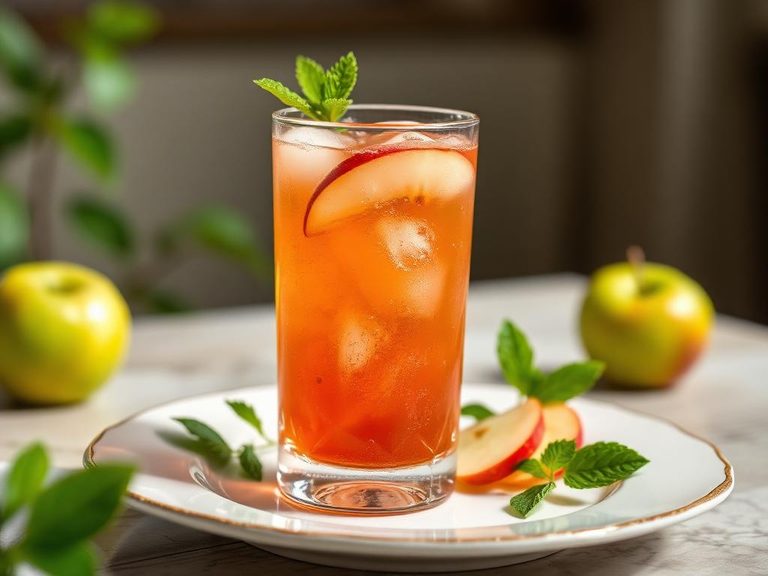
This is a light, refreshing apple juice beverage, typically a blend of apple juice concentrate and water, often with added vitamin C. It offers a sweet, crisp apple flavor without the full-bodied texture or deep amber color of 100% juice, resulting in a lighter, more diluted taste. Nutritionally, it's a low-calorie, sugar-sweetened option with minimal fat or protein.
Calorie split: 0% protein · 96% carbs · 4% fat
↓ Full nutrition💚 Why it's loved
People love it for its familiar, sweet apple taste that's less intense than pure juice, making it an easy, thirst-quenching drink for all ages. Its versatility allows it to be enjoyed chilled on its own, used as a base for spritzers, or mixed into smoothies.
⚠️ Watch-outs & how to enjoy it better
The primary downside is its added sugar content (4.8g per 100g), which can contribute to blood-sugar spikes if consumed in large amounts without other nutrients. To counteract this, practice portion control (e.g., stick to a 240ml serving) and pair it with a source of protein or healthy fat, like a handful of nuts or a cheese stick, to slow sugar absorption.
Key benefits
- Low in calories (22 kcal per 100g)
- Source of simple carbohydrates for quick energy
- Often fortified with Vitamin C
- Provides hydration with a pleasant flavor
- Shelf-stable and convenient
🍽️ Popular dishes

🌍 Where it's eaten
💡 Did you know?
The 'light' or 'diet' versions often use non-nutritive sweeteners or are simply more diluted with water, but this specific nutrition profile (5.1g carbs, 4.8g sugar) indicates it's a diluted juice beverage, not a zero-calorie diet drink.
Full nutrition (USDA data · scales with serving)
| Water | 94.8 g |
| Energy | 22.0 kcal |
| Protein | 0.00 g |
| Total lipid (fat) | 0.10 g |
| Carbohydrate, by difference | 5.1 g |
| Fiber, total dietary | 0.00 g |
| Total Sugars | 4.8 g |
| Calcium, Ca | 3.0 mg |
| Iron, Fe | 0.20 mg |
| Magnesium, Mg | 5.0 mg |
| Phosphorus, P | 9.0 mg |
| Potassium, K | 51.0 mg |
| Sodium, Na | 13.0 mg |
| Zinc, Zn | 0.04 mg |
| Copper, Cu | 0.01 mg |
| Selenium, Se | 0.10 ug |
| Vitamin C, total ascorbic acid | 24.0 mg |
| Thiamin | 0.00 mg |
| Riboflavin | 0.01 mg |
| Niacin | 0.07 mg |
| Vitamin B-6 | 0.02 mg |
| Folate, total | 0.00 ug |
| Folic acid | 0.00 ug |
| Folate, food | 0.00 ug |
| Folate, DFE | 0.00 ug |
| Choline, total | 1.8 mg |
| Vitamin B-12 | 0.00 ug |
| Vitamin B-12, added | 0.00 ug |
| Vitamin A, RAE | 0.00 ug |
| Retinol | 0.00 ug |
| Carotene, beta | 0.00 ug |
| Carotene, alpha | 0.00 ug |
| Cryptoxanthin, beta | 0.00 ug |
| Lycopene | 0.00 ug |
| Lutein + zeaxanthin | 16.0 ug |
| Vitamin E (alpha-tocopherol) | 0.01 mg |
| Vitamin E, added | 0.00 mg |
| Vitamin D (D2 + D3) | 0.00 ug |
| Vitamin K (phylloquinone) | 0.00 ug |
| Alcohol, ethyl | 0.00 g |
| Caffeine | 0.00 mg |
| Theobromine | 0.00 mg |
Fat & fatty acid profile (per 100g)
| Fatty acids, total saturated | 0.00 g |
| SFA 4:0 | 0.00 g |
| SFA 6:0 | 0.00 g |
| SFA 8:0 | 0.00 g |
| SFA 10:0 | 0.00 g |
| SFA 12:0 | 0.00 g |
| SFA 14:0 | 0.00 g |
| SFA 16:0 | 0.00 g |
| SFA 18:0 | 0.00 g |
| Fatty acids, total monounsaturated | 0.00 g |
| MUFA 16:1 | 0.00 g |
| MUFA 18:1 | 0.00 g |
| MUFA 20:1 | 0.00 g |
| MUFA 22:1 | 0.00 g |
| Fatty acids, total polyunsaturated | 0.00 g |
| PUFA 18:2 | 0.00 g |
| PUFA 18:3 | 0.00 g |
| PUFA 18:4 | 0.00 g |
| PUFA 20:4 | 0.00 g |
| PUFA 20:5 n-3 (EPA) | 0.00 g |
| PUFA 22:5 n-3 (DPA) | 0.00 g |
| PUFA 22:6 n-3 (DHA) | 0.00 g |
| Cholesterol | 0.00 mg |
FAQ
Is apple juice beverage the same as 100% apple juice?
No. A beverage typically contains 40-50% juice, with the rest being water and sometimes added sweeteners or vitamins. 100% apple juice is made solely from apples.
Does it contain added sugar?
The nutrition facts show 4.8g of sugar per 100g. Since apple juice naturally contains sugar, some of this is intrinsic, but beverages often have added sugars or sweeteners to enhance taste after dilution.
Is it a good source of vitamins?
It is not a significant source of most vitamins or minerals naturally, but many brands fortify it with Vitamin C (ascorbic acid) to add nutritional value and act as a preservative.
Nutrient density (calculated · NRF9.3)
Nutrient Rich Foods index: beneficial nutrients (protein, fiber, vitamins, minerals) minus saturated fat, added sugar & sodium, per 100 kcal.
NRF9.3 index — Fulgoni, Keast & Drewnowski, 2009. Computed from USDA nutrients.
Weight-loss friendliness (composite index)
Energy density 0.22 kcal/g · 0% calories from protein · 0.0 g fiber · 4.8 g sugar per 100 g.
Composite of energy density (Rolls et al., 1999), protein & fiber satiety, minus sugar. A calculated heuristic — ranks satiety-per-calorie, not a clinical measure.
Dietary load (calculated from USDA values)
Potential renal acid load. Positive = acid-forming, negative = alkaline-forming.
Sodium-to-potassium ratio: 0.25 (lower is better — aim for ≤ 1)
Sodium:potassium per WHO potassium guidance. Computed from USDA nutrients.