

Vegetable curry
Common food

Photo: Wikipedia
Vegetable curry is a vibrant, aromatic dish where a medley of vegetables is simmered in a spiced coconut or tomato-based sauce. The texture is a comforting mix of tender vegetables in a rich, creamy gravy, with flavors that range from earthy and warm to bright and tangy. Nutritionally, it's a low-calorie, high-fiber option that delivers healthy fats and a spectrum of plant-based nutrients.
Calorie split: 7% protein · 40% carbs · 53% fat
↓ Full nutrition💚 Why it's loved
People love vegetable curry for its deep, complex layers of flavor that transform simple vegetables into a satisfying feast. It's a culinary chameleon, beloved for its versatility to be mild or fiery, and its central role in communal meals across many cultures.
⚠️ Watch-outs & how to enjoy it better
Some versions can be high in sodium or saturated fat from coconut milk, and the spices may cause digestive discomfort for some. Those monitoring blood sugar should be mindful of portion size with rice, and individuals with nightshade sensitivities may need to avoid tomatoes or peppers in the base. To counteract, opt for light coconut milk, control portion size, and pair with a protein like lentils or chicken.
Key benefits
- Excellent source of dietary fiber for digestive health.
- Rich in antioxidants from spices like turmeric and cumin.
- Provides healthy fats from coconut milk or oil.
- Low in calories while being nutrient-dense.
- Highly customizable for various dietary needs.
🍽️ Popular dishes
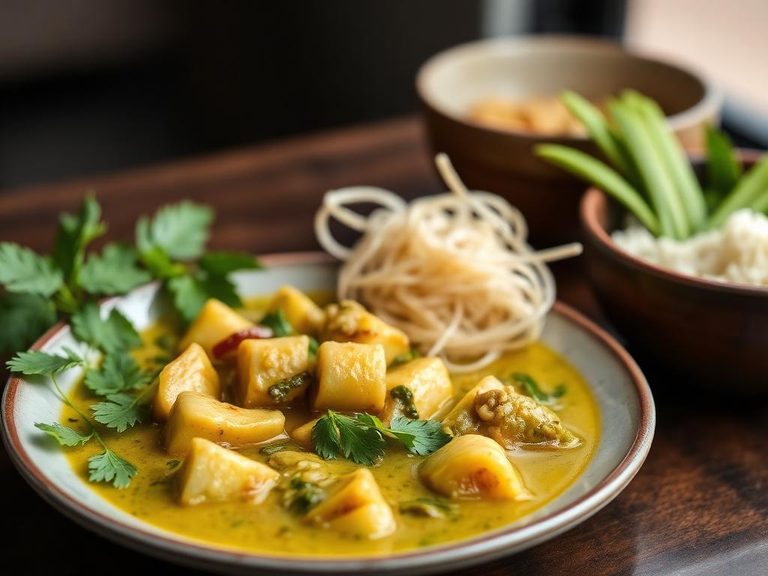
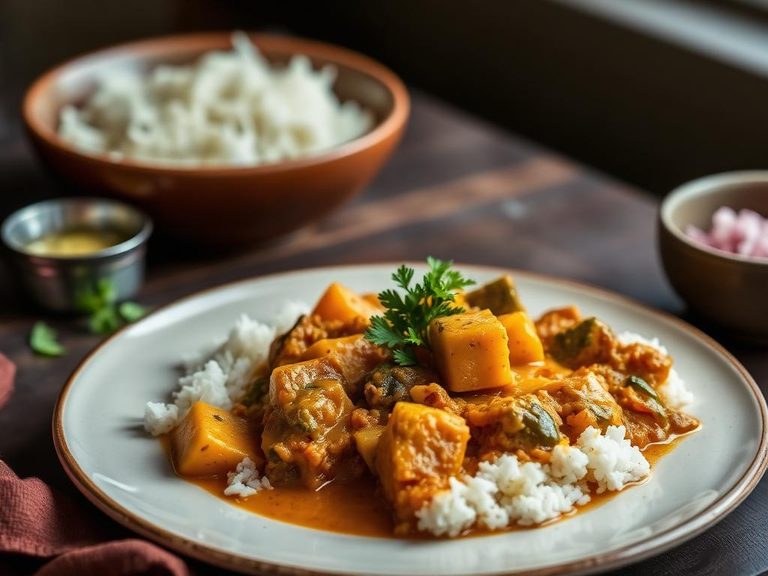
🌍 Where it's eaten
💡 Did you know?
The iconic yellow color of many curries comes from turmeric, which contains curcumin—a compound studied for its anti-inflammatory properties.
Full nutrition (USDA data · scales with serving)
| Water | 82.7 g |
| Energy | 86.0 kcal |
| Protein | 1.6 g |
| Total lipid (fat) | 5.3 g |
| Carbohydrate, by difference | 8.8 g |
| Fiber, total dietary | 1.8 g |
| Total Sugars | 3.2 g |
| Calcium, Ca | 21.0 mg |
| Iron, Fe | 0.68 mg |
| Magnesium, Mg | 16.0 mg |
| Phosphorus, P | 41.0 mg |
| Potassium, K | 286 mg |
| Sodium, Na | 388 mg |
| Zinc, Zn | 0.26 mg |
| Copper, Cu | 0.09 mg |
| Selenium, Se | 0.60 ug |
| Vitamin C, total ascorbic acid | 12.3 mg |
| Thiamin | 0.05 mg |
| Riboflavin | 0.06 mg |
| Niacin | 0.81 mg |
| Vitamin B-6 | 0.14 mg |
| Folate, total | 19.0 ug |
| Folic acid | 0.00 ug |
| Folate, food | 19.0 ug |
| Folate, DFE | 19.0 ug |
| Choline, total | 12.3 mg |
| Vitamin B-12 | 0.01 ug |
| Vitamin B-12, added | 0.00 ug |
| Vitamin A, RAE | 66.0 ug |
| Retinol | 1.0 ug |
| Carotene, beta | 662 ug |
| Carotene, alpha | 215 ug |
| Cryptoxanthin, beta | 1.0 ug |
| Lycopene | 4602 ug |
| Lutein + zeaxanthin | 139 ug |
| Vitamin E (alpha-tocopherol) | 1.4 mg |
| Vitamin E, added | 0.00 mg |
| Vitamin D (D2 + D3) | 0.00 ug |
| Vitamin K (phylloquinone) | 10.4 ug |
| Alcohol, ethyl | 0.00 g |
| Caffeine | 0.00 mg |
| Theobromine | 0.00 mg |
Fat & fatty acid profile (per 100g)
| Fatty acids, total saturated | 1.3 g |
| SFA 4:0 | 0.00 g |
| SFA 6:0 | 0.01 g |
| SFA 8:0 | 0.05 g |
| SFA 10:0 | 0.04 g |
| SFA 12:0 | 0.29 g |
| SFA 14:0 | 0.13 g |
| SFA 16:0 | 0.53 g |
| SFA 18:0 | 0.17 g |
| Fatty acids, total monounsaturated | 1.9 g |
| MUFA 16:1 | 0.02 g |
| MUFA 18:1 | 1.8 g |
| MUFA 20:1 | 0.03 g |
| MUFA 22:1 | 0.00 g |
| Fatty acids, total polyunsaturated | 1.7 g |
| PUFA 18:2 | 1.5 g |
| PUFA 18:3 | 0.20 g |
| PUFA 18:4 | 0.00 g |
| PUFA 20:4 | 0.00 g |
| PUFA 20:5 n-3 (EPA) | 0.00 g |
| PUFA 22:5 n-3 (DPA) | 0.00 g |
| PUFA 22:6 n-3 (DHA) | 0.00 g |
| Cholesterol | 0.00 mg |
FAQ
Is vegetable curry healthy?
Yes, it's generally very healthy. It's low in calories, high in fiber and vegetables, and packed with beneficial spices. Healthiness depends on the specific recipe, particularly the amount of oil and type of coconut milk used.
How long does vegetable curry last in the fridge?
Stored in an airtight container, it typically lasts for 3-4 days. The flavors often deepen and improve the next day.
Can I freeze vegetable curry?
Yes, it freezes well for up to 3 months. Note that the texture of some vegetables (like zucchini) may soften upon thawing.
Nutrient density (calculated · NRF9.3)
Nutrient Rich Foods index: beneficial nutrients (protein, fiber, vitamins, minerals) minus saturated fat, added sugar & sodium, per 100 kcal.
NRF9.3 index — Fulgoni, Keast & Drewnowski, 2009. Computed from USDA nutrients.
Weight-loss friendliness (composite index)
Energy density 0.86 kcal/g · 7% calories from protein · 1.8 g fiber · 3.2 g sugar per 100 g.
Composite of energy density (Rolls et al., 1999), protein & fiber satiety, minus sugar. A calculated heuristic — ranks satiety-per-calorie, not a clinical measure.
Dietary load (calculated from USDA values)
Potential renal acid load. Positive = acid-forming, negative = alkaline-forming.
Sodium-to-potassium ratio: 1.36 (lower is better — aim for ≤ 1)
Sodium:potassium per WHO potassium guidance. Computed from USDA nutrients.