

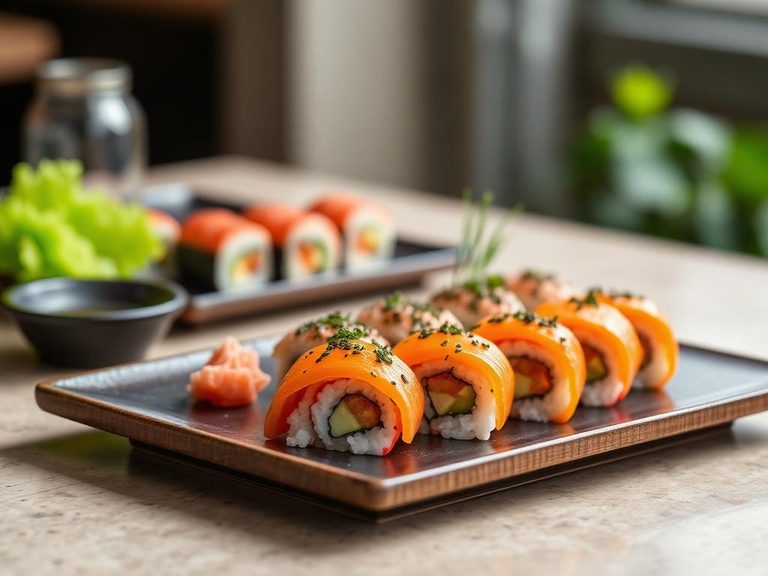
Sushi, topped with salmon
Common food

Photo: Wikipedia
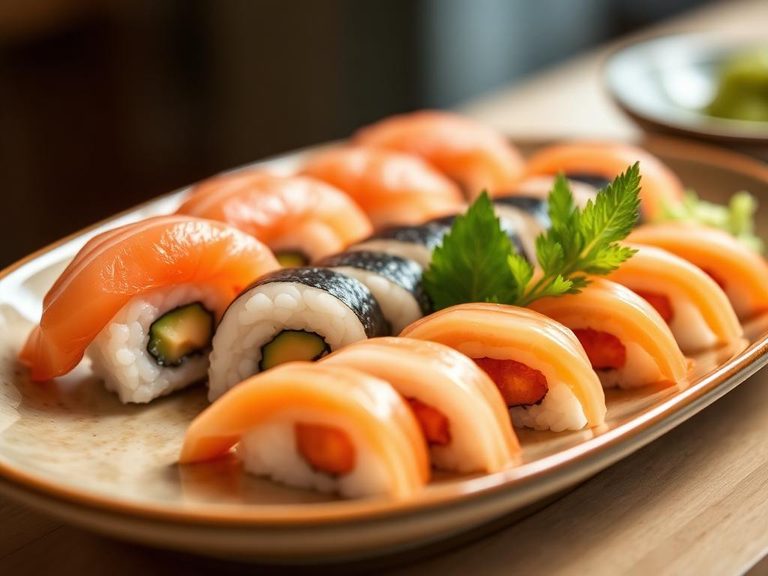
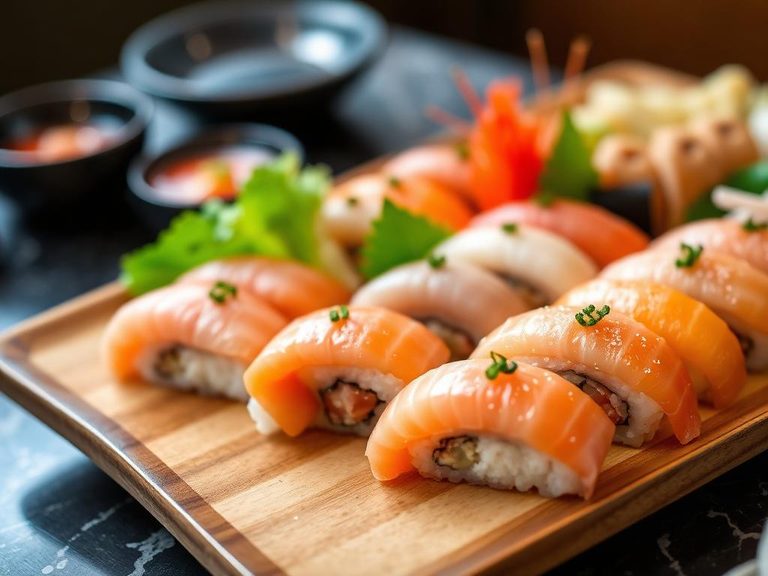
A piece of vinegared rice crowned with a glistening slice of raw salmon, offering a buttery, melt-in-your-mouth texture against the firm, slightly sticky rice. It's a clean, elegant bite where the fish's natural richness is the star, with a nutrition profile that's lean and protein-focused.
Calorie split: 34% protein · 51% carbs · 15% fat
↓ Full nutrition💚 Why it's loved
People love it for the sublime contrast between the cool, silky salmon and the seasoned rice, a simplicity that highlights premium ingredients. It's a versatile staple of Japanese cuisine, enjoyed as a quick snack, part of a meal, or in elaborate presentations.
⚠️ Watch-outs & how to enjoy it better
The raw fish is a common allergen and poses a risk for foodborne illness if not sourced and handled impeccably. The white rice can cause a rapid blood-sugar spike, especially without other components. Counteract this by choosing a brown rice (if available), pairing it with a side of edamame or miso soup for fiber/protein, and practicing strict portion control.
Key benefits
- Excellent source of high-quality protein for muscle maintenance.
- Low in fat, especially saturated fat.
- Provides omega-3 fatty acids from the salmon.
- A good source of B vitamins, particularly B12.
🍽️ Popular dishes
🌍 Where it's eaten
💡 Did you know?
The salmon we commonly eat in sushi today was popularized in Norway in the 1980s through a marketing campaign to sell their farmed salmon to Japan, as salmon was traditionally not eaten raw there due to parasite risks.
Full nutrition (USDA data · scales with serving)
| Water | 74.8 g |
| Energy | 107 kcal |
| Protein | 8.9 g |
| Total lipid (fat) | 1.7 g |
| Carbohydrate, by difference | 13.4 g |
| Fiber, total dietary | 0.60 g |
| Total Sugars | 0.80 g |
| Calcium, Ca | 5.0 mg |
| Iron, Fe | 0.23 mg |
| Magnesium, Mg | 13.0 mg |
| Phosphorus, P | 94.0 mg |
| Potassium, K | 133 mg |
| Sodium, Na | 317 mg |
| Zinc, Zn | 0.40 mg |
| Copper, Cu | 0.05 mg |
| Selenium, Se | 13.7 ug |
| Vitamin C, total ascorbic acid | 0.00 mg |
| Thiamin | 0.06 mg |
| Riboflavin | 0.08 mg |
| Niacin | 3.1 mg |
| Vitamin B-6 | 0.27 mg |
| Folate, total | 3.0 ug |
| Folic acid | 0.00 ug |
| Folate, food | 3.0 ug |
| Folate, DFE | 3.0 ug |
| Choline, total | 34.0 mg |
| Vitamin B-12 | 1.6 ug |
| Vitamin B-12, added | 0.00 ug |
| Vitamin A, RAE | 17.0 ug |
| Retinol | 17.0 ug |
| Carotene, beta | 0.00 ug |
| Carotene, alpha | 0.00 ug |
| Cryptoxanthin, beta | 0.00 ug |
| Lycopene | 0.00 ug |
| Lutein + zeaxanthin | 0.00 ug |
| Vitamin E (alpha-tocopherol) | 0.31 mg |
| Vitamin E, added | 0.00 mg |
| Vitamin D (D2 + D3) | 4.9 ug |
| Vitamin K (phylloquinone) | 0.00 ug |
| Alcohol, ethyl | 0.00 g |
| Caffeine | 0.00 mg |
| Theobromine | 0.00 mg |
Fat & fatty acid profile (per 100g)
| Fatty acids, total saturated | 0.30 g |
| SFA 4:0 | 0.00 g |
| SFA 6:0 | 0.00 g |
| SFA 8:0 | 0.00 g |
| SFA 10:0 | 0.00 g |
| SFA 12:0 | 0.00 g |
| SFA 14:0 | 0.04 g |
| SFA 16:0 | 0.21 g |
| SFA 18:0 | 0.04 g |
| Fatty acids, total monounsaturated | 0.52 g |
| MUFA 16:1 | 0.05 g |
| MUFA 18:1 | 0.29 g |
| MUFA 20:1 | 0.13 g |
| MUFA 22:1 | 0.11 g |
| Fatty acids, total polyunsaturated | 0.43 g |
| PUFA 18:2 | 0.10 g |
| PUFA 18:3 | 0.02 g |
| PUFA 18:4 | 0.02 g |
| PUFA 20:4 | 0.01 g |
| PUFA 20:5 n-3 (EPA) | 0.09 g |
| PUFA 22:5 n-3 (DPA) | 0.03 g |
| PUFA 22:6 n-3 (DHA) | 0.16 g |
| Cholesterol | 18.0 mg |
FAQ
Is salmon sushi safe to eat?
Yes, when prepared in reputable establishments using 'sushi-grade' or 'sashimi-grade' fish, which has been flash-frozen to kill parasites. Always buy from trusted sources.
Why is the rice sometimes warm and the fish cold?
This is a hallmark of Edomae-style sushi. The warm, vinegared rice (shari) slightly warms the fish (neta), enhancing its aroma and texture, while the fish itself remains cool.
How is it different from sashimi?
Sushi always includes vinegared rice. Sashimi is simply sliced raw fish served without rice.
Nutrient density (calculated · NRF9.3)
Nutrient Rich Foods index: beneficial nutrients (protein, fiber, vitamins, minerals) minus saturated fat, added sugar & sodium, per 100 kcal.
NRF9.3 index — Fulgoni, Keast & Drewnowski, 2009. Computed from USDA nutrients.
Weight-loss friendliness (composite index)
Energy density 1.07 kcal/g · 33% calories from protein · 0.6 g fiber · 0.8 g sugar per 100 g.
Composite of energy density (Rolls et al., 1999), protein & fiber satiety, minus sugar. A calculated heuristic — ranks satiety-per-calorie, not a clinical measure.
Dietary load (calculated from USDA values)
Potential renal acid load. Positive = acid-forming, negative = alkaline-forming.
Sodium-to-potassium ratio: 2.38 (lower is better — aim for ≤ 1)
Sodium:potassium per WHO potassium guidance. Computed from USDA nutrients.