

Sushi roll, salmon
Common food

Photo: Wikipedia
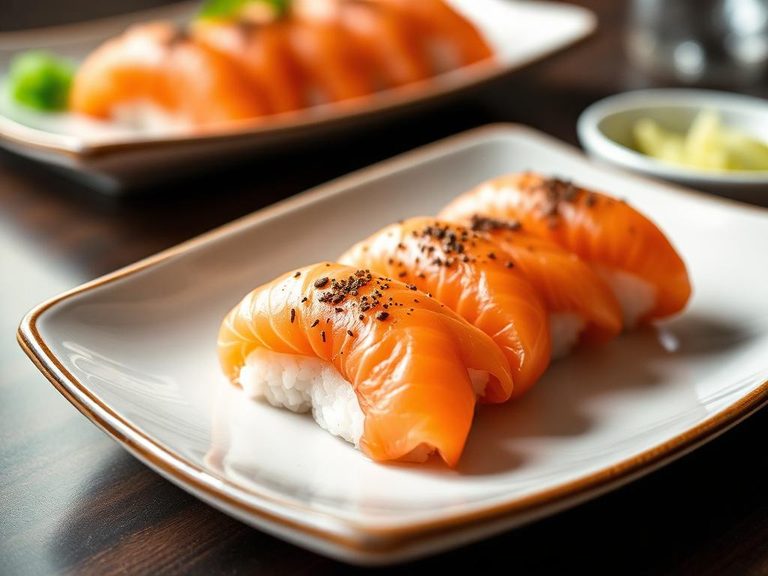
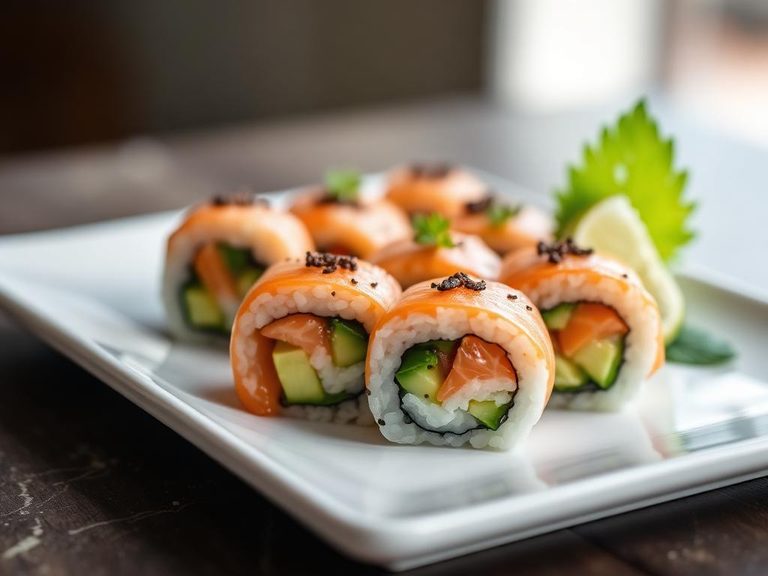
A classic Japanese sushi roll featuring vinegared rice and fresh salmon, often wrapped in seaweed. The texture is a delightful contrast between the soft, slightly sticky rice, the tender, buttery salmon, and the crisp nori. Nutritionally, it's a lean protein source with a moderate carbohydrate content from the rice.
Calorie split: 27% protein · 61% carbs · 11% fat
↓ Full nutrition💚 Why it's loved
People love it for the perfect harmony of savory, umami-rich salmon and the subtle sweetness of the sushi rice, all wrapped in the oceanic flavor of nori. It's a beloved, portable, and customizable meal that bridges traditional Japanese cuisine and global food culture.
⚠️ Watch-outs & how to enjoy it better
The white rice can cause a rapid blood-sugar spike, and the roll may be high in sodium from the rice seasoning and soy sauce. To counteract this, pair it with a side of edamame or miso soup for extra protein and fiber, and use low-sodium soy sauce or dip sparingly.
Key benefits
- Good source of high-quality protein from salmon.
- Contains omega-3 fatty acids from the salmon.
- Provides quick energy from the rice carbohydrates.
- Low in fat compared to many other prepared foods.
🍽️ Popular dishes
🌍 Where it's eaten
💡 Did you know?
The 'salmon' in traditional Edo-period sushi was often cured or cooked, as the practice of eating raw fish (sashimi) on rice became popularized in Tokyo (then Edo) in the early 19th century.
Full nutrition (USDA data · scales with serving)
| Water | 75.3 g |
| Energy | 103 kcal |
| Protein | 6.9 g |
| Total lipid (fat) | 1.3 g |
| Carbohydrate, by difference | 15.3 g |
| Fiber, total dietary | 0.70 g |
| Total Sugars | 0.92 g |
| Calcium, Ca | 5.0 mg |
| Iron, Fe | 0.22 mg |
| Magnesium, Mg | 11.0 mg |
| Phosphorus, P | 69.0 mg |
| Potassium, K | 101 mg |
| Sodium, Na | 350 mg |
| Zinc, Zn | 0.40 mg |
| Copper, Cu | 0.05 mg |
| Selenium, Se | 11.1 ug |
| Vitamin C, total ascorbic acid | 0.50 mg |
| Thiamin | 0.05 mg |
| Riboflavin | 0.07 mg |
| Niacin | 2.3 mg |
| Vitamin B-6 | 0.20 mg |
| Folate, total | 4.0 ug |
| Folic acid | 0.00 ug |
| Folate, food | 4.0 ug |
| Folate, DFE | 4.0 ug |
| Choline, total | 24.6 mg |
| Vitamin B-12 | 1.1 ug |
| Vitamin B-12, added | 0.00 ug |
| Vitamin A, RAE | 15.0 ug |
| Retinol | 12.0 ug |
| Carotene, beta | 38.0 ug |
| Carotene, alpha | 0.00 ug |
| Cryptoxanthin, beta | 0.00 ug |
| Lycopene | 0.00 ug |
| Lutein + zeaxanthin | 0.00 ug |
| Vitamin E (alpha-tocopherol) | 0.24 mg |
| Vitamin E, added | 0.00 mg |
| Vitamin D (D2 + D3) | 3.4 ug |
| Vitamin K (phylloquinone) | 0.10 ug |
| Alcohol, ethyl | 0.00 g |
| Caffeine | 0.00 mg |
| Theobromine | 0.00 mg |
Fat & fatty acid profile (per 100g)
| Fatty acids, total saturated | 0.23 g |
| SFA 4:0 | 0.00 g |
| SFA 6:0 | 0.00 g |
| SFA 8:0 | 0.00 g |
| SFA 10:0 | 0.00 g |
| SFA 12:0 | 0.00 g |
| SFA 14:0 | 0.03 g |
| SFA 16:0 | 0.16 g |
| SFA 18:0 | 0.03 g |
| Fatty acids, total monounsaturated | 0.38 g |
| MUFA 16:1 | 0.03 g |
| MUFA 18:1 | 0.22 g |
| MUFA 20:1 | 0.09 g |
| MUFA 22:1 | 0.08 g |
| Fatty acids, total polyunsaturated | 0.32 g |
| PUFA 18:2 | 0.08 g |
| PUFA 18:3 | 0.01 g |
| PUFA 18:4 | 0.01 g |
| PUFA 20:4 | 0.00 g |
| PUFA 20:5 n-3 (EPA) | 0.06 g |
| PUFA 22:5 n-3 (DPA) | 0.02 g |
| PUFA 22:6 n-3 (DHA) | 0.12 g |
| Cholesterol | 12.0 mg |
FAQ
Is a salmon sushi roll a complete protein?
Yes, the combination of salmon (animal protein) and rice provides all the essential amino acids, making it a complete protein source.
Why is the rice in sushi sticky?
Sushi rice is made with short-grain varieties that have a higher amylopectin starch content. When cooked and seasoned with vinegar, sugar, and salt, it becomes sticky enough to hold its shape.
Can I make a salmon sushi roll at home without a bamboo mat?
Yes, you can use a clean kitchen towel or plastic wrap to help roll and shape the sushi tightly. The key is to apply even, gentle pressure.
Nutrient density (calculated · NRF9.3)
Nutrient Rich Foods index: beneficial nutrients (protein, fiber, vitamins, minerals) minus saturated fat, added sugar & sodium, per 100 kcal.
NRF9.3 index — Fulgoni, Keast & Drewnowski, 2009. Computed from USDA nutrients.
Weight-loss friendliness (composite index)
Energy density 1.03 kcal/g · 27% calories from protein · 0.7 g fiber · 0.9 g sugar per 100 g.
Composite of energy density (Rolls et al., 1999), protein & fiber satiety, minus sugar. A calculated heuristic — ranks satiety-per-calorie, not a clinical measure.
Dietary load (calculated from USDA values)
Potential renal acid load. Positive = acid-forming, negative = alkaline-forming.
Sodium-to-potassium ratio: 3.47 (lower is better — aim for ≤ 1)
Sodium:potassium per WHO potassium guidance. Computed from USDA nutrients.