

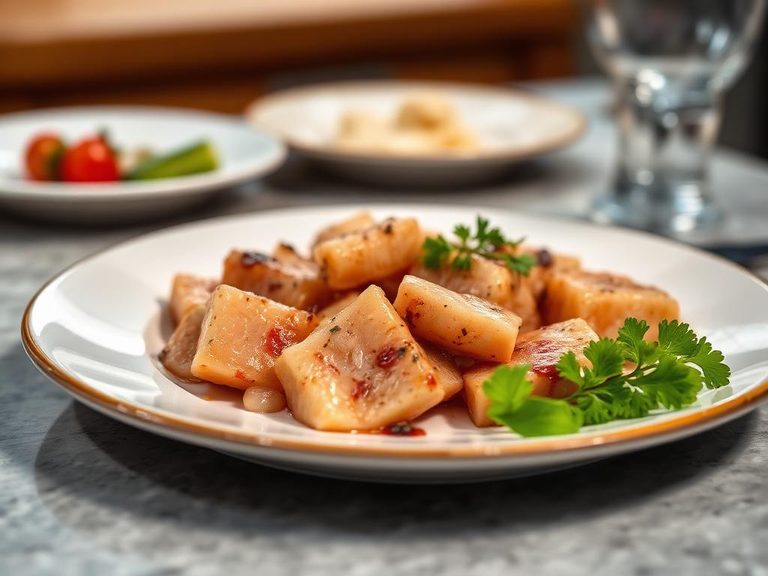
Stuffed cabbage, with meat and rice, Syrian dish, Puerto Rican style
Common food

Photo: Wikipedia
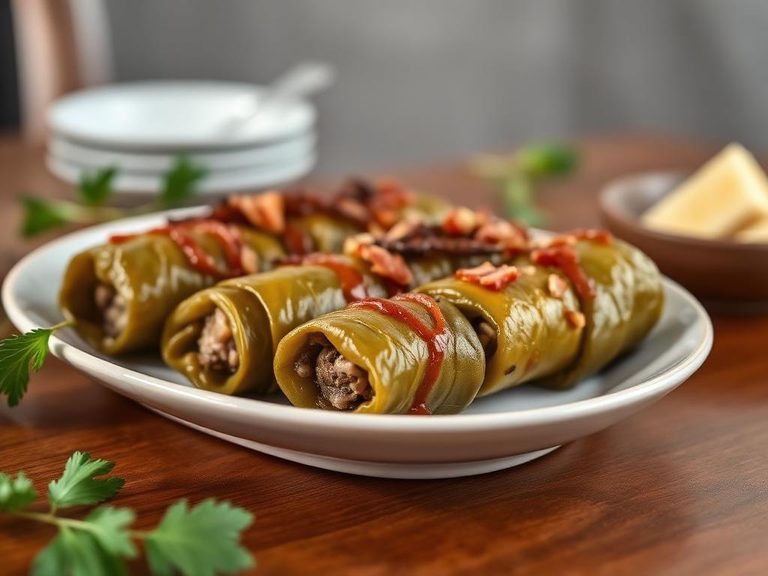
This is a savory, handcrafted roll of tender cabbage leaves wrapped around a hearty filling of seasoned ground meat and rice, simmered in a tangy tomato-based sauce. The texture is soft and yielding, with the cabbage becoming melt-in-your-mouth tender while the rice and meat provide a satisfying, cohesive bite. Nutritionally, it's a low-calorie, high-fiber dish that delivers a balanced mix of protein and complex carbohydrates.
Calorie split: 15% protein · 53% carbs · 32% fat
↓ Full nutrition💚 Why it's loved
People love it for the harmonious blend of sweet, savory, and tangy flavors, where the cabbage becomes a delicate wrapper for the rich filling. It's also cherished as a versatile comfort food that can be made ahead and often tastes even better the next day, embodying home-cooked warmth across many cultures.
⚠️ Watch-outs & how to enjoy it better
The dish can be high in sodium depending on the broth and seasoning used, which is a consideration for those monitoring salt intake. To counteract this, use low-sodium broth and season with herbs, lemon juice, or vinegar instead of extra salt. The cabbage, while healthy, can cause gas in some individuals; cooking it thoroughly and starting with smaller portions can help.
Key benefits
- Low in calories per serving
- Good source of dietary fiber from cabbage
- Provides complete protein from meat and rice
- Rich in vitamins C and K from cabbage
- Naturally gluten-free if using gluten-free broth
🍽️ Popular dishes
🌍 Where it's eaten
💡 Did you know?
The technique of wrapping meat in leaves is ancient and global, with archaeological evidence suggesting similar dishes existed in the Roman Empire, long before the tomato-based sauces we associate with them today became common.
Full nutrition (USDA data · scales with serving)
| Water | 81.9 g |
| Energy | 84.0 kcal |
| Protein | 3.1 g |
| Total lipid (fat) | 3.0 g |
| Carbohydrate, by difference | 11.1 g |
| Fiber, total dietary | 1.8 g |
| Total Sugars | 2.3 g |
| Calcium, Ca | 31.0 mg |
| Iron, Fe | 0.69 mg |
| Magnesium, Mg | 14.0 mg |
| Phosphorus, P | 44.0 mg |
| Potassium, K | 183 mg |
| Sodium, Na | 147 mg |
| Zinc, Zn | 0.68 mg |
| Copper, Cu | 0.04 mg |
| Selenium, Se | 3.1 ug |
| Vitamin C, total ascorbic acid | 20.6 mg |
| Thiamin | 0.07 mg |
| Riboflavin | 0.05 mg |
| Niacin | 0.98 mg |
| Vitamin B-6 | 0.12 mg |
| Folate, total | 32.0 ug |
| Folic acid | 13.0 ug |
| Folate, food | 20.0 ug |
| Folate, DFE | 41.0 ug |
| Choline, total | 13.4 mg |
| Vitamin B-12 | 0.16 ug |
| Vitamin B-12, added | 0.00 ug |
| Vitamin A, RAE | 5.0 ug |
| Retinol | 0.00 ug |
| Carotene, beta | 48.0 ug |
| Carotene, alpha | 18.0 ug |
| Cryptoxanthin, beta | 0.00 ug |
| Lycopene | 1320 ug |
| Lutein + zeaxanthin | 18.0 ug |
| Vitamin E (alpha-tocopherol) | 0.52 mg |
| Vitamin E, added | 0.00 mg |
| Vitamin D (D2 + D3) | 0.00 ug |
| Vitamin K (phylloquinone) | 35.9 ug |
| Alcohol, ethyl | 0.00 g |
| Caffeine | 0.00 mg |
| Theobromine | 0.00 mg |
Fat & fatty acid profile (per 100g)
| Fatty acids, total saturated | 0.80 g |
| SFA 4:0 | 0.00 g |
| SFA 6:0 | 0.00 g |
| SFA 8:0 | 0.00 g |
| SFA 10:0 | 0.00 g |
| SFA 12:0 | 0.00 g |
| SFA 14:0 | 0.04 g |
| SFA 16:0 | 0.51 g |
| SFA 18:0 | 0.22 g |
| Fatty acids, total monounsaturated | 1.5 g |
| MUFA 16:1 | 0.07 g |
| MUFA 18:1 | 1.4 g |
| MUFA 20:1 | 0.01 g |
| MUFA 22:1 | 0.00 g |
| Fatty acids, total polyunsaturated | 0.20 g |
| PUFA 18:2 | 0.18 g |
| PUFA 18:3 | 0.02 g |
| PUFA 18:4 | 0.00 g |
| PUFA 20:4 | 0.00 g |
| PUFA 20:5 n-3 (EPA) | 0.00 g |
| PUFA 22:5 n-3 (DPA) | 0.00 g |
| PUFA 22:6 n-3 (DHA) | 0.00 g |
| Cholesterol | 7.0 mg |
FAQ
Can I make this dish vegetarian?
Yes, you can replace the meat with a mixture of cooked lentils, mushrooms, or plant-based ground meat, and use vegetable broth. The texture and flavor will be different but still delicious.
Why do my cabbage rolls fall apart when cooking?
The cabbage leaves need to be pliable. Blanching the whole head in boiling water for a few minutes before separating the leaves makes them flexible. Also, don't overfill the rolls and tuck the ends in securely.
Is this dish gluten-free?
It can be. Ensure your broth and any added seasonings are gluten-free. The core ingredients (cabbage, meat, rice) are naturally gluten-free.
Nutrient density (calculated · NRF9.3)
Nutrient Rich Foods index: beneficial nutrients (protein, fiber, vitamins, minerals) minus saturated fat, added sugar & sodium, per 100 kcal.
NRF9.3 index — Fulgoni, Keast & Drewnowski, 2009. Computed from USDA nutrients.
Weight-loss friendliness (composite index)
Energy density 0.84 kcal/g · 15% calories from protein · 1.8 g fiber · 2.3 g sugar per 100 g.
Composite of energy density (Rolls et al., 1999), protein & fiber satiety, minus sugar. A calculated heuristic — ranks satiety-per-calorie, not a clinical measure.
Dietary load (calculated from USDA values)
Potential renal acid load. Positive = acid-forming, negative = alkaline-forming.
Sodium-to-potassium ratio: 0.80 (lower is better — aim for ≤ 1)
Sodium:potassium per WHO potassium guidance. Computed from USDA nutrients.