

Spinach and cheese casserole
Common food

Photo: Wikipedia
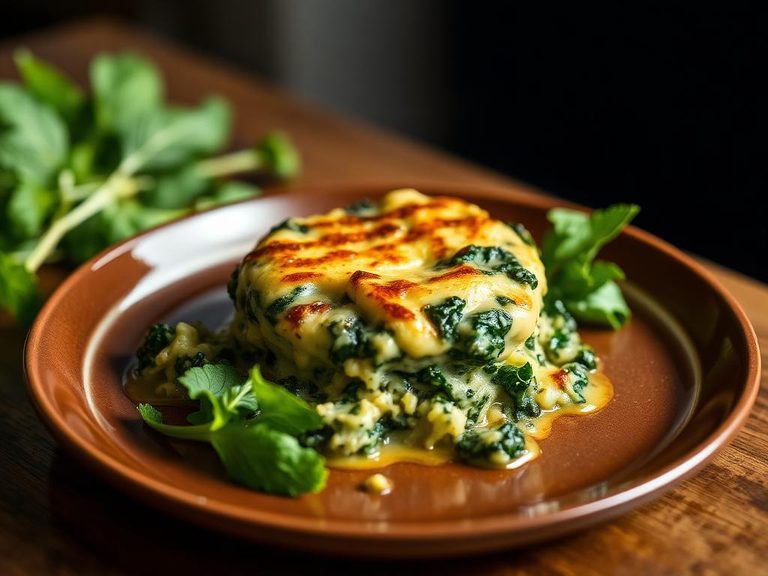
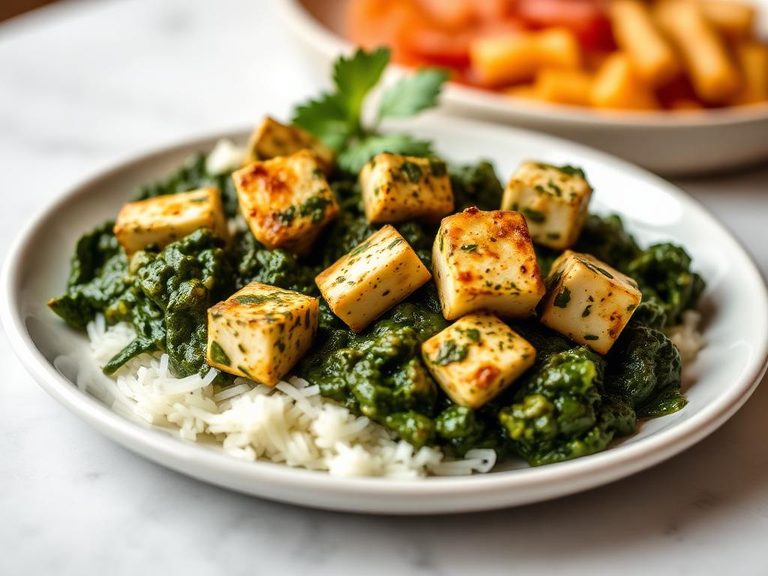
A baked casserole where tender spinach is bound in a creamy, savory matrix of melted cheese, often with a light egg custard. The texture is a delightful contrast of soft, leafy greens against a rich, gooey, and sometimes slightly crisp top. It's a nutrient-dense dish, packing over 7g of protein and a good dose of fiber per 100g while remaining relatively low in calories.
Calorie split: 21% protein · 29% carbs · 50% fat
↓ Full nutrition💚 Why it's loved
People adore it for its comforting, savory flavor profile and the satisfying combination of creamy cheese with earthy spinach. It's a versatile dish that works as a hearty side, a light main, or a potluck favorite, embodying home-style comfort in many cultures.
⚠️ Watch-outs & how to enjoy it better
The dish can be high in sodium from cheese and added salt, and the oxalates in spinach may affect mineral absorption for some. To mitigate, use lower-sodium cheese, season with herbs and garlic instead of excess salt, and pair with a vitamin C-rich side (like tomatoes) to enhance iron absorption. Those watching saturated fat should opt for part-skim cheeses.
Key benefits
- High in protein for a vegetarian dish
- Good source of dietary fiber
- Rich in vitamins A and K from spinach
- Provides calcium from cheese
- Low in sugar
🍽️ Popular dishes
🌍 Where it's eaten
💡 Did you know?
The classic French dish 'Spinach Gratin' was popularized in the 1900s by chef Auguste Escoffier, who helped standardize many modern culinary techniques.
Full nutrition (USDA data · scales with serving)
| Water | 73.5 g |
| Energy | 130 kcal |
| Protein | 7.0 g |
| Total lipid (fat) | 7.6 g |
| Carbohydrate, by difference | 9.9 g |
| Fiber, total dietary | 2.8 g |
| Total Sugars | 1.0 g |
| Calcium, Ca | 235 mg |
| Iron, Fe | 1.7 mg |
| Magnesium, Mg | 62.0 mg |
| Phosphorus, P | 127 mg |
| Potassium, K | 247 mg |
| Sodium, Na | 311 mg |
| Zinc, Zn | 0.90 mg |
| Copper, Cu | 0.13 mg |
| Selenium, Se | 8.6 ug |
| Vitamin C, total ascorbic acid | 1.1 mg |
| Thiamin | 0.13 mg |
| Riboflavin | 0.21 mg |
| Niacin | 0.82 mg |
| Vitamin B-6 | 0.11 mg |
| Folate, total | 71.0 ug |
| Folic acid | 7.0 ug |
| Folate, food | 64.0 ug |
| Folate, DFE | 75.0 ug |
| Choline, total | 20.2 mg |
| Vitamin B-12 | 0.18 ug |
| Vitamin B-12, added | 0.00 ug |
| Vitamin A, RAE | 427 ug |
| Retinol | 51.0 ug |
| Carotene, beta | 4516 ug |
| Carotene, alpha | 0.00 ug |
| Cryptoxanthin, beta | 1.0 ug |
| Lycopene | 0.00 ug |
| Lutein + zeaxanthin | 9766 ug |
| Vitamin E (alpha-tocopherol) | 2.4 mg |
| Vitamin E, added | 0.00 mg |
| Vitamin D (D2 + D3) | 0.40 ug |
| Vitamin K (phylloquinone) | 355 ug |
| Alcohol, ethyl | 0.00 g |
| Caffeine | 0.00 mg |
| Theobromine | 0.00 mg |
Fat & fatty acid profile (per 100g)
| Fatty acids, total saturated | 3.9 g |
| SFA 4:0 | 0.15 g |
| SFA 6:0 | 0.10 g |
| SFA 8:0 | 0.06 g |
| SFA 10:0 | 0.14 g |
| SFA 12:0 | 0.15 g |
| SFA 14:0 | 0.58 g |
| SFA 16:0 | 1.9 g |
| SFA 18:0 | 0.72 g |
| Fatty acids, total monounsaturated | 1.8 g |
| MUFA 16:1 | 0.12 g |
| MUFA 18:1 | 1.7 g |
| MUFA 20:1 | 0.01 g |
| MUFA 22:1 | 0.00 g |
| Fatty acids, total polyunsaturated | 0.78 g |
| PUFA 18:2 | 0.48 g |
| PUFA 18:3 | 0.30 g |
| PUFA 18:4 | 0.00 g |
| PUFA 20:4 | 0.01 g |
| PUFA 20:5 n-3 (EPA) | 0.00 g |
| PUFA 22:5 n-3 (DPA) | 0.00 g |
| PUFA 22:6 n-3 (DHA) | 0.00 g |
| Cholesterol | 19.0 mg |
FAQ
Can I make this ahead of time?
Yes. Assemble the casserole, cover, and refrigerate for up to 24 hours before baking. You may need to add 5-10 minutes to the baking time if it's cold.
How do I prevent it from being watery?
Thaw frozen spinach completely and squeeze out all excess moisture. For fresh spinach, wilt it first in a pan and then squeeze thoroughly in a clean kitchen towel.
What can I use instead of cheese?
For a dairy-free version, use nutritional yeast for a cheesy flavor and a creamy base made from blended silken tofu or cashews. For lower fat, use a mix of cottage cheese and a small amount of strong-flavored cheese.
Nutrient density (calculated · NRF9.3)
Nutrient Rich Foods index: beneficial nutrients (protein, fiber, vitamins, minerals) minus saturated fat, added sugar & sodium, per 100 kcal.
NRF9.3 index — Fulgoni, Keast & Drewnowski, 2009. Computed from USDA nutrients.
Weight-loss friendliness (composite index)
Energy density 1.30 kcal/g · 22% calories from protein · 2.8 g fiber · 1.0 g sugar per 100 g.
Composite of energy density (Rolls et al., 1999), protein & fiber satiety, minus sugar. A calculated heuristic — ranks satiety-per-calorie, not a clinical measure.
Dietary load (calculated from USDA values)
Potential renal acid load. Positive = acid-forming, negative = alkaline-forming.
Sodium-to-potassium ratio: 1.26 (lower is better — aim for ≤ 1)
Sodium:potassium per WHO potassium guidance. Computed from USDA nutrients.