

Snowpeas, fresh, cooked, fat added
Common food

Photo: Wikipedia
Snow peas are crisp, edible-podded peas harvested before the peas inside fully develop. When cooked with a touch of fat, they develop a glossy sheen and a tender-crisp texture that balances a fresh, grassy sweetness with a subtle savory depth. Nutritionally, they are a low-calorie source of fiber and plant-based protein, making them a light yet satisfying addition to meals.
Calorie split: 17% protein · 45% carbs · 38% fat
↓ Full nutrition💚 Why it's loved
People love snow peas for their satisfying crunch and sweet, clean flavor that brightens any dish. Their versatility shines in quick stir-fries, salads, and as a crunchy dipper, making them a staple in both home kitchens and professional restaurants.
⚠️ Watch-outs & how to enjoy it better
Some may find the fibrous pod slightly tough if overcooked, leading to a chewy texture. Those monitoring blood sugar should be mindful of the natural sugars, though the fiber content helps moderate the impact. To counteract, cook only until tender-crisp and pair with protein or healthy fats to create a more balanced meal.
Key benefits
- Low in calories, high in volume for weight management
- Good source of dietary fiber for digestive health
- Provides plant-based protein and essential vitamins
- Contains antioxidants like vitamin C and beta-carotene
- Versatile for adding texture and nutrients to dishes
🍽️ Popular dishes


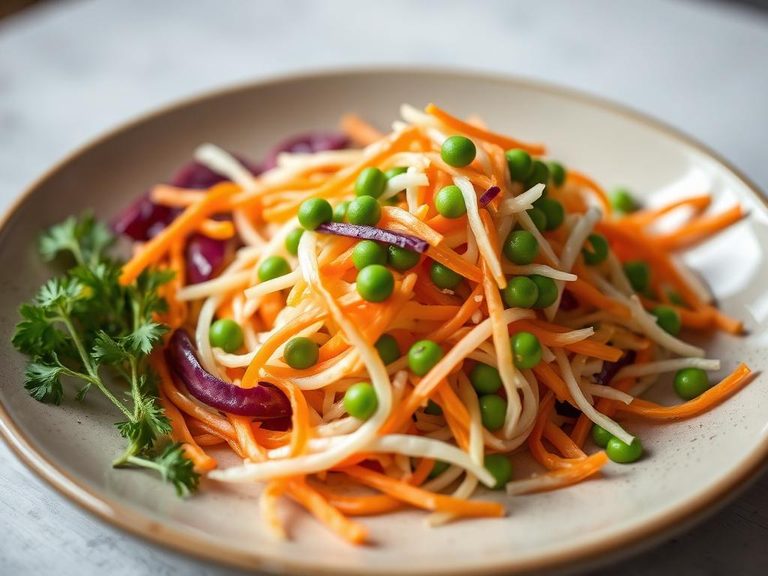
🌍 Where it's eaten
💡 Did you know?
Unlike garden peas, the entire pod of a snow pea is edible because it lacks the tough, fibrous inner membrane that develops as peas mature.
Full nutrition (USDA data · scales with serving)
| Water | 85.8 g |
| Energy | 66.0 kcal |
| Protein | 2.8 g |
| Total lipid (fat) | 2.9 g |
| Carbohydrate, by difference | 7.6 g |
| Fiber, total dietary | 2.6 g |
| Total Sugars | 4.0 g |
| Calcium, Ca | 44.0 mg |
| Iron, Fe | 2.1 mg |
| Magnesium, Mg | 24.0 mg |
| Phosphorus, P | 54.0 mg |
| Potassium, K | 202 mg |
| Sodium, Na | 130 mg |
| Zinc, Zn | 0.27 mg |
| Copper, Cu | 0.08 mg |
| Selenium, Se | 0.70 ug |
| Vitamin C, total ascorbic acid | 51.4 mg |
| Thiamin | 0.14 mg |
| Riboflavin | 0.08 mg |
| Niacin | 0.57 mg |
| Vitamin B-6 | 0.16 mg |
| Folate, total | 36.0 ug |
| Folic acid | 0.00 ug |
| Folate, food | 36.0 ug |
| Folate, DFE | 36.0 ug |
| Choline, total | 17.8 mg |
| Vitamin B-12 | 0.00 ug |
| Vitamin B-12, added | 0.00 ug |
| Vitamin A, RAE | 64.0 ug |
| Retinol | 11.0 ug |
| Carotene, beta | 609 ug |
| Carotene, alpha | 42.0 ug |
| Cryptoxanthin, beta | 0.00 ug |
| Lycopene | 0.00 ug |
| Lutein + zeaxanthin | 709 ug |
| Vitamin E (alpha-tocopherol) | 0.79 mg |
| Vitamin E, added | 0.00 mg |
| Vitamin D (D2 + D3) | 0.00 ug |
| Vitamin K (phylloquinone) | 27.4 ug |
| Alcohol, ethyl | 0.00 g |
| Caffeine | 0.00 mg |
| Theobromine | 0.00 mg |
Fat & fatty acid profile (per 100g)
| Fatty acids, total saturated | 0.73 g |
| SFA 4:0 | 0.02 g |
| SFA 6:0 | 0.01 g |
| SFA 8:0 | 0.01 g |
| SFA 10:0 | 0.02 g |
| SFA 12:0 | 0.02 g |
| SFA 14:0 | 0.07 g |
| SFA 16:0 | 0.41 g |
| SFA 18:0 | 0.14 g |
| Fatty acids, total monounsaturated | 0.96 g |
| MUFA 16:1 | 0.01 g |
| MUFA 18:1 | 0.93 g |
| MUFA 20:1 | 0.01 g |
| MUFA 22:1 | 0.00 g |
| Fatty acids, total polyunsaturated | 0.85 g |
| PUFA 18:2 | 0.75 g |
| PUFA 18:3 | 0.10 g |
| PUFA 18:4 | 0.00 g |
| PUFA 20:4 | 0.00 g |
| PUFA 20:5 n-3 (EPA) | 0.00 g |
| PUFA 22:5 n-3 (DPA) | 0.00 g |
| PUFA 22:6 n-3 (DHA) | 0.00 g |
| Cholesterol | 2.0 mg |
FAQ
What's the difference between snow peas and snap peas?
Snow peas have flat, thin pods with very undeveloped peas inside, while snap peas have plumper, rounded pods with more mature, sweet peas. Snow peas are prized for their crisp pod, snap peas for their juicy sweetness.
How do I keep snow peas crisp when cooking?
Use high heat for a very short time (1-2 minutes). You can also blanch them in boiling water for 30 seconds, then immediately plunge into ice water to stop the cooking and lock in color and crunch.
Are snow peas good for you raw?
Yes, they are delicious raw, retaining their maximum crunch and vitamin C content. They make a great snack with hummus or a fresh addition to salads.
Nutrient density (calculated · NRF9.3)
Nutrient Rich Foods index: beneficial nutrients (protein, fiber, vitamins, minerals) minus saturated fat, added sugar & sodium, per 100 kcal.
NRF9.3 index — Fulgoni, Keast & Drewnowski, 2009. Computed from USDA nutrients.
Weight-loss friendliness (composite index)
Energy density 0.66 kcal/g · 17% calories from protein · 2.6 g fiber · 4.0 g sugar per 100 g.
Composite of energy density (Rolls et al., 1999), protein & fiber satiety, minus sugar. A calculated heuristic — ranks satiety-per-calorie, not a clinical measure.
Dietary load (calculated from USDA values)
Potential renal acid load. Positive = acid-forming, negative = alkaline-forming.
Sodium-to-potassium ratio: 0.64 (lower is better — aim for ≤ 1)
Sodium:potassium per WHO potassium guidance. Computed from USDA nutrients.