

School Lunch, pizza, pepperoni topping, thin crust, whole grain, frozen, cooked
Whole food · Fast Foods
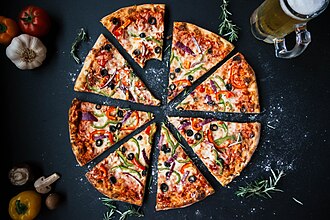
Photo: Wikipedia
This is a classic, crispy thin-crust pepperoni pizza made with a whole-grain base, designed for quick school lunches. The crust offers a satisfying snap and a nutty, wheat-forward flavor, while the melted cheese and savory, slightly spicy pepperoni provide a familiar, comforting taste. Nutritionally, it's a solid source of protein and fiber for a pre-made meal, helping to keep energy levels steady.
Calorie split: 20% protein · 49% carbs · 31% fat
↓ Full nutrition💚 Why it's loved
People love it for the perfect, nostalgic combination of crispy crust, gooey cheese, and salty, spicy pepperoni. It's a versatile canvas that feels like a treat while still being a complete, satisfying meal.
⚠️ Watch-outs & how to enjoy it better
The combination of refined carbs and fat can lead to a blood-sugar spike followed by a crash, and it can be high in sodium. To counteract this, pair it with a side salad or raw veggies to add volume and fiber, and be mindful of portion size—stick to one or two slices. Also, check labels for common allergens like wheat, milk, and soy.
Key benefits
- Provides a good balance of protein (12.78g) and fiber (4.3g) per serving.
- Whole-grain crust offers more nutrients and sustained energy than refined white flour.
- Convenient, quick-to-prepare option for busy school schedules.
- Offers a familiar, kid-friendly flavor that encourages eating a balanced meal.
🍽️ Popular dishes
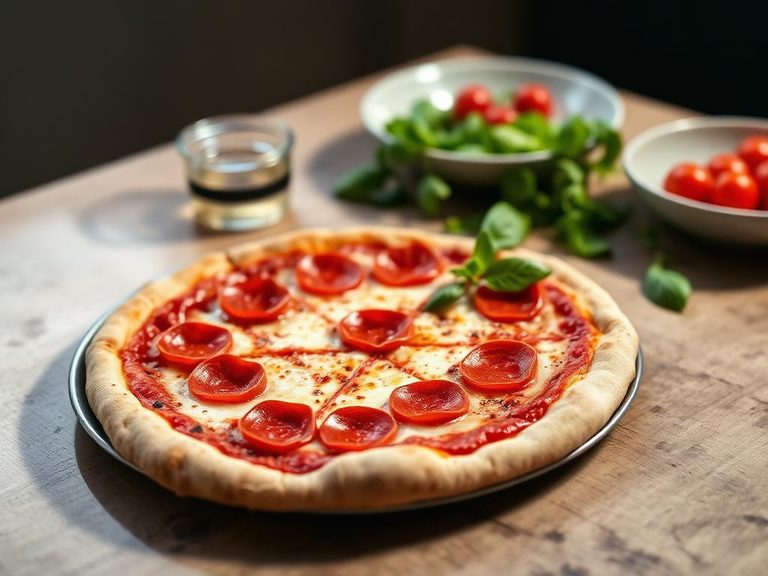



🌍 Where it's eaten
💡 Did you know?
The pepperoni topping as we know it is a purely American invention, created by Italian immigrants in the early 20th century and first appearing on pizza in New York City around 1919.
Full nutrition (USDA data · scales with serving)
| Water | 44.9 g |
| Energy | 254 kcal |
| Energy | 1061 kj |
| Protein | 12.8 g |
| Total lipid (fat) | 8.6 g |
| Ash | 2.5 g |
| Carbohydrate, by difference | 31.2 g |
| Fiber, total dietary | 4.3 g |
| Total Sugars | 7.6 g |
| Calcium, Ca | 202 mg |
| Iron, Fe | 2.7 mg |
| Magnesium, Mg | 51.0 mg |
| Phosphorus, P | 316 mg |
| Potassium, K | 382 mg |
| Sodium, Na | 495 mg |
| Zinc, Zn | 2.5 mg |
| Copper, Cu | 0.10 mg |
| Manganese, Mn | 0.34 mg |
| Selenium, Se | 23.4 ug |
| Vitamin C, total ascorbic acid | 0.00 mg |
| Thiamin | 0.35 mg |
| Riboflavin | 0.34 mg |
| Niacin | 3.7 mg |
| Vitamin B-6 | 0.19 mg |
| Folate, total | 55.0 ug |
| Folic acid | 36.0 ug |
| Folate, food | 19.0 ug |
| Folate, DFE | 80.0 ug |
| Choline, total | 37.7 mg |
| Vitamin B-12 | 2.2 ug |
| Vitamin B-12, added | 0.00 ug |
| Vitamin A, RAE | 75.0 ug |
| Retinol | 67.0 ug |
| Carotene, beta | 106 ug |
| Carotene, alpha | 0.00 ug |
| Cryptoxanthin, beta | 0.00 ug |
| Vitamin A, IU | 399 iu |
| Lycopene | 1964 ug |
| Lutein + zeaxanthin | 24.0 ug |
| Vitamin E (alpha-tocopherol) | 0.80 mg |
| Vitamin E, added | 0.00 mg |
| Vitamin D (D2 + D3), International Units | 0.00 iu |
| Vitamin D (D2 + D3) | 0.00 ug |
| Vitamin K (phylloquinone) | 5.2 ug |
| Alcohol, ethyl | 0.00 g |
| Caffeine | 0.00 mg |
| Theobromine | 0.00 mg |
Fat & fatty acid profile (per 100g)
| Fatty acids, total saturated | 2.8 g |
| SFA 4:0 | 0.09 g |
| SFA 6:0 | 0.07 g |
| SFA 8:0 | 0.05 g |
| SFA 10:0 | 0.11 g |
| SFA 12:0 | 0.13 g |
| SFA 14:0 | 0.42 g |
| SFA 16:0 | 1.3 g |
| SFA 18:0 | 0.52 g |
| Fatty acids, total monounsaturated | 2.1 g |
| MUFA 16:1 | 0.12 g |
| MUFA 18:1 | 1.9 g |
| MUFA 20:1 | 0.02 g |
| MUFA 22:1 | 0.00 g |
| Fatty acids, total polyunsaturated | 2.2 g |
| PUFA 18:2 | 2.0 g |
| PUFA 18:3 | 0.19 g |
| PUFA 18:4 | 0.00 g |
| PUFA 20:3 | 0.02 g |
| PUFA 20:4 | 0.03 g |
| PUFA 20:5 n-3 (EPA) | 0.01 g |
| PUFA 22:5 n-3 (DPA) | 0.01 g |
| PUFA 22:6 n-3 (DHA) | 0.00 g |
| Fatty acids, total trans | 0.26 g |
| Cholesterol | 24.0 mg |
FAQ
Is this a healthy lunch option?
It can be part of a balanced diet. The whole-grain crust and protein are positives, but it's important to watch portion size and pair it with vegetables to increase fiber and nutrient density, balancing the sodium and fat content.
How does the whole-grain crust differ from regular?
Whole-grain crust uses flour from the entire wheat kernel, providing more fiber, vitamins, and minerals than refined white flour. This can help with digestion and provide a slower release of energy.
Why is it often high in sodium?
Sodium is a preservative and flavor enhancer found in cured meats like pepperoni, cheese, and the pizza sauce. Looking for lower-sodium versions or balancing it with low-sodium sides can help manage intake.
Nutrient density (calculated · NRF9.3)
Nutrient Rich Foods index: beneficial nutrients (protein, fiber, vitamins, minerals) minus saturated fat, added sugar & sodium, per 100 kcal.
NRF9.3 index — Fulgoni, Keast & Drewnowski, 2009. Computed from USDA nutrients.
Weight-loss friendliness (composite index)
Energy density 2.54 kcal/g · 20% calories from protein · 4.3 g fiber · 7.6 g sugar per 100 g.
Composite of energy density (Rolls et al., 1999), protein & fiber satiety, minus sugar. A calculated heuristic — ranks satiety-per-calorie, not a clinical measure.
Dietary load (calculated from USDA values)
Potential renal acid load. Positive = acid-forming, negative = alkaline-forming.
Sodium-to-potassium ratio: 1.30 (lower is better — aim for ≤ 1)
Sodium:potassium per WHO potassium guidance. Computed from USDA nutrients.