

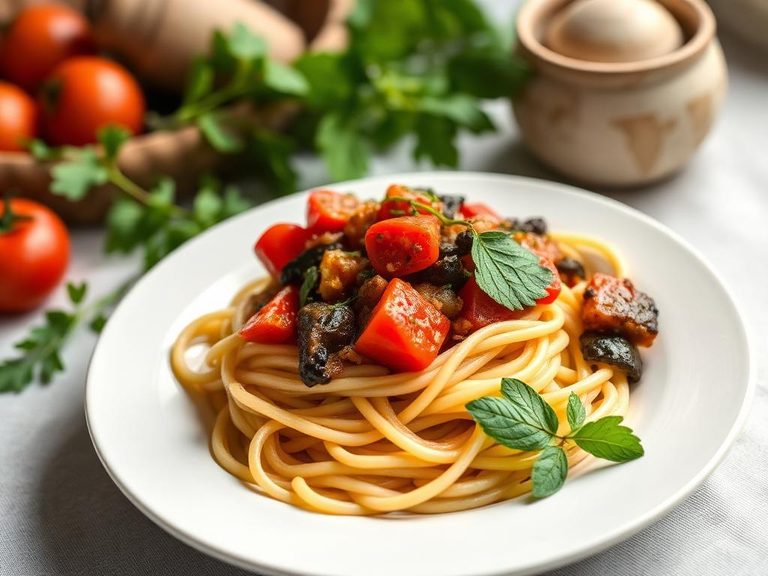
Pasta with tomato-based sauce, and added vegetables, home recipe
Common food

Photo: Wikipedia
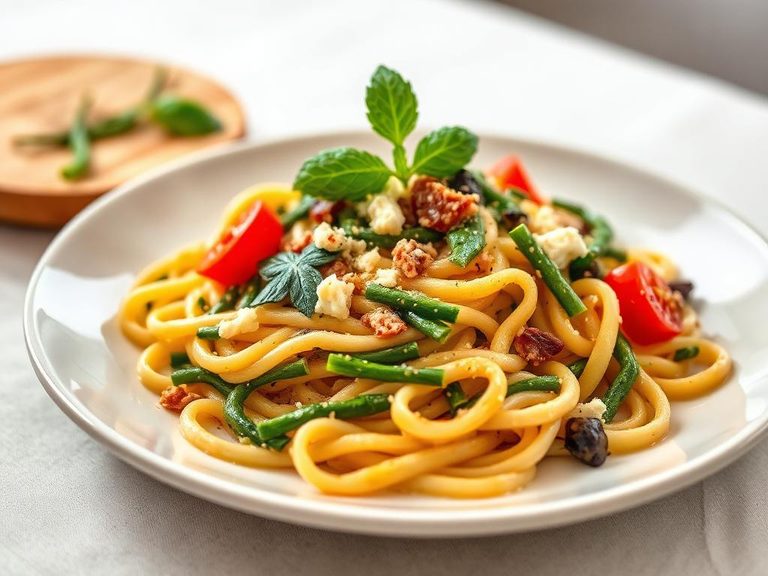
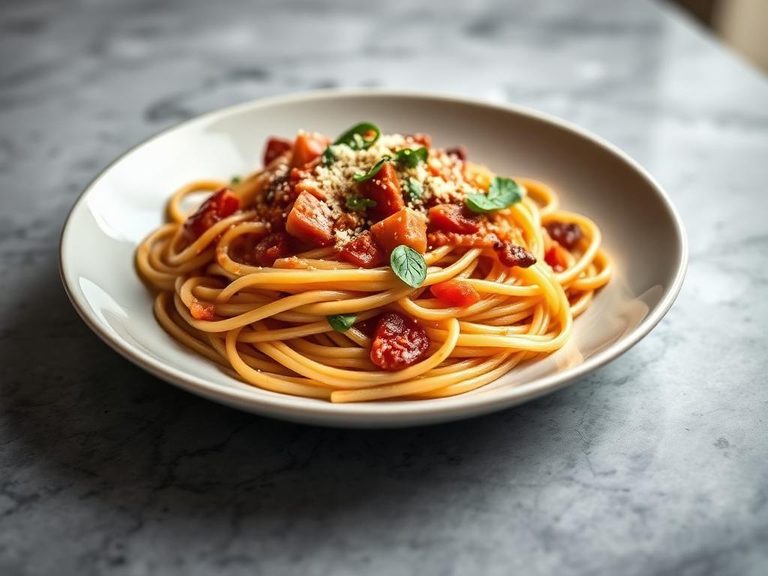
This is a vibrant, home-cooked pasta dish where al dente noodles are coated in a rich, simmered tomato sauce, studded with tender vegetables like bell peppers, onions, and zucchini. The taste is a savory, slightly sweet umami from the tomatoes, balanced by the earthy vegetables and a hint of garlic or herbs. Nutritionally, it's a low-fat, high-fiber meal that provides sustained energy from complex carbohydrates.
Calorie split: 15% protein · 76% carbs · 9% fat
↓ Full nutrition💚 Why it's loved
People love it for its comforting, familiar flavors and incredible versatility—it's a blank canvas for any vegetable or herb. It's a staple of home cooking that brings a sense of warmth and simplicity to the table.
⚠️ Watch-outs & how to enjoy it better
The high carbohydrate content can cause blood-sugar spikes, especially for those with insulin sensitivity. To counteract this, pair it with a source of protein (like grilled chicken or beans) and healthy fat (like a sprinkle of Parmesan or a drizzle of olive oil) to slow digestion. Also, be mindful of sodium if using canned tomatoes or pre-made sauces.
Key benefits
- High in dietary fiber for digestive health
- Low in fat, making it heart-friendly
- Rich in lycopene, an antioxidant from cooked tomatoes
- Provides complex carbohydrates for steady energy
- Vegetables add vitamins A and C
🍽️ Popular dishes
🌍 Where it's eaten
💡 Did you know?
The tomato, the star of the sauce, was once feared as poisonous in Europe and was grown only as an ornamental plant for nearly 200 years before being embraced as food.
Full nutrition (USDA data · scales with serving)
| Water | 74.8 g |
| Energy | 104 kcal |
| Protein | 3.7 g |
| Total lipid (fat) | 1.1 g |
| Carbohydrate, by difference | 19.6 g |
| Fiber, total dietary | 1.8 g |
| Total Sugars | 2.7 g |
| Calcium, Ca | 15.0 mg |
| Iron, Fe | 1.0 mg |
| Magnesium, Mg | 18.0 mg |
| Phosphorus, P | 49.0 mg |
| Potassium, K | 175 mg |
| Sodium, Na | 155 mg |
| Zinc, Zn | 0.38 mg |
| Copper, Cu | 0.10 mg |
| Selenium, Se | 15.1 ug |
| Vitamin C, total ascorbic acid | 5.8 mg |
| Thiamin | 0.16 mg |
| Riboflavin | 0.12 mg |
| Niacin | 2.5 mg |
| Vitamin B-6 | 0.11 mg |
| Folate, total | 46.0 ug |
| Folic acid | 34.0 ug |
| Folate, food | 12.0 ug |
| Folate, DFE | 70.0 ug |
| Choline, total | 9.8 mg |
| Vitamin B-12 | 0.00 ug |
| Vitamin B-12, added | 0.00 ug |
| Vitamin A, RAE | 16.0 ug |
| Retinol | 0.00 ug |
| Carotene, beta | 189 ug |
| Carotene, alpha | 1.0 ug |
| Cryptoxanthin, beta | 11.0 ug |
| Lycopene | 4676 ug |
| Lutein + zeaxanthin | 132 ug |
| Vitamin E (alpha-tocopherol) | 0.97 mg |
| Vitamin E, added | 0.00 mg |
| Vitamin D (D2 + D3) | 0.00 ug |
| Vitamin K (phylloquinone) | 5.6 ug |
| Alcohol, ethyl | 0.00 g |
| Caffeine | 0.00 mg |
| Theobromine | 0.00 mg |
Fat & fatty acid profile (per 100g)
| Fatty acids, total saturated | 0.16 g |
| SFA 4:0 | 0.00 g |
| SFA 6:0 | 0.00 g |
| SFA 8:0 | 0.00 g |
| SFA 10:0 | 0.00 g |
| SFA 12:0 | 0.00 g |
| SFA 14:0 | 0.00 g |
| SFA 16:0 | 0.12 g |
| SFA 18:0 | 0.02 g |
| Fatty acids, total monounsaturated | 0.21 g |
| MUFA 16:1 | 0.00 g |
| MUFA 18:1 | 0.20 g |
| MUFA 20:1 | 0.00 g |
| MUFA 22:1 | 0.00 g |
| Fatty acids, total polyunsaturated | 0.37 g |
| PUFA 18:2 | 0.32 g |
| PUFA 18:3 | 0.04 g |
| PUFA 18:4 | 0.00 g |
| PUFA 20:4 | 0.00 g |
| PUFA 20:5 n-3 (EPA) | 0.00 g |
| PUFA 22:5 n-3 (DPA) | 0.00 g |
| PUFA 22:6 n-3 (DHA) | 0.00 g |
| Cholesterol | 1.0 mg |
FAQ
Can I make this sauce ahead of time?
Yes, the sauce often tastes better the next day as flavors meld. Store it in an airtight container in the fridge for up to 4 days or freeze for up to 3 months.
How do I prevent the pasta from getting mushy?
Cook the pasta to al dente (firm to the bite) separately, then toss it with the hot sauce just before serving. Never boil the pasta directly in the sauce unless making a specific one-pot recipe.
What's the best way to add more protein?
Stir in a can of drained white beans or lentils, top with grilled chicken, shrimp, or crumbled Italian sausage, or mix in some ricotta cheese for a creamy boost.
Nutrient density (calculated · NRF9.3)
Nutrient Rich Foods index: beneficial nutrients (protein, fiber, vitamins, minerals) minus saturated fat, added sugar & sodium, per 100 kcal.
NRF9.3 index — Fulgoni, Keast & Drewnowski, 2009. Computed from USDA nutrients.
Weight-loss friendliness (composite index)
Energy density 1.04 kcal/g · 14% calories from protein · 1.8 g fiber · 2.7 g sugar per 100 g.
Composite of energy density (Rolls et al., 1999), protein & fiber satiety, minus sugar. A calculated heuristic — ranks satiety-per-calorie, not a clinical measure.
Dietary load (calculated from USDA values)
Potential renal acid load. Positive = acid-forming, negative = alkaline-forming.
Sodium-to-potassium ratio: 0.89 (lower is better — aim for ≤ 1)
Sodium:potassium per WHO potassium guidance. Computed from USDA nutrients.