

Oysters Rockefeller
Common food

Photo: Wikipedia
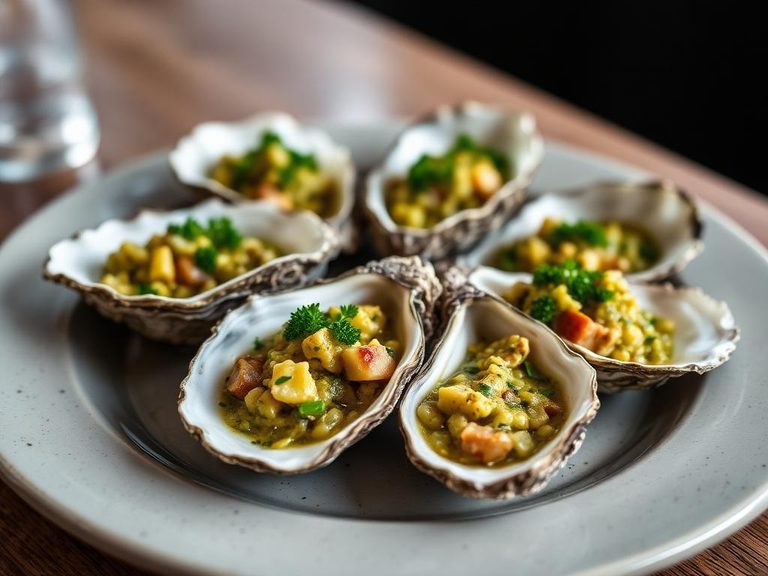
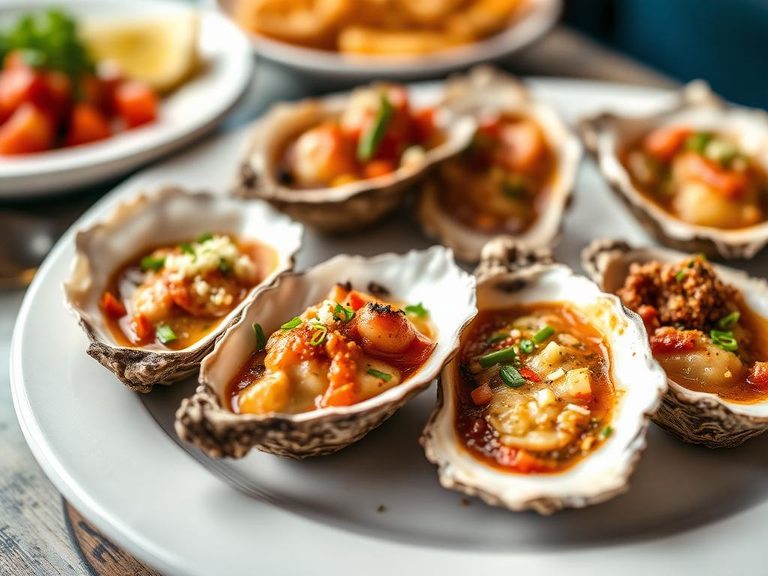
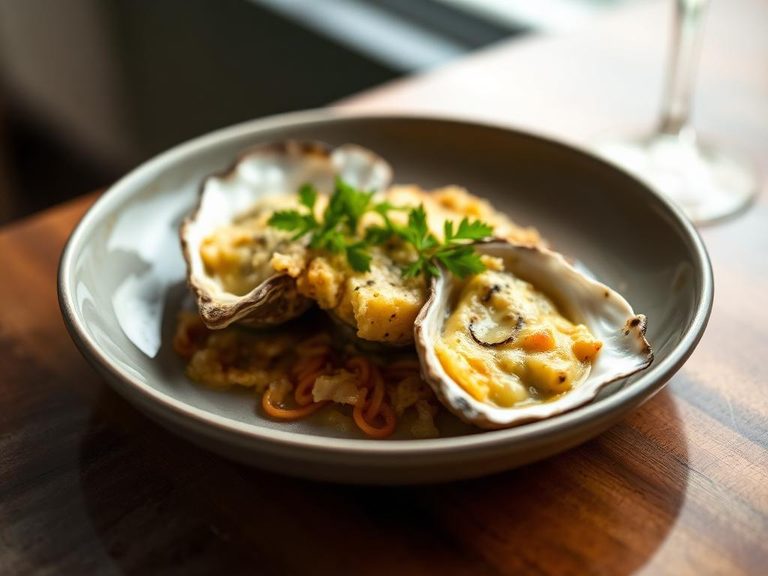
Oysters Rockefeller is a luxurious baked appetizer featuring a plump oyster on the half-shell, blanketed in a rich, savory sauce of sautéed greens, butter, and breadcrumbs, then browned until bubbling. The texture is a delightful contrast: the tender, briny oyster beneath a crisp, herbaceous topping. Nutritionally, it provides a notable protein boost from the oyster while the sauce contributes most of the fat and carbohydrate content.
Calorie split: 22% protein · 28% carbs · 50% fat
↓ Full nutrition💚 Why it's loved
People love it for its decadent, savory flavor profile that marries the oceanic brine of the oyster with a rich, buttery, and herbaceous topping. It's a classic celebratory dish, deeply associated with New Orleans fine dining and special occasions.
⚠️ Watch-outs & how to enjoy it better
The dish is high in saturated fat and sodium due to the butter and oyster brine, and the breadcrumb topping can be a source of refined carbs. Those monitoring fat intake or with gluten sensitivities should be cautious. To counteract, opt for a smaller portion as an appetizer, and consider a recipe using whole-grain breadcrumbs or a lighter, olive-oil-based topping.
Key benefits
- Excellent source of high-quality protein from oysters
- Provides essential minerals like zinc and selenium from shellfish
- Contains iron and vitamins from the spinach or green vegetable base
- Offers a satisfying, nutrient-dense appetizer portion
🍽️ Popular dishes
🌍 Where it's eaten
💡 Did you know?
Despite its name, the dish contains no actual Rockefeller family connection; it was created at Antoine's in New Orleans in 1899 and named for the rich, green topping resembling the color of money, which John D. Rockefeller's fortune symbolized.
Full nutrition (USDA data · scales with serving)
| Water | 73.4 g |
| Energy | 134 kcal |
| Protein | 7.6 g |
| Total lipid (fat) | 7.5 g |
| Carbohydrate, by difference | 9.4 g |
| Fiber, total dietary | 1.9 g |
| Total Sugars | 1.2 g |
| Calcium, Ca | 106 mg |
| Iron, Fe | 3.4 mg |
| Magnesium, Mg | 47.0 mg |
| Phosphorus, P | 104 mg |
| Potassium, K | 245 mg |
| Sodium, Na | 430 mg |
| Zinc, Zn | 18.8 mg |
| Copper, Cu | 1.4 mg |
| Selenium, Se | 16.7 ug |
| Vitamin C, total ascorbic acid | 1.2 mg |
| Thiamin | 0.14 mg |
| Riboflavin | 0.16 mg |
| Niacin | 1.7 mg |
| Vitamin B-6 | 0.11 mg |
| Folate, total | 57.0 ug |
| Folic acid | 6.0 ug |
| Folate, food | 51.0 ug |
| Folate, DFE | 61.0 ug |
| Choline, total | 48.3 mg |
| Vitamin B-12 | 3.5 ug |
| Vitamin B-12, added | 0.00 ug |
| Vitamin A, RAE | 280 ug |
| Retinol | 39.0 ug |
| Carotene, beta | 2891 ug |
| Carotene, alpha | 0.00 ug |
| Cryptoxanthin, beta | 0.00 ug |
| Lycopene | 0.00 ug |
| Lutein + zeaxanthin | 6251 ug |
| Vitamin E (alpha-tocopherol) | 1.8 mg |
| Vitamin E, added | 0.00 mg |
| Vitamin D (D2 + D3) | 0.00 ug |
| Vitamin K (phylloquinone) | 217 ug |
| Alcohol, ethyl | 0.00 g |
| Caffeine | 0.00 mg |
| Theobromine | 0.00 mg |
Fat & fatty acid profile (per 100g)
| Fatty acids, total saturated | 3.2 g |
| SFA 4:0 | 0.09 g |
| SFA 6:0 | 0.06 g |
| SFA 8:0 | 0.04 g |
| SFA 10:0 | 0.09 g |
| SFA 12:0 | 0.10 g |
| SFA 14:0 | 0.37 g |
| SFA 16:0 | 1.7 g |
| SFA 18:0 | 0.65 g |
| Fatty acids, total monounsaturated | 2.0 g |
| MUFA 16:1 | 0.12 g |
| MUFA 18:1 | 1.8 g |
| MUFA 20:1 | 0.04 g |
| MUFA 22:1 | 0.00 g |
| Fatty acids, total polyunsaturated | 1.1 g |
| PUFA 18:2 | 0.62 g |
| PUFA 18:3 | 0.23 g |
| PUFA 18:4 | 0.02 g |
| PUFA 20:4 | 0.03 g |
| PUFA 20:5 n-3 (EPA) | 0.08 g |
| PUFA 22:5 n-3 (DPA) | 0.01 g |
| PUFA 22:6 n-3 (DHA) | 0.06 g |
| Cholesterol | 36.0 mg |
FAQ
What does Oysters Rockefeller taste like?
It has a complex flavor: the oyster itself is briny and slightly sweet, while the topping is rich, buttery, and savory with notes of herbs, anise, and a crisp, toasty texture from the breadcrumbs.
Is Oysters Rockefeller healthy?
It offers benefits like protein and minerals from oysters, but it's also high in calories, fat, and sodium from the buttery sauce. It's best enjoyed occasionally as part of a balanced diet.
What is the green topping made of?
The classic topping is a mixture of finely chopped spinach, parsley, celery, green onions, breadcrumbs, butter, and often a touch of anise-flavored liqueur like Pernod.
Nutrient density (calculated · NRF9.3)
Nutrient Rich Foods index: beneficial nutrients (protein, fiber, vitamins, minerals) minus saturated fat, added sugar & sodium, per 100 kcal.
NRF9.3 index — Fulgoni, Keast & Drewnowski, 2009. Computed from USDA nutrients.
Weight-loss friendliness (composite index)
Energy density 1.34 kcal/g · 23% calories from protein · 1.9 g fiber · 1.2 g sugar per 100 g.
Composite of energy density (Rolls et al., 1999), protein & fiber satiety, minus sugar. A calculated heuristic — ranks satiety-per-calorie, not a clinical measure.
Dietary load (calculated from USDA values)
Potential renal acid load. Positive = acid-forming, negative = alkaline-forming.
Sodium-to-potassium ratio: 1.76 (lower is better — aim for ≤ 1)
Sodium:potassium per WHO potassium guidance. Computed from USDA nutrients.