

Mint julep
Common food

Photo: Wikipedia
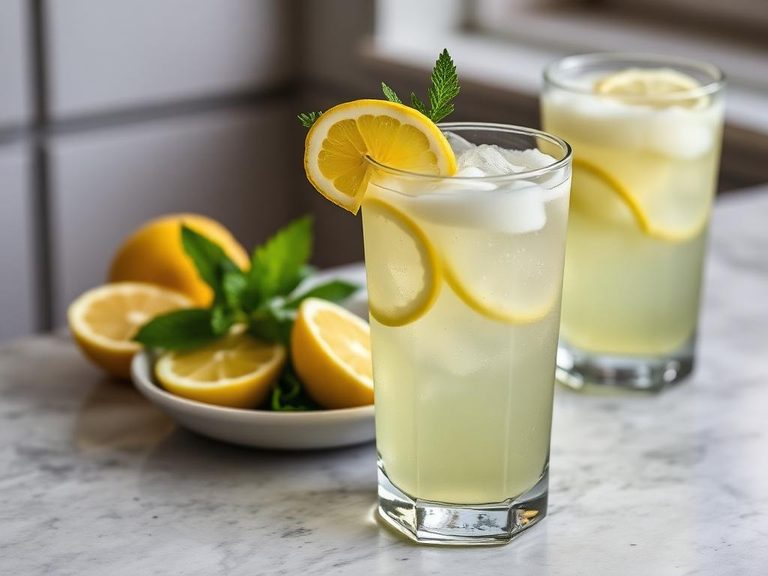
A Mint Julep is a classic American cocktail traditionally served in a silver or pewter cup, featuring bourbon, fresh mint, sugar, and crushed ice. It delivers a potent, refreshing burst of sweet, herbaceous, and oaky flavors, with the icy slush providing a signature cooling texture. Nutritionally, it is essentially a source of simple carbohydrates from sugar, with negligible protein or fat.
Calorie split: 0% protein · 100% carbs · 0% fat
↓ Full nutrition💚 Why it's loved
People love the Mint Julep for its iconic status as the signature drink of the Kentucky Derby, embodying Southern hospitality and tradition. Its invigorating combination of strong bourbon, sweet sugar, and fresh mint creates a complex yet highly drinkable experience.
⚠️ Watch-outs & how to enjoy it better
The high sugar content can lead to rapid blood-sugar spikes and contributes empty calories, while the alcohol can cause dehydration and impair judgment. To counteract this, practice strict portion control (one julep per hour), consume a full glass of water alongside it, and consider using a sugar substitute or reducing the simple syrup.
Key benefits
- Provides a quick source of energy from simple sugars.
- Serves as a traditional social and celebratory beverage.
- Offers a refreshing, cooling sensation, especially in hot weather.
🍽️ Popular dishes
🌍 Where it's eaten
💡 Did you know?
The official rules for a Mint Julep, as per the Kentucky Derby, mandate it be served in a frosted silver or pewter cup, which is essential for maintaining the drink's signature icy temperature and presentation.
Full nutrition (USDA data · scales with serving)
| Water | 70.5 g |
| Energy | 187 kcal |
| Protein | 0.00 g |
| Total lipid (fat) | 0.01 g |
| Carbohydrate, by difference | 5.8 g |
| Fiber, total dietary | 0.00 g |
| Total Sugars | 5.8 g |
| Calcium, Ca | 0.00 mg |
| Iron, Fe | 0.03 mg |
| Magnesium, Mg | 0.00 mg |
| Phosphorus, P | 3.0 mg |
| Potassium, K | 1.0 mg |
| Sodium, Na | 4.0 mg |
| Zinc, Zn | 0.05 mg |
| Copper, Cu | 0.02 mg |
| Selenium, Se | 0.00 ug |
| Vitamin C, total ascorbic acid | 0.00 mg |
| Thiamin | 0.00 mg |
| Riboflavin | 0.00 mg |
| Niacin | 0.01 mg |
| Vitamin B-6 | 0.00 mg |
| Folate, total | 0.00 ug |
| Folic acid | 0.00 ug |
| Folate, food | 0.00 ug |
| Folate, DFE | 0.00 ug |
| Choline, total | 0.00 mg |
| Vitamin B-12 | 0.00 ug |
| Vitamin B-12, added | 0.00 ug |
| Vitamin A, RAE | 0.00 ug |
| Retinol | 0.00 ug |
| Carotene, beta | 0.00 ug |
| Carotene, alpha | 0.00 ug |
| Cryptoxanthin, beta | 0.00 ug |
| Lycopene | 0.00 ug |
| Lutein + zeaxanthin | 0.00 ug |
| Vitamin E (alpha-tocopherol) | 0.00 mg |
| Vitamin E, added | 0.00 mg |
| Vitamin D (D2 + D3) | 0.00 ug |
| Vitamin K (phylloquinone) | 0.00 ug |
| Alcohol, ethyl | 23.7 g |
| Caffeine | 0.00 mg |
| Theobromine | 0.00 mg |
Fat & fatty acid profile (per 100g)
| Fatty acids, total saturated | 0.00 g |
| SFA 4:0 | 0.00 g |
| SFA 6:0 | 0.00 g |
| SFA 8:0 | 0.00 g |
| SFA 10:0 | 0.00 g |
| SFA 12:0 | 0.00 g |
| SFA 14:0 | 0.00 g |
| SFA 16:0 | 0.00 g |
| SFA 18:0 | 0.00 g |
| Fatty acids, total monounsaturated | 0.00 g |
| MUFA 16:1 | 0.00 g |
| MUFA 18:1 | 0.00 g |
| MUFA 20:1 | 0.00 g |
| MUFA 22:1 | 0.00 g |
| Fatty acids, total polyunsaturated | 0.00 g |
| PUFA 18:2 | 0.00 g |
| PUFA 18:3 | 0.00 g |
| PUFA 18:4 | 0.00 g |
| PUFA 20:4 | 0.00 g |
| PUFA 20:5 n-3 (EPA) | 0.00 g |
| PUFA 22:5 n-3 (DPA) | 0.00 g |
| PUFA 22:6 n-3 (DHA) | 0.00 g |
| Cholesterol | 0.00 mg |
FAQ
What is the difference between a Mint Julep and a Mojito?
The primary difference is the base spirit and preparation. A Mint Julep uses bourbon whiskey and is built in a cup with crushed ice, while a Mojito uses white rum, lime juice, and soda water, and is typically muddled and served in a highball glass.
Can I make a non-alcoholic version?
Yes, you can create a 'virgin' Mint Julep by substituting the bourbon with a non-alcoholic whiskey alternative or a strong brewed black tea, then proceeding with the same muddling of mint and sugar over crushed ice.
Why is crushed ice so important for a Mint Julep?
Crushed ice chills the drink rapidly and dilutes it slightly as it melts, which is crucial for tempering the strong bourbon and integrating the flavors. It also creates the characteristic frost on the outside of the cup.
Nutrient density (calculated · NRF9.3)
Nutrient Rich Foods index: beneficial nutrients (protein, fiber, vitamins, minerals) minus saturated fat, added sugar & sodium, per 100 kcal.
NRF9.3 index — Fulgoni, Keast & Drewnowski, 2009. Computed from USDA nutrients.
Weight-loss friendliness (composite index)
Energy density 1.87 kcal/g · 0% calories from protein · 0.0 g fiber · 5.8 g sugar per 100 g.
Composite of energy density (Rolls et al., 1999), protein & fiber satiety, minus sugar. A calculated heuristic — ranks satiety-per-calorie, not a clinical measure.
Dietary load (calculated from USDA values)
Potential renal acid load. Positive = acid-forming, negative = alkaline-forming.
Sodium-to-potassium ratio: 4.00 (lower is better — aim for ≤ 1)
Sodium:potassium per WHO potassium guidance. Computed from USDA nutrients.