

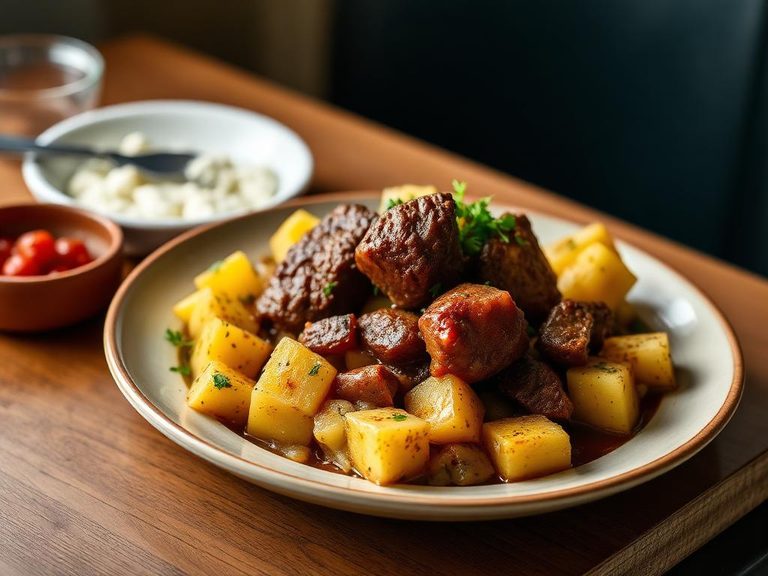
Lamb or mutton and potatoes with gravy
Common food
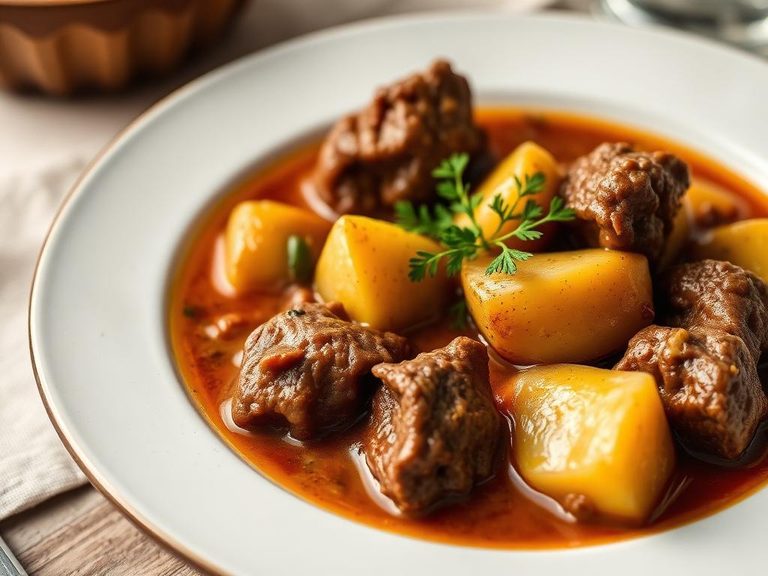
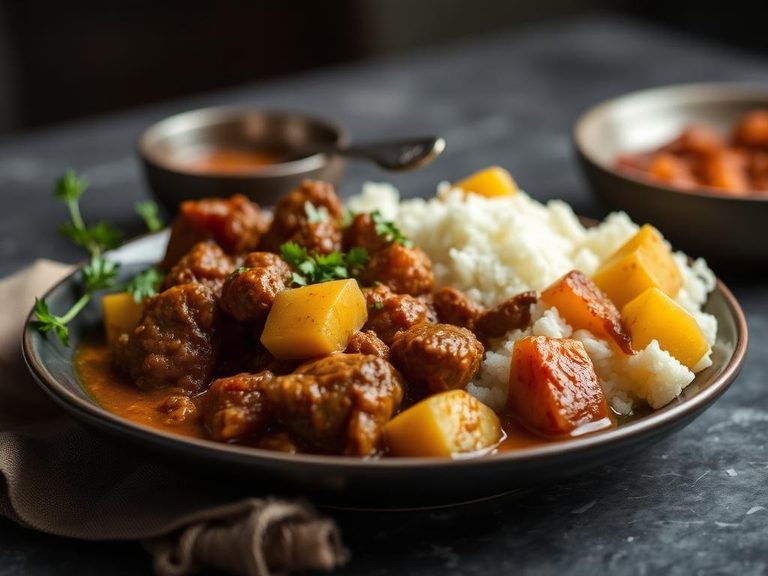
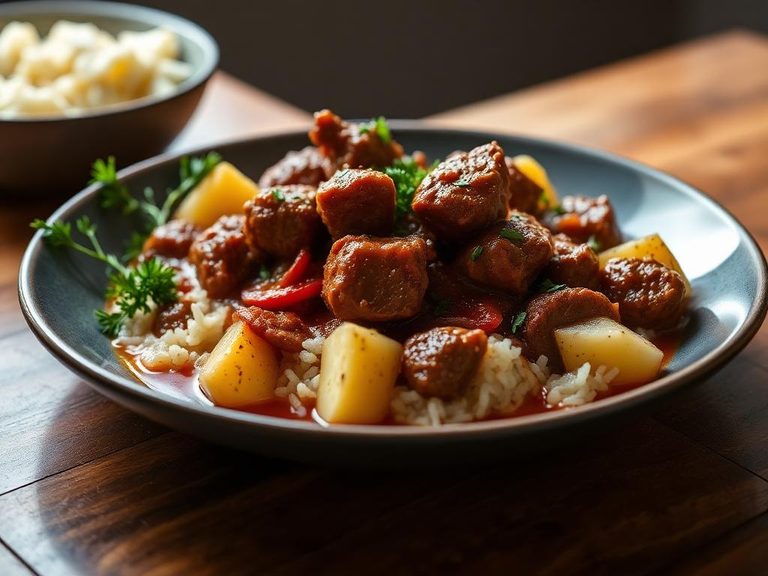
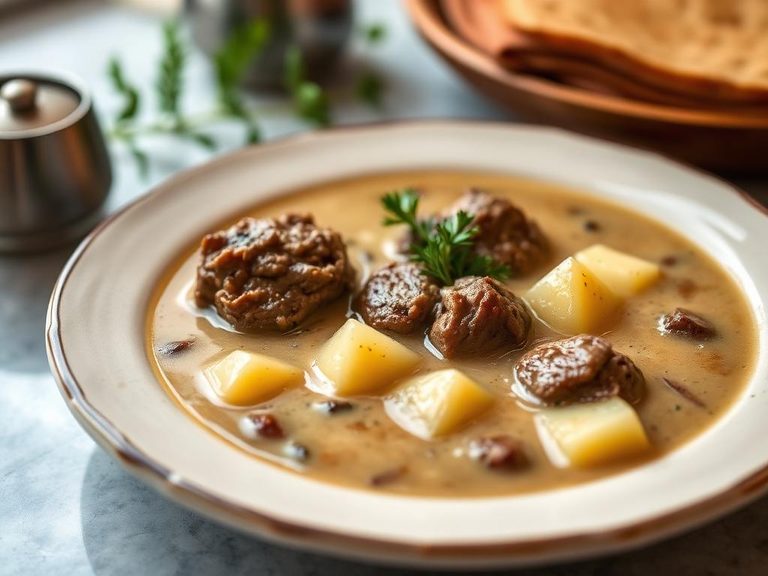
This is a hearty, rustic dish of tender lamb or mutton chunks and potatoes simmered in a savory, often herb-infused gravy. The meat is typically rich and slightly gamey, while the potatoes absorb the gravy's deep, umami flavor, becoming soft and comforting. At 129 kcal per 100g, it's a surprisingly lean yet satisfying meal, offering a good balance of protein and carbohydrates.
Calorie split: 16% protein · 39% carbs · 45% fat
↓ Full nutrition💚 Why it's loved
People love this dish for its deep, comforting flavors and the way the meat becomes incredibly tender when slow-cooked. It's a staple of home cooking and family gatherings, often evoking a sense of tradition and warmth.
⚠️ Watch-outs & how to enjoy it better
The high sodium content in the gravy can be a concern for those monitoring blood pressure. To mitigate this, use low-sodium stock and limit added salt. The fat content, while moderate, can be reduced by trimming the lamb and skimming the gravy. For blood sugar management, pair a smaller portion with a non-starchy vegetable like steamed broccoli to add fiber and slow carbohydrate absorption.
Key benefits
- Provides a complete protein source from the lamb.
- Rich in B vitamins, especially B12, from the meat.
- Potatoes offer a good source of potassium and vitamin C.
- The gravy can be a source of minerals if made from bone broth.
- A warming, calorie-dense meal suitable for cold climates.
🍽️ Popular dishes
🌍 Where it's eaten
💡 Did you know?
The practice of slow-cooking lamb with potatoes in a gravy is a culinary technique found across multiple continents, from the tagines of Morocco to the stews of the British Isles, demonstrating a universal human ingenuity in creating nourishing meals from simple, available ingredients.
Full nutrition (USDA data · scales with serving)
| Water | 74.6 g |
| Energy | 129 kcal |
| Protein | 5.1 g |
| Total lipid (fat) | 6.5 g |
| Carbohydrate, by difference | 12.5 g |
| Fiber, total dietary | 1.0 g |
| Total Sugars | 0.58 g |
| Calcium, Ca | 11.0 mg |
| Iron, Fe | 0.50 mg |
| Magnesium, Mg | 16.0 mg |
| Phosphorus, P | 59.0 mg |
| Potassium, K | 241 mg |
| Sodium, Na | 308 mg |
| Zinc, Zn | 0.90 mg |
| Copper, Cu | 0.12 mg |
| Selenium, Se | 4.6 ug |
| Vitamin C, total ascorbic acid | 4.0 mg |
| Thiamin | 0.08 mg |
| Riboflavin | 0.07 mg |
| Niacin | 1.9 mg |
| Vitamin B-6 | 0.17 mg |
| Folate, total | 8.0 ug |
| Folic acid | 0.00 ug |
| Folate, food | 8.0 ug |
| Folate, DFE | 8.0 ug |
| Choline, total | 23.5 mg |
| Vitamin B-12 | 0.41 ug |
| Vitamin B-12, added | 0.00 ug |
| Vitamin A, RAE | 0.00 ug |
| Retinol | 0.00 ug |
| Carotene, beta | 1.0 ug |
| Carotene, alpha | 0.00 ug |
| Cryptoxanthin, beta | 0.00 ug |
| Lycopene | 0.00 ug |
| Lutein + zeaxanthin | 5.0 ug |
| Vitamin E (alpha-tocopherol) | 0.47 mg |
| Vitamin E, added | 0.00 mg |
| Vitamin D (D2 + D3) | 0.00 ug |
| Vitamin K (phylloquinone) | 4.3 ug |
| Alcohol, ethyl | 0.00 g |
| Caffeine | 0.00 mg |
| Theobromine | 0.00 mg |
Fat & fatty acid profile (per 100g)
| Fatty acids, total saturated | 1.9 g |
| SFA 4:0 | 0.00 g |
| SFA 6:0 | 0.00 g |
| SFA 8:0 | 0.00 g |
| SFA 10:0 | 0.01 g |
| SFA 12:0 | 0.02 g |
| SFA 14:0 | 0.14 g |
| SFA 16:0 | 1.1 g |
| SFA 18:0 | 0.57 g |
| Fatty acids, total monounsaturated | 2.7 g |
| MUFA 16:1 | 0.14 g |
| MUFA 18:1 | 2.5 g |
| MUFA 20:1 | 0.02 g |
| MUFA 22:1 | 0.00 g |
| Fatty acids, total polyunsaturated | 1.2 g |
| PUFA 18:2 | 1.1 g |
| PUFA 18:3 | 0.15 g |
| PUFA 18:4 | 0.00 g |
| PUFA 20:4 | 0.01 g |
| PUFA 20:5 n-3 (EPA) | 0.00 g |
| PUFA 22:5 n-3 (DPA) | 0.00 g |
| PUFA 22:6 n-3 (DHA) | 0.00 g |
| Cholesterol | 17.0 mg |
FAQ
Is lamb or mutton healthier than beef?
Lamb and mutton can be leaner than some cuts of beef and are rich in B vitamins and zinc. However, the overall healthiness depends on the cut, cooking method, and portion size.
How can I make the gravy less fatty?
To reduce fat, trim excess fat from the meat before cooking, use a leaner cut, and skim the fat from the surface of the gravy after cooking. Using a low-sodium broth can also help manage salt intake.
Can I use other vegetables in this dish?
Absolutely. Carrots, onions, celery, and peas are common additions that add flavor, fiber, and nutrients. Adding more vegetables can also help balance the meal and make it more filling.
Nutrient density (calculated · NRF9.3)
Nutrient Rich Foods index: beneficial nutrients (protein, fiber, vitamins, minerals) minus saturated fat, added sugar & sodium, per 100 kcal.
NRF9.3 index — Fulgoni, Keast & Drewnowski, 2009. Computed from USDA nutrients.
Weight-loss friendliness (composite index)
Energy density 1.29 kcal/g · 16% calories from protein · 1.0 g fiber · 0.6 g sugar per 100 g.
Composite of energy density (Rolls et al., 1999), protein & fiber satiety, minus sugar. A calculated heuristic — ranks satiety-per-calorie, not a clinical measure.
Dietary load (calculated from USDA values)
Potential renal acid load. Positive = acid-forming, negative = alkaline-forming.
Sodium-to-potassium ratio: 1.28 (lower is better — aim for ≤ 1)
Sodium:potassium per WHO potassium guidance. Computed from USDA nutrients.