

Jam or jelly, reduced sugar
Common food

Photo: Wikipedia
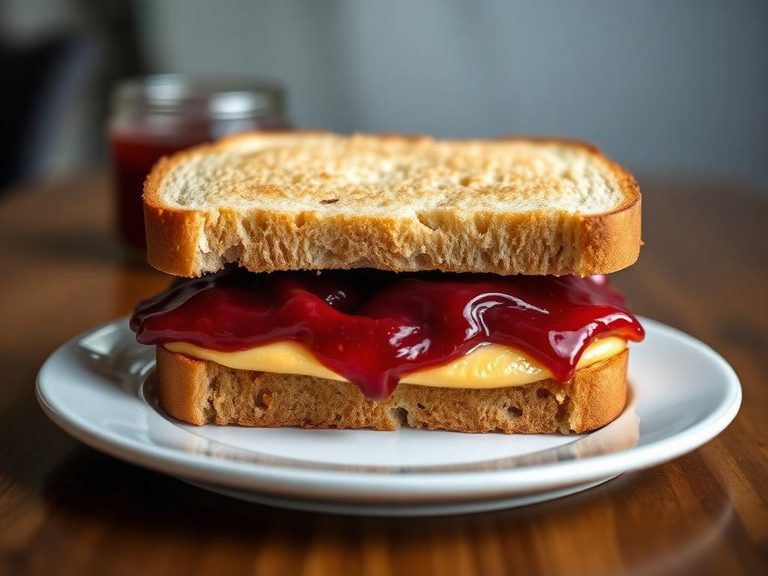
Reduced-sugar jam or jelly is a fruit preserve made with less added sugar than traditional recipes, often using sweeteners or fruit juice concentrates to maintain sweetness. It typically has a thick, spreadable texture with a bright, fruity flavor, though the mouthfeel may be slightly less syrupy than full-sugar versions. Nutritionally, it provides a lower-calorie option with about 151 kcal per 100g and 29.41g of sugar, making it a lighter choice for those watching their sugar intake.
Calorie split: 0% protein · 99% carbs · 1% fat
↓ Full nutrition💚 Why it's loved
People love reduced-sugar jam for its ability to deliver a sweet, fruity taste with fewer calories, making it a guilt-free addition to toast, yogurt, or pastries. Its versatility allows it to be used in both sweet and savory dishes, appealing to those seeking flavor without excessive sugar.
⚠️ Watch-outs & how to enjoy it better
The reduced sugar content may lead to a less intense sweetness and a thinner texture, which some find less satisfying than traditional jam. Additionally, it can still cause blood-sugar spikes in individuals with diabetes or insulin resistance, so portion control is key—pairing it with protein or fat (like peanut butter or nuts) can help stabilize blood sugar levels.
Key benefits
- Lower in calories than regular jam (151 kcal vs. ~250 kcal per 100g)
- Reduced sugar content helps moderate daily sugar intake
- Provides some dietary fiber (1.5g per 100g)
- Can be a suitable option for weight management
- Offers a sweet spread without the full sugar load
🍽️ Popular dishes



🌍 Where it's eaten
💡 Did you know?
Reduced-sugar jams often use pectin or other gelling agents to maintain texture, as sugar plays a key role in traditional jam-setting processes.
Full nutrition (USDA data · scales with serving)
| Water | 62.0 g |
| Energy | 151 kcal |
| Protein | 0.00 g |
| Total lipid (fat) | 0.10 g |
| Carbohydrate, by difference | 37.6 g |
| Fiber, total dietary | 1.5 g |
| Total Sugars | 29.4 g |
| Calcium, Ca | 0.00 mg |
| Iron, Fe | 0.00 mg |
| Magnesium, Mg | 4.0 mg |
| Phosphorus, P | 7.0 mg |
| Potassium, K | 59.0 mg |
| Sodium, Na | 0.00 mg |
| Zinc, Zn | 0.05 mg |
| Copper, Cu | 0.04 mg |
| Selenium, Se | 0.40 ug |
| Vitamin C, total ascorbic acid | 15.0 mg |
| Thiamin | 0.01 mg |
| Riboflavin | 0.02 mg |
| Niacin | 0.08 mg |
| Vitamin B-6 | 0.02 mg |
| Folate, total | 18.0 ug |
| Folic acid | 0.00 ug |
| Folate, food | 18.0 ug |
| Folate, DFE | 18.0 ug |
| Choline, total | 4.2 mg |
| Vitamin B-12 | 0.00 ug |
| Vitamin B-12, added | 0.00 ug |
| Vitamin A, RAE | 0.00 ug |
| Retinol | 0.00 ug |
| Carotene, beta | 5.0 ug |
| Carotene, alpha | 0.00 ug |
| Cryptoxanthin, beta | 0.00 ug |
| Lycopene | 0.00 ug |
| Lutein + zeaxanthin | 20.0 ug |
| Vitamin E (alpha-tocopherol) | 0.21 mg |
| Vitamin E, added | 0.00 mg |
| Vitamin D (D2 + D3) | 0.00 ug |
| Vitamin K (phylloquinone) | 1.6 ug |
| Alcohol, ethyl | 0.00 g |
| Caffeine | 0.00 mg |
| Theobromine | 0.00 mg |
Fat & fatty acid profile (per 100g)
| Fatty acids, total saturated | 0.01 g |
| SFA 4:0 | 0.00 g |
| SFA 6:0 | 0.00 g |
| SFA 8:0 | 0.00 g |
| SFA 10:0 | 0.00 g |
| SFA 12:0 | 0.00 g |
| SFA 14:0 | 0.00 g |
| SFA 16:0 | 0.00 g |
| SFA 18:0 | 0.00 g |
| Fatty acids, total monounsaturated | 0.01 g |
| MUFA 16:1 | 0.00 g |
| MUFA 18:1 | 0.01 g |
| MUFA 20:1 | 0.00 g |
| MUFA 22:1 | 0.00 g |
| Fatty acids, total polyunsaturated | 0.05 g |
| PUFA 18:2 | 0.03 g |
| PUFA 18:3 | 0.02 g |
| PUFA 18:4 | 0.00 g |
| PUFA 20:4 | 0.00 g |
| PUFA 20:5 n-3 (EPA) | 0.00 g |
| PUFA 22:5 n-3 (DPA) | 0.00 g |
| PUFA 22:6 n-3 (DHA) | 0.00 g |
| Cholesterol | 0.00 mg |
FAQ
Is reduced-sugar jam healthier than regular jam?
Yes, it generally has fewer calories and less sugar per serving, but it still contains sugar and should be consumed in moderation, especially by those monitoring blood sugar.
Can I use reduced-sugar jam in baking?
Yes, it can be used in baking, but it may affect the sweetness and moisture of the final product. Adjusting other ingredients may be necessary.
Does reduced-sugar jam have any added sweeteners?
Some brands use artificial sweeteners or sugar alcohols, while others rely on fruit juice concentrates. Check the label for specific ingredients.
Nutrient density (calculated · NRF9.3)
Nutrient Rich Foods index: beneficial nutrients (protein, fiber, vitamins, minerals) minus saturated fat, added sugar & sodium, per 100 kcal.
NRF9.3 index — Fulgoni, Keast & Drewnowski, 2009. Computed from USDA nutrients.
Weight-loss friendliness (composite index)
Energy density 1.51 kcal/g · 0% calories from protein · 1.5 g fiber · 29.4 g sugar per 100 g.
Composite of energy density (Rolls et al., 1999), protein & fiber satiety, minus sugar. A calculated heuristic — ranks satiety-per-calorie, not a clinical measure.
Dietary load (calculated from USDA values)
Potential renal acid load. Positive = acid-forming, negative = alkaline-forming.
Sodium-to-potassium ratio: 0.00 (lower is better — aim for ≤ 1)
Sodium:potassium per WHO potassium guidance. Computed from USDA nutrients.