

Jai, Monk's Food
Common food
Jai, also known as Monk's Food or Buddha's Delight, is a traditional Chinese vegetarian dish typically made with a medley of dried and fresh ingredients like mushrooms, tofu, and vegetables. It has a complex, savory flavor profile with a variety of textures ranging from chewy to crisp, and is notably low in calories while offering a good source of plant-based protein and fiber.
Calorie split: 26% protein · 48% carbs · 26% fat
↓ Full nutrition💚 Why it's loved
People love Jai for its deep, umami-rich flavor that develops from the combination of fermented and dried ingredients, and its cultural significance as a celebratory dish during Chinese New Year and other festivals.
⚠️ Watch-outs & how to enjoy it better
The dish can be high in sodium due to soy sauce and fermented bean curd, which may concern those monitoring salt intake. To counteract this, you can rinse canned ingredients, use low-sodium sauces, and balance the meal with fresh, low-sodium sides. Some ingredients like certain mushrooms or bean products may also be allergens for some individuals.
Key benefits
- Excellent source of plant-based protein for vegetarians
- High in dietary fiber, promoting digestive health
- Very low in calories, suitable for weight management
- Rich in various vitamins and minerals from diverse ingredients
- Often contains antioxidants from mushrooms and vegetables
🍽️ Popular dishes
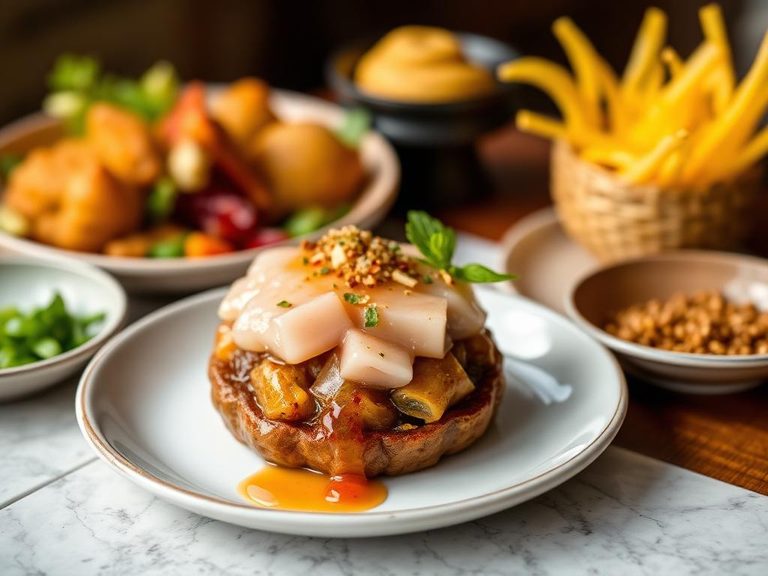
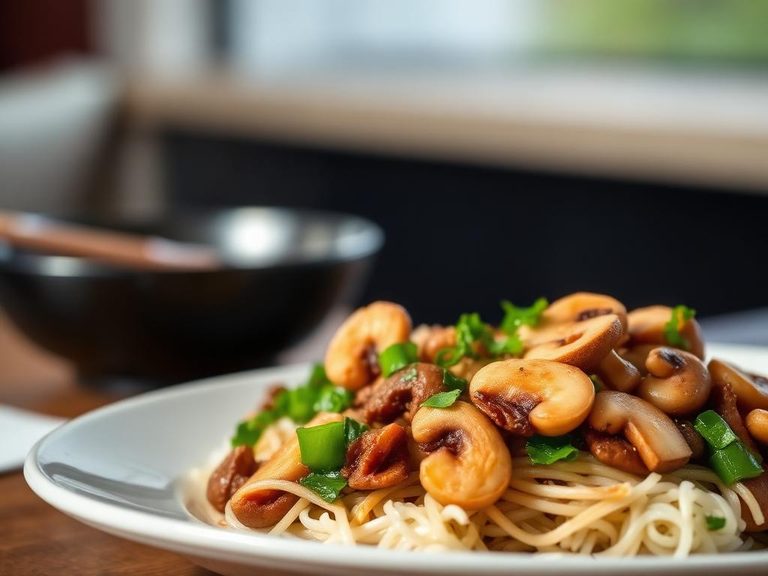
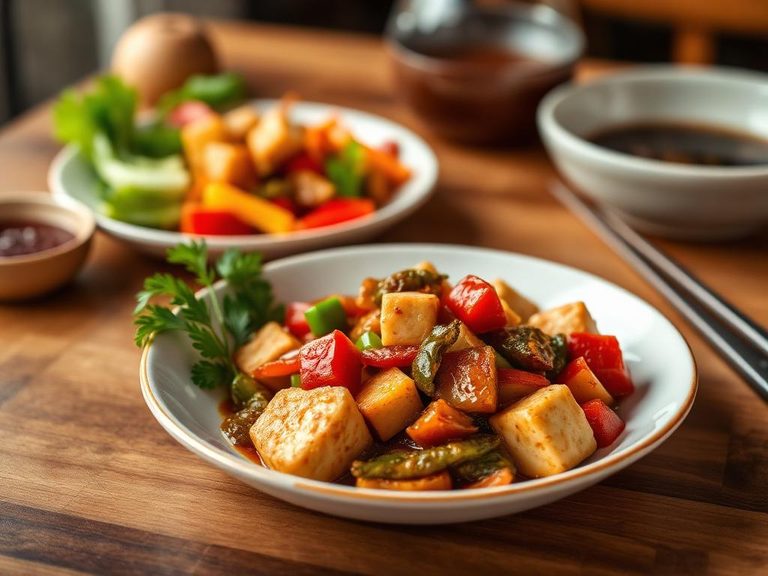
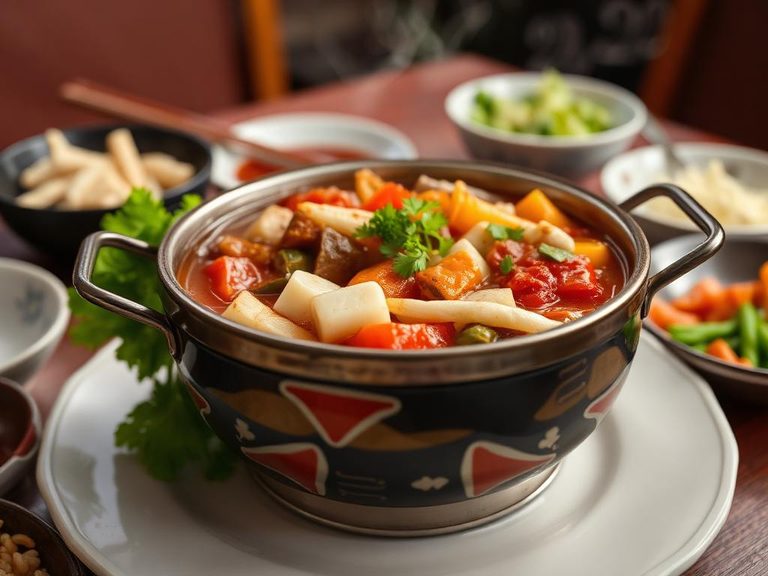
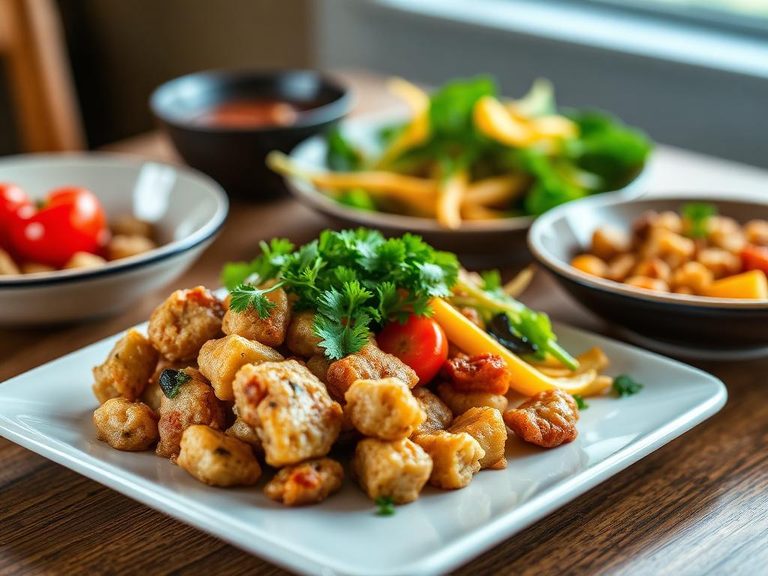
🌍 Where it's eaten
💡 Did you know?
The name 'Monk's Food' originates from Buddhist monks who abstained from meat and created this dish using available vegetarian ingredients, often during fasting periods.
Full nutrition (USDA data · scales with serving)
| Water | 85.5 g |
| Energy | 60.0 kcal |
| Protein | 4.3 g |
| Total lipid (fat) | 1.9 g |
| Carbohydrate, by difference | 7.7 g |
| Fiber, total dietary | 1.7 g |
| Total Sugars | 1.1 g |
| Calcium, Ca | 54.0 mg |
| Iron, Fe | 0.82 mg |
| Magnesium, Mg | 21.0 mg |
| Phosphorus, P | 70.0 mg |
| Potassium, K | 193 mg |
| Sodium, Na | 28.0 mg |
| Zinc, Zn | 0.50 mg |
| Copper, Cu | 0.14 mg |
| Selenium, Se | 4.6 ug |
| Vitamin C, total ascorbic acid | 5.8 mg |
| Thiamin | 0.04 mg |
| Riboflavin | 0.05 mg |
| Niacin | 0.67 mg |
| Vitamin B-6 | 0.11 mg |
| Folate, total | 20.0 ug |
| Folic acid | 0.00 ug |
| Folate, food | 20.0 ug |
| Folate, DFE | 20.0 ug |
| Choline, total | 24.8 mg |
| Vitamin B-12 | 0.00 ug |
| Vitamin B-12, added | 0.00 ug |
| Vitamin A, RAE | 0.00 ug |
| Retinol | 0.00 ug |
| Carotene, beta | 2.0 ug |
| Carotene, alpha | 0.00 ug |
| Cryptoxanthin, beta | 0.00 ug |
| Lycopene | 0.00 ug |
| Lutein + zeaxanthin | 0.00 ug |
| Vitamin E (alpha-tocopherol) | 0.10 mg |
| Vitamin E, added | 0.00 mg |
| Vitamin D (D2 + D3) | 0.00 ug |
| Vitamin K (phylloquinone) | 1.0 ug |
| Alcohol, ethyl | 0.00 g |
| Caffeine | 0.00 mg |
| Theobromine | 0.00 mg |
Fat & fatty acid profile (per 100g)
| Fatty acids, total saturated | 0.28 g |
| SFA 4:0 | 0.00 g |
| SFA 6:0 | 0.00 g |
| SFA 8:0 | 0.00 g |
| SFA 10:0 | 0.00 g |
| SFA 12:0 | 0.00 g |
| SFA 14:0 | 0.01 g |
| SFA 16:0 | 0.21 g |
| SFA 18:0 | 0.07 g |
| Fatty acids, total monounsaturated | 0.40 g |
| MUFA 16:1 | 0.01 g |
| MUFA 18:1 | 0.39 g |
| MUFA 20:1 | 0.00 g |
| MUFA 22:1 | 0.00 g |
| Fatty acids, total polyunsaturated | 1.0 g |
| PUFA 18:2 | 0.90 g |
| PUFA 18:3 | 0.12 g |
| PUFA 18:4 | 0.00 g |
| PUFA 20:4 | 0.00 g |
| PUFA 20:5 n-3 (EPA) | 0.00 g |
| PUFA 22:5 n-3 (DPA) | 0.00 g |
| PUFA 22:6 n-3 (DHA) | 0.00 g |
| Cholesterol | 0.00 mg |
FAQ
Is Jai suitable for vegans?
Yes, traditional Jai is a vegan dish as it is made entirely from plant-based ingredients like tofu, mushrooms, and vegetables, without any animal products.
Can I make Jai with fresh ingredients only?
While dried ingredients like mushrooms and bean curd sticks are key for authentic texture and flavor, you can substitute with fresh versions, though the dish may lack some depth.
How long does Jai last in the refrigerator?
Properly stored in an airtight container, Jai can last for 3-4 days in the refrigerator. It often tastes even better the next day as the flavors meld.
Nutrient density (calculated · NRF9.3)
Nutrient Rich Foods index: beneficial nutrients (protein, fiber, vitamins, minerals) minus saturated fat, added sugar & sodium, per 100 kcal.
NRF9.3 index — Fulgoni, Keast & Drewnowski, 2009. Computed from USDA nutrients.
Weight-loss friendliness (composite index)
Energy density 0.60 kcal/g · 28% calories from protein · 1.7 g fiber · 1.1 g sugar per 100 g.
Composite of energy density (Rolls et al., 1999), protein & fiber satiety, minus sugar. A calculated heuristic — ranks satiety-per-calorie, not a clinical measure.
Dietary load (calculated from USDA values)
Potential renal acid load. Positive = acid-forming, negative = alkaline-forming.
Sodium-to-potassium ratio: 0.15 (lower is better — aim for ≤ 1)
Sodium:potassium per WHO potassium guidance. Computed from USDA nutrients.