

Frankfurters or hot dogs and sauerkraut
Common food
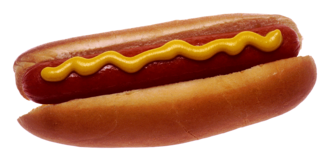
Photo: Wikipedia
Frankfurters and sauerkraut is a classic pairing of smoky, savory sausage and tangy, fermented cabbage. The hot dog provides a juicy, meaty bite, while the sauerkraut adds a crisp, acidic contrast that cuts through the richness. Nutritionally, it's a high-fat, moderate-protein dish with very few carbohydrates, primarily from the fermented cabbage.
Calorie split: 15% protein · 7% carbs · 78% fat
↓ Full nutrition💚 Why it's loved
People love this combo for its perfect balance of savory, smoky, and sour flavors, creating a deeply satisfying comfort food. It's a versatile staple, easily served on a bun, in a bowl, or as a side, and is deeply rooted in German-American culinary tradition.
⚠️ Watch-outs & how to enjoy it better
The primary downsides are the high sodium content from both the cured sausage and the sauerkraut, and the high saturated fat from the frankfurter. To counteract, choose low-sodium sauerkraut and uncured, leaner turkey or chicken franks, and balance the meal with a large portion of fresh, low-sodium vegetables like a side salad or roasted broccoli.
Key benefits
- Sauerkraut is a natural source of probiotics from fermentation.
- Provides a good dose of protein from the frankfurter.
- Very low in sugar and net carbohydrates.
- Sauerkraut is rich in vitamin C and vitamin K.
- The combination is a satisfying, low-fiber meal option.
🍽️ Popular dishes





🌍 Where it's eaten
💡 Did you know?
The sauerkraut in this classic pairing is a fermented food, and its tangy flavor comes from lactic acid produced by bacteria, which also acts as a natural preservative.
Full nutrition (USDA data · scales with serving)
| Water | 69.2 g |
| Energy | 198 kcal |
| Protein | 7.6 g |
| Total lipid (fat) | 17.3 g |
| Carbohydrate, by difference | 3.4 g |
| Fiber, total dietary | 1.1 g |
| Total Sugars | 1.5 g |
| Calcium, Ca | 21.0 mg |
| Iron, Fe | 1.3 mg |
| Magnesium, Mg | 12.0 mg |
| Phosphorus, P | 83.0 mg |
| Potassium, K | 266 mg |
| Sodium, Na | 764 mg |
| Zinc, Zn | 1.3 mg |
| Copper, Cu | 0.07 mg |
| Selenium, Se | 6.6 ug |
| Vitamin C, total ascorbic acid | 5.1 mg |
| Thiamin | 0.03 mg |
| Riboflavin | 0.10 mg |
| Niacin | 1.3 mg |
| Vitamin B-6 | 0.11 mg |
| Folate, total | 9.0 ug |
| Folic acid | 0.00 ug |
| Folate, food | 9.0 ug |
| Folate, DFE | 9.0 ug |
| Choline, total | 23.6 mg |
| Vitamin B-12 | 0.51 ug |
| Vitamin B-12, added | 0.00 ug |
| Vitamin A, RAE | 2.0 ug |
| Retinol | 2.0 ug |
| Carotene, beta | 3.0 ug |
| Carotene, alpha | 2.0 ug |
| Cryptoxanthin, beta | 0.00 ug |
| Lycopene | 0.00 ug |
| Lutein + zeaxanthin | 113 ug |
| Vitamin E (alpha-tocopherol) | 0.37 mg |
| Vitamin E, added | 0.00 mg |
| Vitamin D (D2 + D3) | 0.60 ug |
| Vitamin K (phylloquinone) | 6.1 ug |
| Alcohol, ethyl | 0.00 g |
| Caffeine | 0.00 mg |
| Theobromine | 0.00 mg |
Fat & fatty acid profile (per 100g)
| Fatty acids, total saturated | 7.0 g |
| SFA 4:0 | 0.00 g |
| SFA 6:0 | 0.00 g |
| SFA 8:0 | 0.00 g |
| SFA 10:0 | 0.01 g |
| SFA 12:0 | 0.01 g |
| SFA 14:0 | 0.52 g |
| SFA 16:0 | 3.9 g |
| SFA 18:0 | 2.3 g |
| Fatty acids, total monounsaturated | 7.5 g |
| MUFA 16:1 | 0.66 g |
| MUFA 18:1 | 7.3 g |
| MUFA 20:1 | 0.07 g |
| MUFA 22:1 | 0.04 g |
| Fatty acids, total polyunsaturated | 0.61 g |
| PUFA 18:2 | 0.58 g |
| PUFA 18:3 | 0.07 g |
| PUFA 18:4 | 0.00 g |
| PUFA 20:4 | 0.02 g |
| PUFA 20:5 n-3 (EPA) | 0.00 g |
| PUFA 22:5 n-3 (DPA) | 0.01 g |
| PUFA 22:6 n-3 (DHA) | 0.00 g |
| Cholesterol | 36.0 mg |
FAQ
Is this a healthy meal?
It's a mixed bag. The sauerkraut offers probiotics and vitamins, but the traditional frankfurter is high in sodium and saturated fat. Choosing a leaner, low-sodium sausage and pairing it with a large vegetable side makes it a more balanced choice.
Can I eat this on a low-carb diet?
Yes, it's a very low-carb option. The net carbs come almost entirely from the sauerkraut, making it suitable for keto and low-carb diets, especially when served without a bun.
Why is the sodium so high?
Both components are cured or fermented with salt. The frankfurter is cured for preservation and flavor, and the sauerkraut is salted to draw out water and create the environment for fermentation.
Nutrient density (calculated · NRF9.3)
Nutrient Rich Foods index: beneficial nutrients (protein, fiber, vitamins, minerals) minus saturated fat, added sugar & sodium, per 100 kcal.
NRF9.3 index — Fulgoni, Keast & Drewnowski, 2009. Computed from USDA nutrients.
Weight-loss friendliness (composite index)
Energy density 1.98 kcal/g · 15% calories from protein · 1.1 g fiber · 1.5 g sugar per 100 g.
Composite of energy density (Rolls et al., 1999), protein & fiber satiety, minus sugar. A calculated heuristic — ranks satiety-per-calorie, not a clinical measure.
Dietary load (calculated from USDA values)
Potential renal acid load. Positive = acid-forming, negative = alkaline-forming.
Sodium-to-potassium ratio: 2.87 (lower is better — aim for ≤ 1)
Sodium:potassium per WHO potassium guidance. Computed from USDA nutrients.