

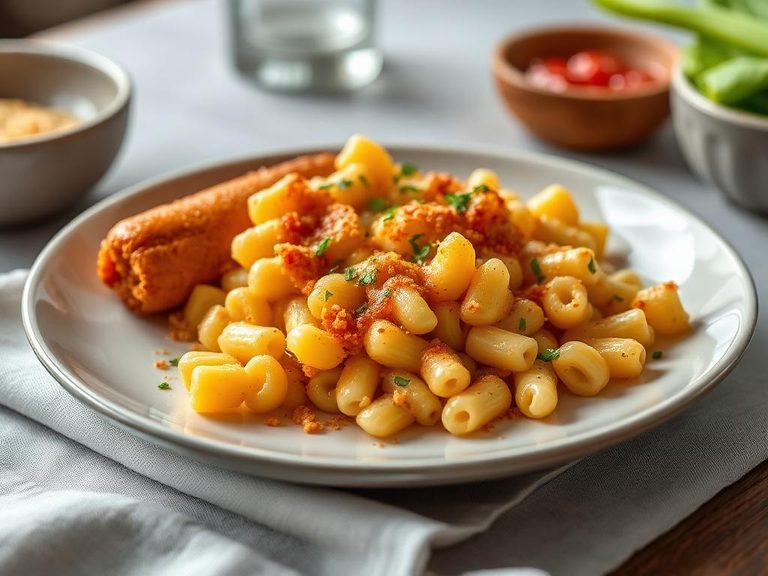
Macaroni or noodles with cheese and frankfurters or hot dogs
Common food

Photo: Wikipedia
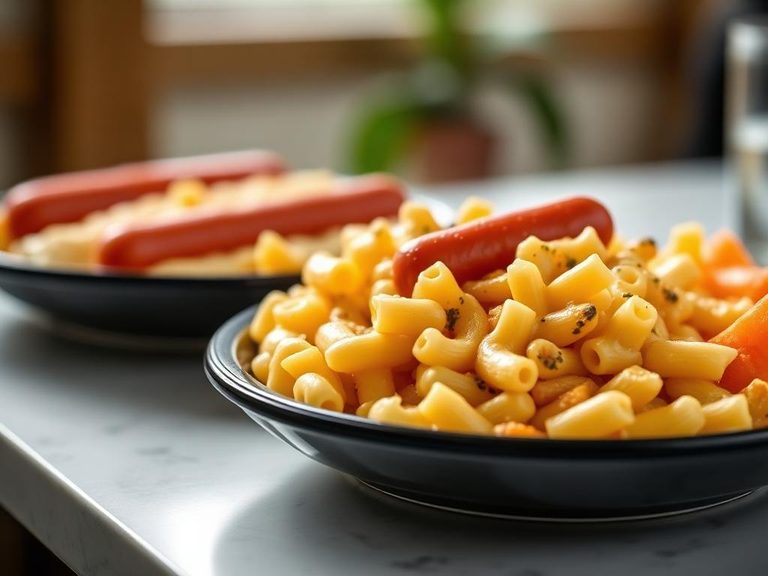
This is the quintessential comfort food of processed pasta tubes or noodles smothered in a smooth, salty cheese sauce, often studded with slices of savory frankfurter. The texture is soft and yielding, with a rich, creamy mouthfeel from the cheese and a satisfying, meaty bite from the hot dog. Nutritionally, it's a calorie-dense energy source, with a significant portion of its calories coming from fats and refined carbohydrates.
Calorie split: 12% protein · 36% carbs · 53% fat
↓ Full nutrition💚 Why it's loved
People adore it for its uncomplicated, savory satisfaction—a warm, gooey bowl that delivers a powerful hit of salt, fat, and umami in minutes. It's a nostalgic staple, often associated with childhood, college life, and no-fuss weeknight meals.
⚠️ Watch-outs & how to enjoy it better
The dish is typically high in sodium and saturated fat, and its refined carbohydrates can cause a rapid blood-sugar spike, offering little lasting satiety. To counteract this, pair it with a large side of steamed or roasted non-starchy vegetables (like broccoli or green beans) to add fiber and volume, and consider using a smaller portion of the main dish while increasing the veggie ratio.
Key benefits
- Provides quick energy from carbohydrates
- Contains some protein from cheese and meat
- Highly palatable and satisfying for cravings
- Extremely quick and easy to prepare
- A familiar, nostalgic comfort food for many
🍽️ Popular dishes
🌍 Where it's eaten
💡 Did you know?
The classic American boxed version, Kraft Macaroni & Cheese, was introduced in 1937 during the Great Depression and sold out its entire first production run within two weeks due to its low cost and high yield.
Full nutrition (USDA data · scales with serving)
| Water | 61.3 g |
| Energy | 209 kcal |
| Protein | 6.2 g |
| Total lipid (fat) | 12.3 g |
| Carbohydrate, by difference | 18.7 g |
| Fiber, total dietary | 0.80 g |
| Total Sugars | 3.1 g |
| Calcium, Ca | 50.0 mg |
| Iron, Fe | 0.76 mg |
| Magnesium, Mg | 14.0 mg |
| Phosphorus, P | 105 mg |
| Potassium, K | 106 mg |
| Sodium, Na | 299 mg |
| Zinc, Zn | 0.77 mg |
| Copper, Cu | 0.06 mg |
| Selenium, Se | 14.2 ug |
| Vitamin C, total ascorbic acid | 0.10 mg |
| Thiamin | 0.17 mg |
| Riboflavin | 0.16 mg |
| Niacin | 1.1 mg |
| Vitamin B-6 | 0.13 mg |
| Folate, total | 35.0 ug |
| Folic acid | 31.0 ug |
| Folate, food | 3.0 ug |
| Folate, DFE | 56.0 ug |
| Choline, total | 17.1 mg |
| Vitamin B-12 | 0.39 ug |
| Vitamin B-12, added | 0.00 ug |
| Vitamin A, RAE | 63.0 ug |
| Retinol | 61.0 ug |
| Carotene, beta | 25.0 ug |
| Carotene, alpha | 0.00 ug |
| Cryptoxanthin, beta | 0.00 ug |
| Lycopene | 0.00 ug |
| Lutein + zeaxanthin | 4.0 ug |
| Vitamin E (alpha-tocopherol) | 0.64 mg |
| Vitamin E, added | 0.00 mg |
| Vitamin D (D2 + D3) | 0.40 ug |
| Vitamin K (phylloquinone) | 3.5 ug |
| Alcohol, ethyl | 0.00 g |
| Caffeine | 0.00 mg |
| Theobromine | 0.00 mg |
Fat & fatty acid profile (per 100g)
| Fatty acids, total saturated | 4.9 g |
| SFA 4:0 | 0.09 g |
| SFA 6:0 | 0.06 g |
| SFA 8:0 | 0.04 g |
| SFA 10:0 | 0.09 g |
| SFA 12:0 | 0.10 g |
| SFA 14:0 | 0.53 g |
| SFA 16:0 | 2.6 g |
| SFA 18:0 | 1.3 g |
| Fatty acids, total monounsaturated | 4.0 g |
| MUFA 16:1 | 0.26 g |
| MUFA 18:1 | 3.9 g |
| MUFA 20:1 | 0.03 g |
| MUFA 22:1 | 0.01 g |
| Fatty acids, total polyunsaturated | 1.2 g |
| PUFA 18:2 | 1.1 g |
| PUFA 18:3 | 0.10 g |
| PUFA 18:4 | 0.00 g |
| PUFA 20:4 | 0.01 g |
| PUFA 20:5 n-3 (EPA) | 0.00 g |
| PUFA 22:5 n-3 (DPA) | 0.00 g |
| PUFA 22:6 n-3 (DHA) | 0.00 g |
| Cholesterol | 24.0 mg |
FAQ
Is this dish a good source of protein?
It provides a moderate amount of protein from the cheese and frankfurters, but it's not considered a high-protein meal. For a protein boost, you could use a higher-protein pasta, add extra cheese, or top it with a poached egg.
Can I make a healthier version at home?
Absolutely. Use whole-wheat or legume-based pasta for more fiber and protein. Make a cheese sauce with real cheddar and milk instead of processed powder, and choose low-sodium, nitrate-free turkey dogs or lean chicken sausages.
Why does the cheese sauce sometimes become grainy?
This often happens if the cheese is overheated or if pre-shredded cheese (which contains anti-caking agents) is used. To avoid it, melt butter and flour to make a roux, slowly whisk in warm milk, then remove from heat before stirring in freshly grated cheese.
Nutrient density (calculated · NRF9.3)
Nutrient Rich Foods index: beneficial nutrients (protein, fiber, vitamins, minerals) minus saturated fat, added sugar & sodium, per 100 kcal.
NRF9.3 index — Fulgoni, Keast & Drewnowski, 2009. Computed from USDA nutrients.
Weight-loss friendliness (composite index)
Energy density 2.09 kcal/g · 12% calories from protein · 0.8 g fiber · 3.1 g sugar per 100 g.
Composite of energy density (Rolls et al., 1999), protein & fiber satiety, minus sugar. A calculated heuristic — ranks satiety-per-calorie, not a clinical measure.
Dietary load (calculated from USDA values)
Potential renal acid load. Positive = acid-forming, negative = alkaline-forming.
Sodium-to-potassium ratio: 2.82 (lower is better — aim for ≤ 1)
Sodium:potassium per WHO potassium guidance. Computed from USDA nutrients.