

Escargot
Common food

Photo: Wikipedia
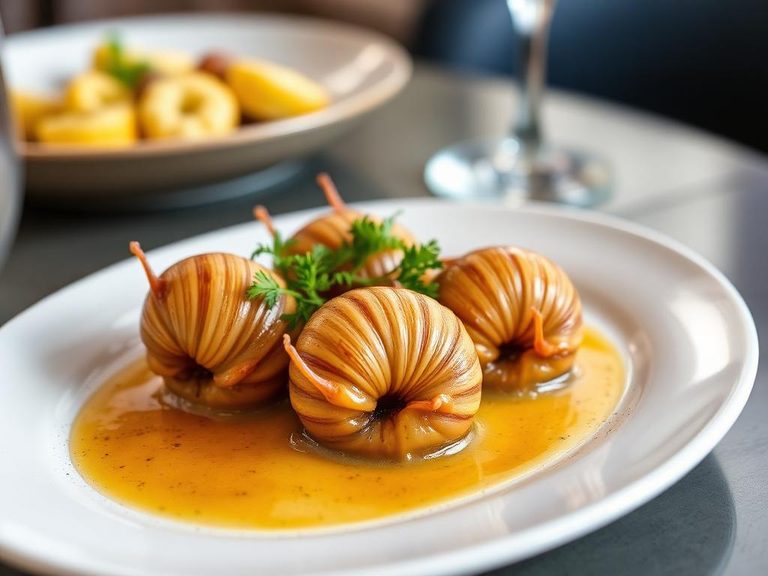
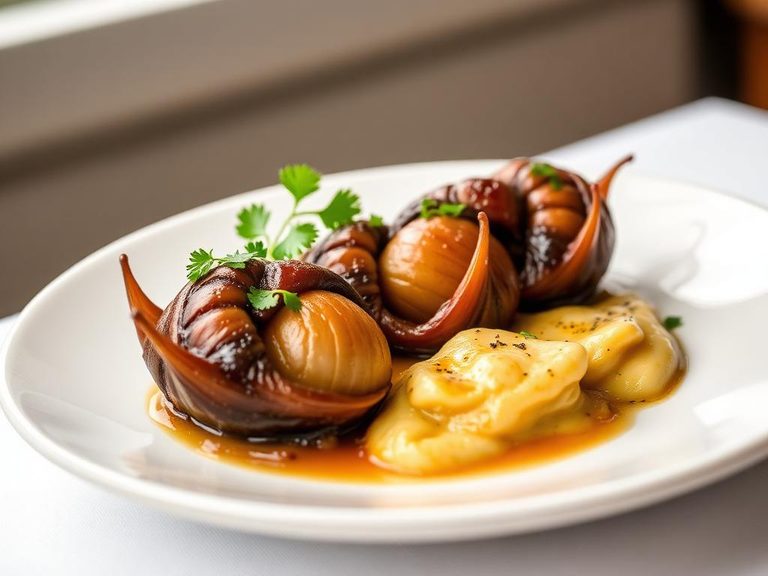
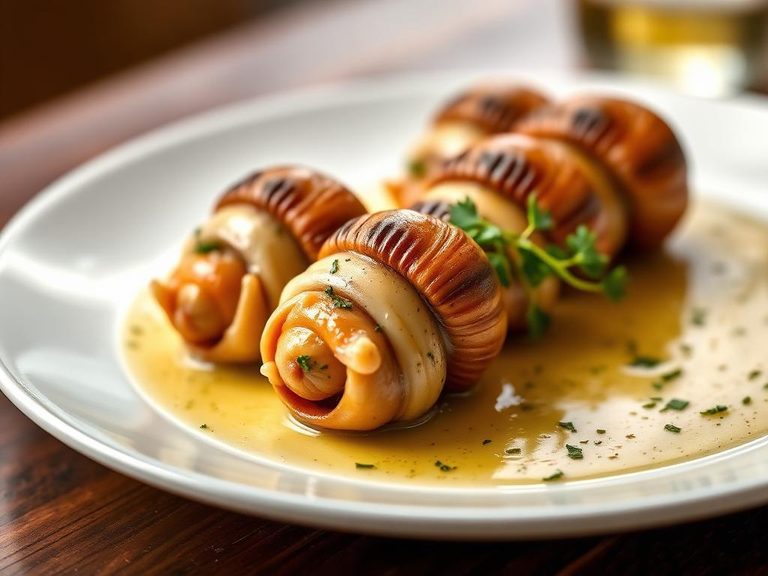
Escargot are land snails, traditionally served sizzling in their shells with a rich compound butter of garlic, parsley, and often a splash of white wine. The texture is uniquely tender yet slightly chewy, akin to a firm mushroom, while the flavor is earthy and deeply savory, acting as a perfect vehicle for the aromatic butter. Nutritionally, they are a powerhouse of lean protein with very few carbohydrates, making them a surprisingly light yet satisfying delicacy.
Calorie split: 53% protein · 7% carbs · 41% fat
↓ Full nutrition💚 Why it's loved
People adore escargot for the luxurious ritual of extracting the meat from the shell, coupled with the irresistible, garlicky-buttery sauce that is the true star of the dish. It is celebrated as a classic symbol of French bistro cuisine, representing a blend of rustic tradition and refined flavor.
⚠️ Watch-outs & how to enjoy it better
The primary downside is the high saturated fat and sodium content from the generous butter and salt used in preparation. Those watching their fat or salt intake should practice strict portion control and consider pairing escargot with a large, acidic green salad and crusty bread to soak up the butter, rather than consuming multiple servings alone.
Key benefits
- Excellent source of high-quality, lean protein
- Naturally low in carbohydrates and sugar
- Contains essential minerals like iron and magnesium
- Low in calories per serving when prepared traditionally
- Provides a good source of tryptophan
🍽️ Popular dishes
🌍 Where it's eaten
💡 Did you know?
The Roman Empire considered snails a delicacy and built special gardens called 'cochlearia' to farm them, seasoning them with milk or wine to purge their systems before cooking.
Full nutrition (USDA data · scales with serving)
| Water | 68.5 g |
| Energy | 158 kcal |
| Protein | 20.0 g |
| Total lipid (fat) | 6.9 g |
| Carbohydrate, by difference | 2.5 g |
| Fiber, total dietary | 0.00 g |
| Total Sugars | 0.00 g |
| Calcium, Ca | 13.0 mg |
| Iron, Fe | 4.4 mg |
| Magnesium, Mg | 310 mg |
| Phosphorus, P | 338 mg |
| Potassium, K | 474 mg |
| Sodium, Na | 287 mg |
| Zinc, Zn | 1.2 mg |
| Copper, Cu | 0.50 mg |
| Selenium, Se | 34.0 ug |
| Vitamin C, total ascorbic acid | 0.00 mg |
| Thiamin | 0.01 mg |
| Riboflavin | 0.14 mg |
| Niacin | 1.7 mg |
| Vitamin B-6 | 0.14 mg |
| Folate, total | 6.0 ug |
| Folic acid | 0.00 ug |
| Folate, food | 6.0 ug |
| Folate, DFE | 6.0 ug |
| Choline, total | 80.7 mg |
| Vitamin B-12 | 0.53 ug |
| Vitamin B-12, added | 0.00 ug |
| Vitamin A, RAE | 35.0 ug |
| Retinol | 35.0 ug |
| Carotene, beta | 0.00 ug |
| Carotene, alpha | 0.00 ug |
| Cryptoxanthin, beta | 0.00 ug |
| Lycopene | 0.00 ug |
| Lutein + zeaxanthin | 0.00 ug |
| Vitamin E (alpha-tocopherol) | 7.2 mg |
| Vitamin E, added | 0.00 mg |
| Vitamin D (D2 + D3) | 0.00 ug |
| Vitamin K (phylloquinone) | 5.3 ug |
| Alcohol, ethyl | 0.00 g |
| Caffeine | 0.00 mg |
| Theobromine | 0.00 mg |
Fat & fatty acid profile (per 100g)
| Fatty acids, total saturated | 1.1 g |
| SFA 4:0 | 0.00 g |
| SFA 6:0 | 0.00 g |
| SFA 8:0 | 0.00 g |
| SFA 10:0 | 0.00 g |
| SFA 12:0 | 0.00 g |
| SFA 14:0 | 0.07 g |
| SFA 16:0 | 0.81 g |
| SFA 18:0 | 0.21 g |
| Fatty acids, total monounsaturated | 2.5 g |
| MUFA 16:1 | 0.08 g |
| MUFA 18:1 | 2.4 g |
| MUFA 20:1 | 0.04 g |
| MUFA 22:1 | 0.00 g |
| Fatty acids, total polyunsaturated | 2.3 g |
| PUFA 18:2 | 1.8 g |
| PUFA 18:3 | 0.23 g |
| PUFA 18:4 | 0.02 g |
| PUFA 20:4 | 0.00 g |
| PUFA 20:5 n-3 (EPA) | 0.15 g |
| PUFA 22:5 n-3 (DPA) | 0.12 g |
| PUFA 22:6 n-3 (DHA) | 0.00 g |
| Cholesterol | 62.0 mg |
FAQ
Do escargot taste like the butter they're cooked in?
Yes, significantly. The snail meat itself has a mild, earthy flavor similar to a mushroom or clam. The iconic taste comes from the garlic-parsley-butter sauce it is cooked and served in.
Are canned escargot safe to eat?
Yes, commercially canned escargot are fully cooked and safe. They are a convenient option, but should be rinsed and often benefit from a quick sauté in fresh butter and garlic to enhance their flavor and texture.
What wine pairs best with escargot?
A crisp, dry white wine with good acidity is ideal. Classic pairings include a Chablis, Sauvignon Blanc, or a dry Alsatian Riesling, which cut through the richness of the butter.
Nutrient density (calculated · NRF9.3)
Nutrient Rich Foods index: beneficial nutrients (protein, fiber, vitamins, minerals) minus saturated fat, added sugar & sodium, per 100 kcal.
NRF9.3 index — Fulgoni, Keast & Drewnowski, 2009. Computed from USDA nutrients.
Weight-loss friendliness (composite index)
Energy density 1.58 kcal/g · 51% calories from protein · 0.0 g fiber · 0.0 g sugar per 100 g.
Composite of energy density (Rolls et al., 1999), protein & fiber satiety, minus sugar. A calculated heuristic — ranks satiety-per-calorie, not a clinical measure.
Dietary load (calculated from USDA values)
Potential renal acid load. Positive = acid-forming, negative = alkaline-forming.
Sodium-to-potassium ratio: 0.61 (lower is better — aim for ≤ 1)
Sodium:potassium per WHO potassium guidance. Computed from USDA nutrients.