

Eggplant with cheese and tomato sauce
Common food
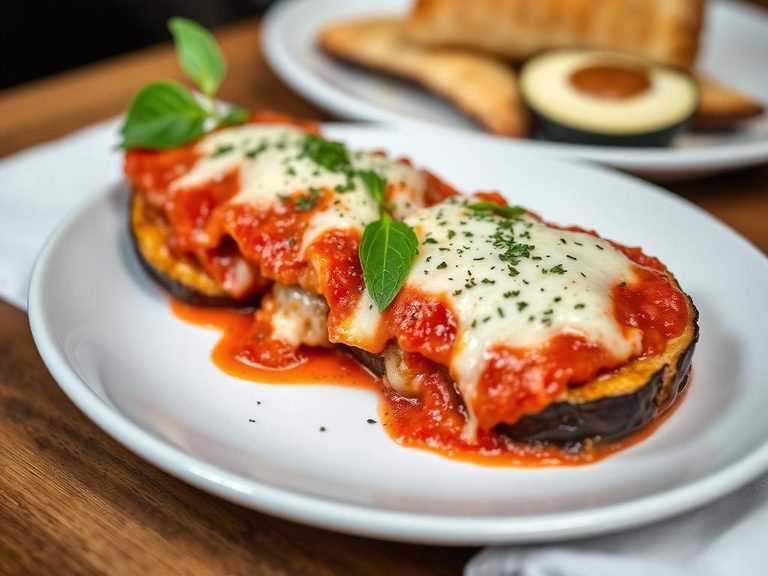
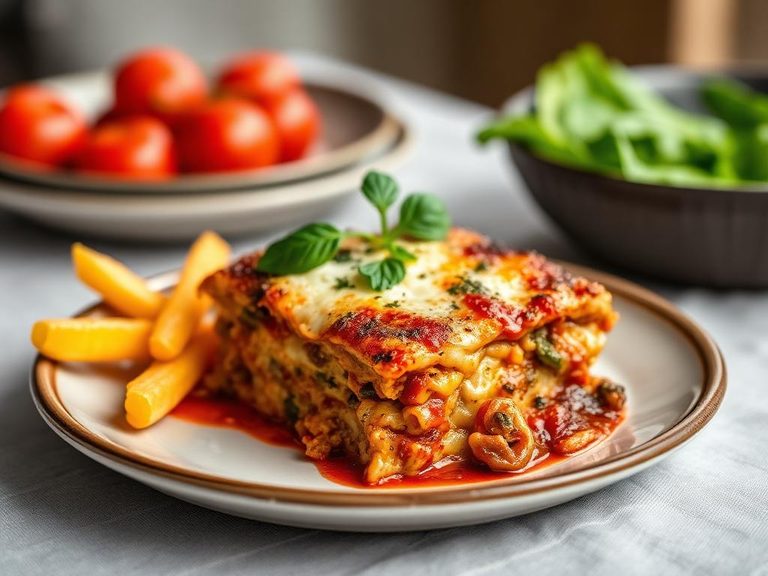
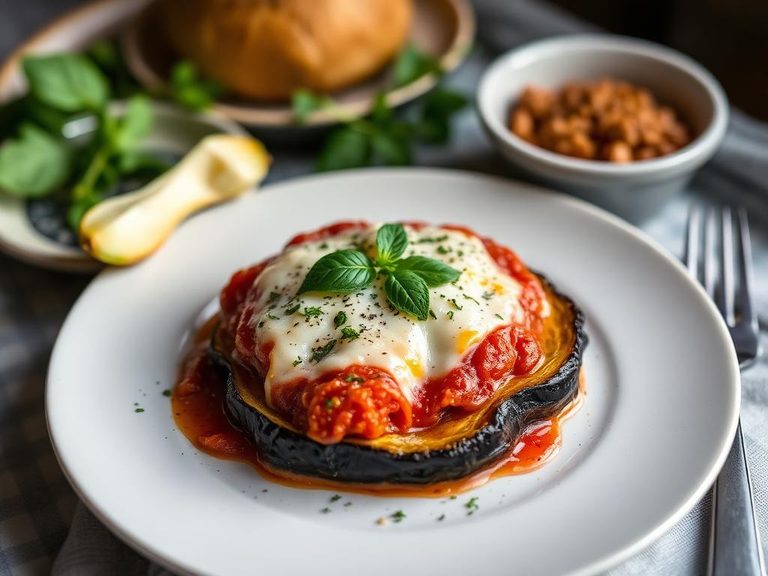
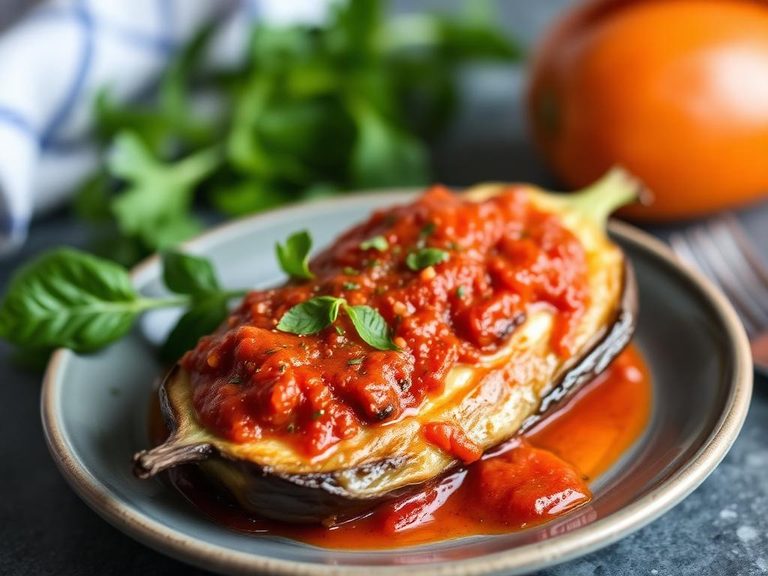
This is a baked or broiled dish where tender, creamy eggplant slices are layered or topped with a rich tomato sauce and melted, bubbly cheese. The texture is a delightful contrast: the soft, almost custard-like eggplant against the tangy sauce and savory, stretchy cheese. It's a surprisingly light, nutrient-dense meal that packs protein and fiber into a low-calorie package.
Calorie split: 26% protein · 27% carbs · 47% fat
↓ Full nutrition💚 Why it's loved
People adore this dish for its comforting, umami-rich flavor profile that feels indulgent yet wholesome. It's incredibly versatile, serving as a satisfying main, a hearty side, or a vegetarian centerpiece in many cuisines.
⚠️ Watch-outs & how to enjoy it better
The primary concern is the sodium content, which can be high from the cheese and any added salt in the sauce, potentially affecting those monitoring blood pressure. To counteract this, use low-sodium tomato sauce and a smaller amount of a strongly flavored cheese like Parmesan. Some may also experience blood sugar spikes from the combination of carbs in the sauce and cheese; pairing it with a side of leafy greens or lean protein can help stabilize blood sugar response.
Key benefits
- High in fiber for digestive health and satiety.
- Good source of plant-based protein from the cheese and eggplant.
- Rich in antioxidants like nasunin from eggplant skin and lycopene from tomatoes.
- Low in calories and sugar, making it suitable for weight management.
- Provides calcium and phosphorus from the cheese for bone health.
🍽️ Popular dishes

🌍 Where it's eaten
💡 Did you know?
The classic Italian dish 'Melanzane alla Parmigiana' does not actually contain Parmigiano-Reggiano cheese; the name likely derives from 'parmiciana,' a Sicilian term for the wooden slats of a shutter, resembling the layered arrangement of the eggplant slices.
Full nutrition (USDA data · scales with serving)
| Water | 80.8 g |
| Energy | 90.0 kcal |
| Protein | 6.2 g |
| Total lipid (fat) | 4.8 g |
| Carbohydrate, by difference | 6.3 g |
| Fiber, total dietary | 2.2 g |
| Total Sugars | 3.4 g |
| Calcium, Ca | 164 mg |
| Iron, Fe | 0.45 mg |
| Magnesium, Mg | 19.0 mg |
| Phosphorus, P | 138 mg |
| Potassium, K | 246 mg |
| Sodium, Na | 325 mg |
| Zinc, Zn | 0.95 mg |
| Copper, Cu | 0.09 mg |
| Selenium, Se | 6.3 ug |
| Vitamin C, total ascorbic acid | 3.0 mg |
| Thiamin | 0.03 mg |
| Riboflavin | 0.11 mg |
| Niacin | 0.66 mg |
| Vitamin B-6 | 0.09 mg |
| Folate, total | 18.0 ug |
| Folic acid | 0.00 ug |
| Folate, food | 18.0 ug |
| Folate, DFE | 18.0 ug |
| Choline, total | 9.7 mg |
| Vitamin B-12 | 0.33 ug |
| Vitamin B-12, added | 0.00 ug |
| Vitamin A, RAE | 50.0 ug |
| Retinol | 44.0 ug |
| Carotene, beta | 76.0 ug |
| Carotene, alpha | 0.00 ug |
| Cryptoxanthin, beta | 1.0 ug |
| Lycopene | 3618 ug |
| Lutein + zeaxanthin | 27.0 ug |
| Vitamin E (alpha-tocopherol) | 0.67 mg |
| Vitamin E, added | 0.00 mg |
| Vitamin D (D2 + D3) | 0.10 ug |
| Vitamin K (phylloquinone) | 3.2 ug |
| Alcohol, ethyl | 0.00 g |
| Caffeine | 0.00 mg |
| Theobromine | 0.00 mg |
Fat & fatty acid profile (per 100g)
| Fatty acids, total saturated | 2.7 g |
| SFA 4:0 | 0.09 g |
| SFA 6:0 | 0.07 g |
| SFA 8:0 | 0.05 g |
| SFA 10:0 | 0.11 g |
| SFA 12:0 | 0.13 g |
| SFA 14:0 | 0.42 g |
| SFA 16:0 | 1.3 g |
| SFA 18:0 | 0.46 g |
| Fatty acids, total monounsaturated | 1.1 g |
| MUFA 16:1 | 0.07 g |
| MUFA 18:1 | 1.1 g |
| MUFA 20:1 | 0.01 g |
| MUFA 22:1 | 0.00 g |
| Fatty acids, total polyunsaturated | 0.26 g |
| PUFA 18:2 | 0.24 g |
| PUFA 18:3 | 0.03 g |
| PUFA 18:4 | 0.00 g |
| PUFA 20:4 | 0.01 g |
| PUFA 20:5 n-3 (EPA) | 0.00 g |
| PUFA 22:5 n-3 (DPA) | 0.00 g |
| PUFA 22:6 n-3 (DHA) | 0.00 g |
| Cholesterol | 15.0 mg |
FAQ
Is eggplant with cheese and tomato sauce keto-friendly?
It can be modified to be keto-friendly. The primary carbs come from the eggplant and tomato sauce. To reduce carbs, use a smaller portion of eggplant, choose a no-sugar-added tomato sauce, and increase the amount of cheese and healthy fats like olive oil.
How do I prevent the eggplant from becoming soggy?
Salt the sliced eggplant and let it sit for 30-60 minutes to draw out moisture, then pat dry before cooking. You can also pre-cook the slices by grilling, broiling, or pan-frying them briefly to remove excess water before assembling the dish.
Can I make this dish vegan?
Yes, you can substitute the cheese with a vegan cheese alternative or use a cashew-based 'ricotta' and nutritional yeast for a cheesy flavor. The tomato sauce remains the same, and the eggplant provides a hearty base.
Nutrient density (calculated · NRF9.3)
Nutrient Rich Foods index: beneficial nutrients (protein, fiber, vitamins, minerals) minus saturated fat, added sugar & sodium, per 100 kcal.
NRF9.3 index — Fulgoni, Keast & Drewnowski, 2009. Computed from USDA nutrients.
Weight-loss friendliness (composite index)
Energy density 0.90 kcal/g · 27% calories from protein · 2.2 g fiber · 3.4 g sugar per 100 g.
Composite of energy density (Rolls et al., 1999), protein & fiber satiety, minus sugar. A calculated heuristic — ranks satiety-per-calorie, not a clinical measure.
Dietary load (calculated from USDA values)
Potential renal acid load. Positive = acid-forming, negative = alkaline-forming.
Sodium-to-potassium ratio: 1.32 (lower is better — aim for ≤ 1)
Sodium:potassium per WHO potassium guidance. Computed from USDA nutrients.