

Moussaka
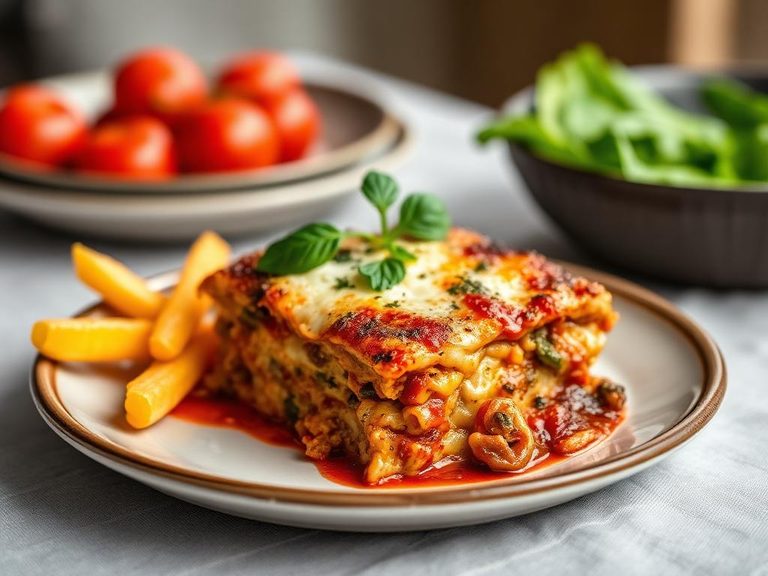
Moussaka is a rich and hearty baked casserole, most famously associated with Greek cuisine, though variations exist across the Balkans and Middle East. It typically features layers of sautéed eggplant (aubergine), a savory meat sauce—usually ground lamb or beef seasoned with cinnamon and allspice—and is topped with a thick, creamy béchamel sauce that browns beautifully in the oven.
🍳 View the full Moussaka recipe →
🍽️ Nutrition at a glance
This dish is generally high in fat and carbohydrates due to the creamy béchamel and the oil used to prepare the eggplant, while providing a solid amount of protein from the meat. A standard serving is quite calorie-dense, often ranging between 400 to 600 calories depending on the specific recipe and portion size.
Nutrition breakdown
| Calories | 450 kcal |
| Protein | 22 g |
| Carbs | 25 g |
| Fat | 28 g |
| Fiber | 4 g |
| Sugar | 8 g |
| Sodium | 850 mg |
| Potassium | 550 mg |
| Vitamin A | 150 mcg RAE |
| Vitamin C | 15 mg |
| Calcium | 200 mg |
| Iron | 2.5 mg |
| Vitamin B12 | 1.8 mcg |
| Phosphorus | 280 mg |
| Zinc | 3.5 mg |
Per 1 typical serving (approx. 300 g) · estimated, varies by recipe
💡 What's interesting
Culturally, moussaka is often considered the 'national dish' of Greece, popularized in its modern form by chef Nikolaos Tselementes in the 1920s who added the French-style béchamel topping. Nutritionally, the eggplant provides a good source of fiber and antioxidants, but the traditional preparation involves frying the slices, which significantly increases the overall fat content compared to roasting.
🍽️ Related dishes
AI estimate may be inaccurate · Terms