

Curry sauce
Common food
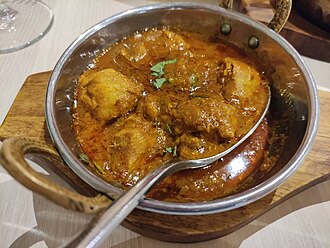
Photo: Wikipedia
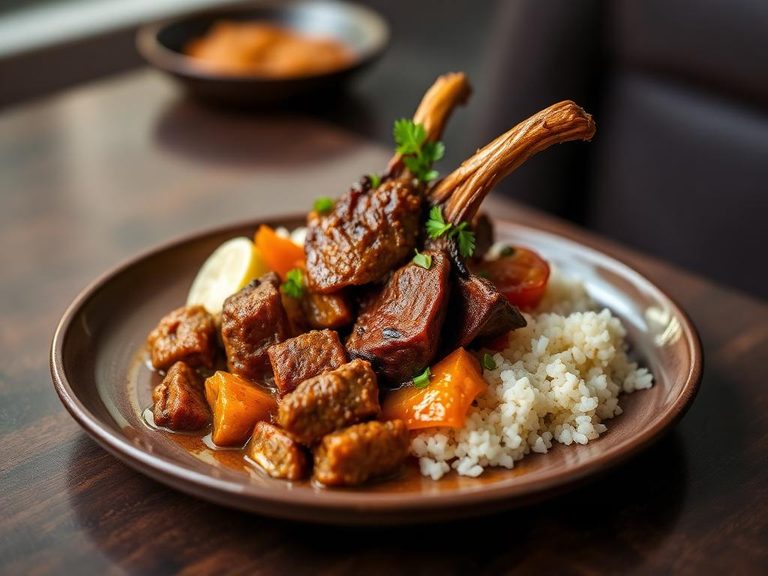
Curry sauce is a rich, aromatic condiment or cooking base, typically featuring a complex blend of spices like turmeric, cumin, and coriander, often simmered with coconut milk, tomatoes, or yogurt. Its texture can range from a thin, brothy liquid to a thick, creamy paste, delivering a warm, savory, and sometimes spicy flavor profile. Nutritionally, it is primarily a source of fat (8.22g per 100g), with minimal protein and moderate carbohydrates, making it a flavorful but calorie-dense addition to meals.
Calorie split: 6% protein · 20% carbs · 74% fat
↓ Full nutrition💚 Why it's loved
People love curry sauce for its deep, layered flavor that can transform simple ingredients into a satisfying meal. Its cultural significance in cuisines from India to Thailand makes it a beloved comfort food that is both versatile and deeply aromatic.
⚠️ Watch-outs & how to enjoy it better
The high fat content (8.22g per 100g) and potential for high sodium can be a concern for those monitoring calorie or salt intake. To counteract this, use portion control (e.g., 2-3 tablespoons per serving) and pair it with high-fiber vegetables or lean protein to balance the meal and slow the absorption of sugars and fats.
Key benefits
- Rich in anti-inflammatory spices like turmeric and ginger
- Can enhance the palatability of vegetables and lean proteins
- Provides dietary fiber (1.4g per 100g) from spice blends and vegetables
- Often contains antioxidants from herbs and spices
- Versatile for both quick meals and slow-cooked dishes
🍽️ Popular dishes

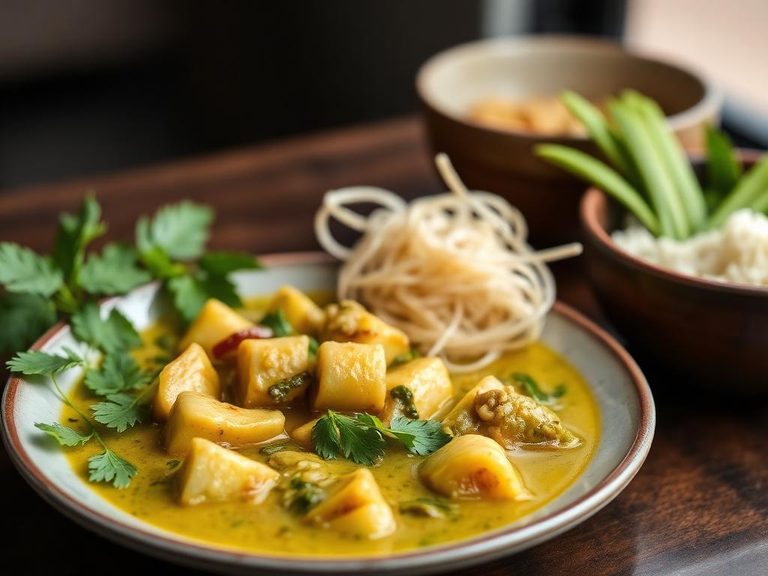
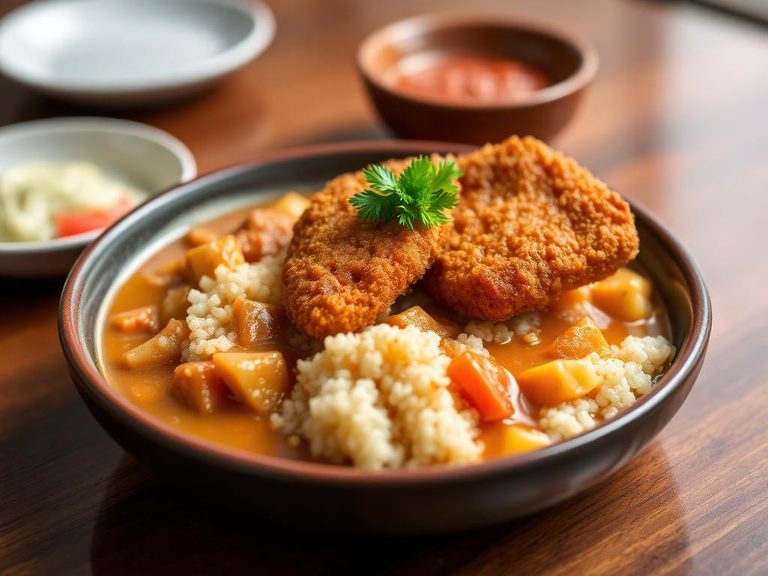

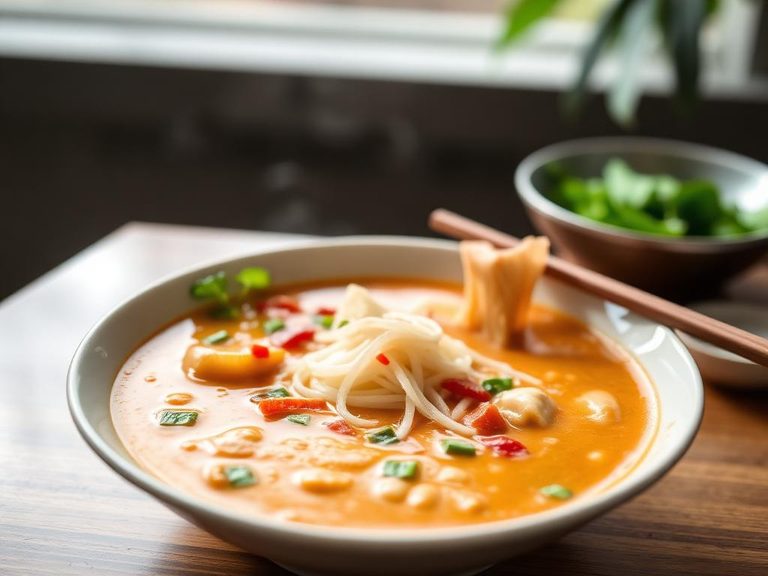
🌍 Where it's eaten
💡 Did you know?
The word 'curry' is believed to be an anglicization of the Tamil word 'kari,' meaning sauce or gravy, and was popularized by British colonists who simplified the complex spice blends into a single 'curry powder.'
Full nutrition (USDA data · scales with serving)
| Water | 83.7 g |
| Energy | 95.0 kcal |
| Protein | 1.4 g |
| Total lipid (fat) | 8.2 g |
| Carbohydrate, by difference | 5.0 g |
| Fiber, total dietary | 1.4 g |
| Total Sugars | 3.4 g |
| Calcium, Ca | 21.0 mg |
| Iron, Fe | 0.89 mg |
| Magnesium, Mg | 15.0 mg |
| Phosphorus, P | 36.0 mg |
| Potassium, K | 268 mg |
| Sodium, Na | 383 mg |
| Zinc, Zn | 0.25 mg |
| Copper, Cu | 0.11 mg |
| Selenium, Se | 1.1 ug |
| Vitamin C, total ascorbic acid | 5.8 mg |
| Thiamin | 0.03 mg |
| Riboflavin | 0.07 mg |
| Niacin | 0.85 mg |
| Vitamin B-6 | 0.08 mg |
| Folate, total | 9.0 ug |
| Folic acid | 0.00 ug |
| Folate, food | 9.0 ug |
| Folate, DFE | 9.0 ug |
| Choline, total | 9.6 mg |
| Vitamin B-12 | 0.03 ug |
| Vitamin B-12, added | 0.00 ug |
| Vitamin A, RAE | 21.0 ug |
| Retinol | 3.0 ug |
| Carotene, beta | 207 ug |
| Carotene, alpha | 0.00 ug |
| Cryptoxanthin, beta | 2.0 ug |
| Lycopene | 11116 ug |
| Lutein + zeaxanthin | 19.0 ug |
| Vitamin E (alpha-tocopherol) | 2.3 mg |
| Vitamin E, added | 0.00 mg |
| Vitamin D (D2 + D3) | 0.10 ug |
| Vitamin K (phylloquinone) | 8.3 ug |
| Alcohol, ethyl | 0.00 g |
| Caffeine | 0.00 mg |
| Theobromine | 0.00 mg |
Fat & fatty acid profile (per 100g)
| Fatty acids, total saturated | 2.5 g |
| SFA 4:0 | 0.01 g |
| SFA 6:0 | 0.01 g |
| SFA 8:0 | 0.12 g |
| SFA 10:0 | 0.10 g |
| SFA 12:0 | 0.75 g |
| SFA 14:0 | 0.32 g |
| SFA 16:0 | 0.82 g |
| SFA 18:0 | 0.29 g |
| Fatty acids, total monounsaturated | 2.7 g |
| MUFA 16:1 | 0.03 g |
| MUFA 18:1 | 2.6 g |
| MUFA 20:1 | 0.04 g |
| MUFA 22:1 | 0.00 g |
| Fatty acids, total polyunsaturated | 2.4 g |
| PUFA 18:2 | 2.2 g |
| PUFA 18:3 | 0.27 g |
| PUFA 18:4 | 0.00 g |
| PUFA 20:4 | 0.00 g |
| PUFA 20:5 n-3 (EPA) | 0.00 g |
| PUFA 22:5 n-3 (DPA) | 0.00 g |
| PUFA 22:6 n-3 (DHA) | 0.00 g |
| Cholesterol | 1.0 mg |
FAQ
Is curry sauce healthy?
Curry sauce can be healthy in moderation, as it contains beneficial spices with anti-inflammatory properties. However, it is often high in fat and sodium, so it's best used as a flavorful addition rather than a main component of a meal.
Can I make curry sauce at home?
Yes, making curry sauce at home allows you to control the ingredients, reducing sodium and fat. A basic recipe involves sautéing onions, garlic, and ginger, then adding spices like turmeric, cumin, and coriander, and simmering with coconut milk or tomatoes.
What is the difference between curry sauce and curry paste?
Curry paste is a concentrated blend of spices, herbs, and aromatics, often used as a base for cooking. Curry sauce is a more diluted, ready-to-use condiment or cooking liquid that may include additional ingredients like coconut milk or tomatoes.
Nutrient density (calculated · NRF9.3)
Nutrient Rich Foods index: beneficial nutrients (protein, fiber, vitamins, minerals) minus saturated fat, added sugar & sodium, per 100 kcal.
NRF9.3 index — Fulgoni, Keast & Drewnowski, 2009. Computed from USDA nutrients.
Weight-loss friendliness (composite index)
Energy density 0.95 kcal/g · 6% calories from protein · 1.4 g fiber · 3.4 g sugar per 100 g.
Composite of energy density (Rolls et al., 1999), protein & fiber satiety, minus sugar. A calculated heuristic — ranks satiety-per-calorie, not a clinical measure.
Dietary load (calculated from USDA values)
Potential renal acid load. Positive = acid-forming, negative = alkaline-forming.
Sodium-to-potassium ratio: 1.43 (lower is better — aim for ≤ 1)
Sodium:potassium per WHO potassium guidance. Computed from USDA nutrients.