

Creamy dressing, made with sour cream and/or buttermilk and oil, reduced calorie
Whole food · Fats and Oils

Photo: Wikipedia
This is a tangy, creamy salad dressing that uses a blend of sour cream or buttermilk with oil to create a rich, pourable consistency. It offers a cool, lactic tang balanced by a subtle richness, with a texture that clings well to greens and vegetables. Nutritionally, it provides a significant source of fat (14g per 100g) but is lower in calories than many full-fat versions.
Calorie split: 4% protein · 18% carbs · 79% fat
↓ Full nutrition💚 Why it's loved
People love it for its perfect balance of cool tang and rich creaminess, which elevates simple salads and acts as a versatile dip. It's a nostalgic staple in many households, often associated with classic potato salad or coleslaw.
⚠️ Watch-outs & how to enjoy it better
The high fat content (14g per 100g) can be a concern for those monitoring fat intake, and the 5.65g of sugar may affect blood sugar for sensitive individuals. To counteract, use it as a dip for raw vegetables (adding fiber) or as a component in a larger meal with lean protein to slow digestion and improve satiety.
Key benefits
- Provides dietary fat for satiety and nutrient absorption.
- Lower calorie than traditional full-fat creamy dressings.
- The buttermilk/sour cream base offers a distinct, tangy flavor profile.
- Versatile base for herbs and spices to customize flavor.
🍽️ Popular dishes
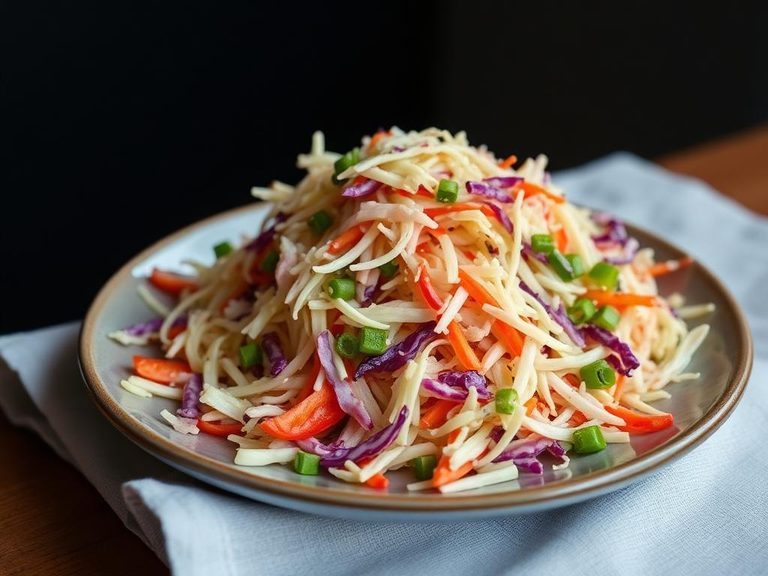
🌍 Where it's eaten
💡 Did you know?
The 'reduced calorie' version often achieves its lighter profile by using buttermilk (which is naturally lower in fat than cream) and sometimes incorporating ingredients like skim milk powder or modified food starch to maintain texture.
Full nutrition (USDA data · scales with serving)
| Water | 74.0 g |
| Energy | 160 kcal |
| Energy | 669 kj |
| Protein | 1.5 g |
| Total lipid (fat) | 14.0 g |
| Ash | 3.0 g |
| Carbohydrate, by difference | 7.0 g |
| Fiber, total dietary | 0.00 g |
| Total Sugars | 5.7 g |
| Calcium, Ca | 6.0 mg |
| Iron, Fe | 0.13 mg |
| Magnesium, Mg | 2.0 mg |
| Phosphorus, P | 7.0 mg |
| Potassium, K | 36.0 mg |
| Sodium, Na | 833 mg |
| Zinc, Zn | 0.04 mg |
| Copper, Cu | 0.00 mg |
| Selenium, Se | 1.6 ug |
| Vitamin C, total ascorbic acid | 0.40 mg |
| Thiamin | 0.01 mg |
| Riboflavin | 0.01 mg |
| Niacin | 0.02 mg |
| Vitamin B-6 | 0.03 mg |
| Folate, total | 6.0 ug |
| Folic acid | 0.00 ug |
| Folate, food | 6.0 ug |
| Folate, DFE | 6.0 ug |
| Choline, total | 16.0 mg |
| Vitamin B-12 | 0.07 ug |
| Vitamin B-12, added | 0.00 ug |
| Vitamin A, RAE | 11.0 ug |
| Retinol | 5.0 ug |
| Carotene, beta | 64.0 ug |
| Carotene, alpha | 17.0 ug |
| Cryptoxanthin, beta | 1.0 ug |
| Vitamin A, IU | 137 iu |
| Lycopene | 5.0 ug |
| Lutein + zeaxanthin | 78.0 ug |
| Vitamin E (alpha-tocopherol) | 2.5 mg |
| Vitamin E, added | 0.00 mg |
| Vitamin D (D2 + D3), International Units | 1.0 iu |
| Vitamin D (D2 + D3) | 0.00 ug |
| Vitamin K (phylloquinone) | 3.5 ug |
| Alcohol, ethyl | 0.00 g |
| Caffeine | 0.00 mg |
| Theobromine | 0.00 mg |
Fat & fatty acid profile (per 100g)
| Fatty acids, total saturated | 2.1 g |
| SFA 4:0 | 0.01 g |
| SFA 6:0 | 0.00 g |
| SFA 8:0 | 0.00 g |
| SFA 10:0 | 0.01 g |
| SFA 12:0 | 0.01 g |
| SFA 14:0 | 0.04 g |
| SFA 16:0 | 1.5 g |
| SFA 18:0 | 0.55 g |
| Fatty acids, total monounsaturated | 3.3 g |
| MUFA 16:1 | 0.03 g |
| MUFA 18:1 | 3.2 g |
| MUFA 20:1 | 0.03 g |
| MUFA 22:1 | 0.00 g |
| Fatty acids, total polyunsaturated | 8.0 g |
| PUFA 18:2 | 7.0 g |
| PUFA 18:3 | 0.94 g |
| PUFA 18:4 | 0.00 g |
| PUFA 20:4 | 0.00 g |
| PUFA 20:5 n-3 (EPA) | 0.00 g |
| PUFA 22:5 n-3 (DPA) | 0.00 g |
| PUFA 22:6 n-3 (DHA) | 0.00 g |
| Cholesterol | 0.00 mg |
FAQ
What's the difference between this and regular ranch dressing?
This is a broader category of dressing made with sour cream/buttermilk and oil. Ranch is a specific American herb-and-spice flavored version within that category, typically containing garlic, onion, and herbs like dill and parsley.
Can I use this as a cooking sauce?
It's best used as a cold dressing or dip. Heating it can cause the dairy components to separate or curdle. It's ideal for finishing or serving alongside cooked dishes.
Is it gluten-free?
The base ingredients (dairy, oil) are naturally gluten-free, but you must check the label for added thickeners, stabilizers, or flavorings that may contain gluten.
Nutrient density (calculated · NRF9.3)
Nutrient Rich Foods index: beneficial nutrients (protein, fiber, vitamins, minerals) minus saturated fat, added sugar & sodium, per 100 kcal.
NRF9.3 index — Fulgoni, Keast & Drewnowski, 2009. Computed from USDA nutrients.
Weight-loss friendliness (composite index)
Energy density 1.60 kcal/g · 4% calories from protein · 0.0 g fiber · 5.7 g sugar per 100 g.
Composite of energy density (Rolls et al., 1999), protein & fiber satiety, minus sugar. A calculated heuristic — ranks satiety-per-calorie, not a clinical measure.
Dietary load (calculated from USDA values)
Potential renal acid load. Positive = acid-forming, negative = alkaline-forming.
Sodium-to-potassium ratio: 23.14 (lower is better — aim for ≤ 1)
Sodium:potassium per WHO potassium guidance. Computed from USDA nutrients.