

Cheese ball
Common food
A cheese ball is a savory, creamy appetizer typically made by blending soft cheeses with seasonings and rolling the mixture into a sphere, often coated in nuts, herbs, or bacon bits. It offers a rich, tangy flavor with a smooth, spreadable texture that's perfect for crackers or vegetables. Nutritionally, it's a high-fat, high-protein snack with minimal carbohydrates.
Calorie split: 16% protein · 4% carbs · 79% fat
↓ Full nutrition💚 Why it's loved
People adore cheese balls for their irresistible combination of creamy, savory flavors and their role as a social centerpiece at gatherings, offering a nostalgic, crowd-pleasing appeal. Their versatility allows for endless customization with different cheeses, spices, and coatings to suit any palate.
⚠️ Watch-outs & how to enjoy it better
The high saturated fat and calorie content can be a concern for those monitoring heart health or calorie intake, and the sodium level may be problematic for individuals with hypertension. To counteract this, practice strict portion control and pair it with fiber-rich vegetables like celery or bell peppers instead of crackers to increase satiety and slow fat absorption.
Key benefits
- Excellent source of protein for muscle maintenance
- Provides calcium for bone health
- Contains fat-soluble vitamins like Vitamin A
- Low in carbohydrates, suitable for low-carb diets
- Offers quick energy from its calorie-dense profile
🍽️ Popular dishes

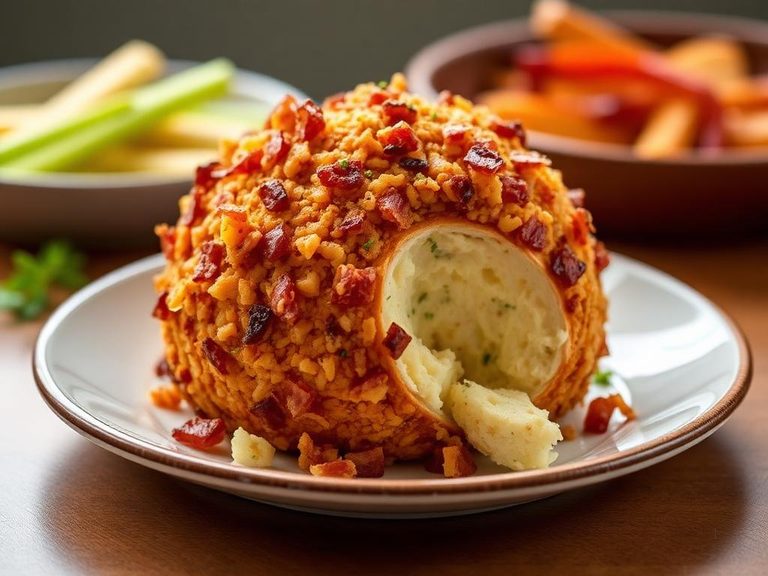
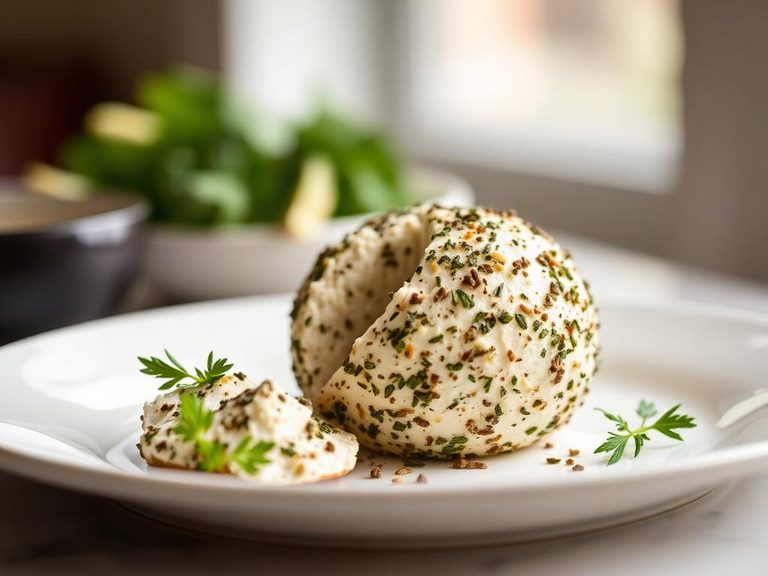


🌍 Where it's eaten
💡 Did you know?
The cheese ball as a party staple surged in popularity in the United States during the 1970s, becoming an iconic symbol of suburban entertaining and potluck culture.
Full nutrition (USDA data · scales with serving)
| Water | 35.4 g |
| Energy | 441 kcal |
| Protein | 17.9 g |
| Total lipid (fat) | 38.9 g |
| Carbohydrate, by difference | 4.8 g |
| Fiber, total dietary | 1.2 g |
| Total Sugars | 1.7 g |
| Calcium, Ca | 391 mg |
| Iron, Fe | 0.62 mg |
| Magnesium, Mg | 48.0 mg |
| Phosphorus, P | 351 mg |
| Potassium, K | 194 mg |
| Sodium, Na | 554 mg |
| Zinc, Zn | 2.7 mg |
| Copper, Cu | 0.28 mg |
| Selenium, Se | 19.8 ug |
| Vitamin C, total ascorbic acid | 0.90 mg |
| Thiamin | 0.11 mg |
| Riboflavin | 0.31 mg |
| Niacin | 1.0 mg |
| Vitamin B-6 | 0.22 mg |
| Folate, total | 34.0 ug |
| Folic acid | 0.00 ug |
| Folate, food | 34.0 ug |
| Folate, DFE | 34.0 ug |
| Choline, total | 27.4 mg |
| Vitamin B-12 | 0.63 ug |
| Vitamin B-12, added | 0.00 ug |
| Vitamin A, RAE | 201 ug |
| Retinol | 201 ug |
| Carotene, beta | 3.0 ug |
| Carotene, alpha | 0.00 ug |
| Cryptoxanthin, beta | 0.00 ug |
| Lycopene | 0.00 ug |
| Lutein + zeaxanthin | 3.0 ug |
| Vitamin E (alpha-tocopherol) | 0.68 mg |
| Vitamin E, added | 0.00 mg |
| Vitamin D (D2 + D3) | 0.40 ug |
| Vitamin K (phylloquinone) | 1.9 ug |
| Alcohol, ethyl | 0.00 g |
| Caffeine | 0.00 mg |
| Theobromine | 0.00 mg |
Fat & fatty acid profile (per 100g)
| Fatty acids, total saturated | 14.6 g |
| SFA 4:0 | 0.43 g |
| SFA 6:0 | 0.36 g |
| SFA 8:0 | 0.23 g |
| SFA 10:0 | 0.55 g |
| SFA 12:0 | 0.63 g |
| SFA 14:0 | 2.1 g |
| SFA 16:0 | 7.2 g |
| SFA 18:0 | 2.7 g |
| Fatty acids, total monounsaturated | 7.8 g |
| MUFA 16:1 | 0.41 g |
| MUFA 18:1 | 7.6 g |
| MUFA 20:1 | 0.09 g |
| MUFA 22:1 | 0.00 g |
| Fatty acids, total polyunsaturated | 11.6 g |
| PUFA 18:2 | 9.0 g |
| PUFA 18:3 | 2.0 g |
| PUFA 18:4 | 0.00 g |
| PUFA 20:4 | 0.04 g |
| PUFA 20:5 n-3 (EPA) | 0.01 g |
| PUFA 22:5 n-3 (DPA) | 0.01 g |
| PUFA 22:6 n-3 (DHA) | 0.00 g |
| Cholesterol | 71.0 mg |
FAQ
How long does a cheese ball last in the refrigerator?
A properly wrapped cheese ball can last for 5-7 days in the refrigerator. Ensure it's tightly covered in plastic wrap to prevent drying and absorbing other odors.
Can I freeze a cheese ball?
Yes, but the texture may change slightly upon thawing, becoming a bit crumbly. Wrap it tightly in plastic wrap and foil, freeze for up to 1 month, and thaw overnight in the refrigerator before serving.
What are the best cheeses for making a cheese ball?
Cream cheese is the classic base for its smooth texture. It's often blended with sharper cheeses like sharp cheddar, blue cheese, or goat cheese for enhanced flavor. Using a mix of soft and hard cheeses creates the ideal consistency and taste.
Nutrient density (calculated · NRF9.3)
Nutrient Rich Foods index: beneficial nutrients (protein, fiber, vitamins, minerals) minus saturated fat, added sugar & sodium, per 100 kcal.
NRF9.3 index — Fulgoni, Keast & Drewnowski, 2009. Computed from USDA nutrients.
Weight-loss friendliness (composite index)
Energy density 4.41 kcal/g · 16% calories from protein · 1.2 g fiber · 1.7 g sugar per 100 g.
Composite of energy density (Rolls et al., 1999), protein & fiber satiety, minus sugar. A calculated heuristic — ranks satiety-per-calorie, not a clinical measure.
Dietary load (calculated from USDA values)
Potential renal acid load. Positive = acid-forming, negative = alkaline-forming.
Sodium-to-potassium ratio: 2.86 (lower is better — aim for ≤ 1)
Sodium:potassium per WHO potassium guidance. Computed from USDA nutrients.