

Brandy and cola
Common food
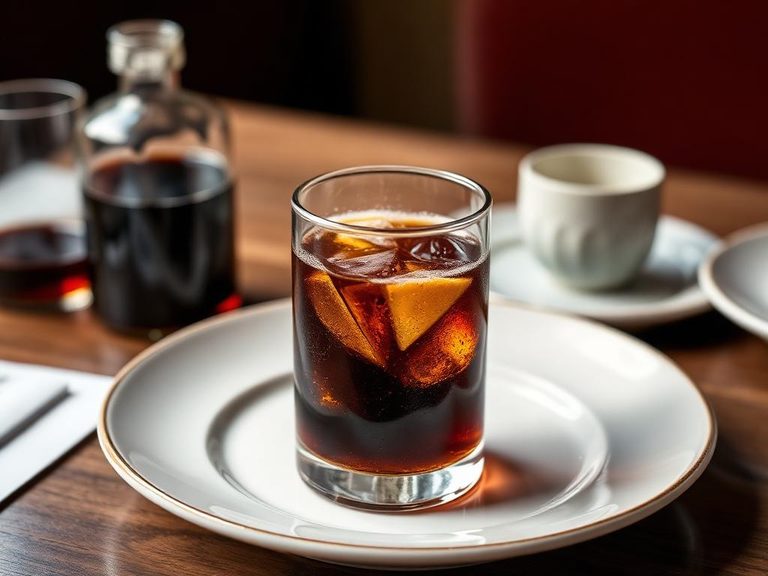
A spirited highball blending the warm, fruity notes of brandy with the sweet, caramel fizz of cola. It's a simple, refreshing mix with a smooth, effervescent texture and a deep amber hue. Nutritionally, it's a source of quick energy from sugar, with negligible protein or fat.
Calorie split: 0% protein · 95% carbs · 5% fat
↓ Full nutrition💚 Why it's loved
People love it for the classic, comforting combination of rich brandy and familiar cola sweetness, making it an easy-to-enjoy, nostalgic cocktail.
⚠️ Watch-outs & how to enjoy it better
The high sugar content can lead to a rapid blood-sugar spike and subsequent crash. To counteract this, consider using a sugar-free cola, limiting the portion, or pairing the drink with a protein-rich snack like nuts or cheese to slow sugar absorption.
Key benefits
- Quick source of carbohydrate energy
- Provides a small amount of antioxidants from brandy
- Simple to prepare with common ingredients
- Can be a social, celebratory drink
🍽️ Popular dishes


🌍 Where it's eaten
💡 Did you know?
The 'Rum and Coke' is iconic, but the 'Brandy and Coke' is a popular variant in many regions, including parts of the US and Southeast Asia, where brandy is a locally preferred spirit.
Full nutrition (USDA data · scales with serving)
| Water | 83.7 g |
| Energy | 89.0 kcal |
| Protein | 0.00 g |
| Total lipid (fat) | 0.19 g |
| Carbohydrate, by difference | 7.8 g |
| Fiber, total dietary | 0.00 g |
| Total Sugars | 7.5 g |
| Calcium, Ca | 1.0 mg |
| Iron, Fe | 0.02 mg |
| Magnesium, Mg | 0.00 mg |
| Phosphorus, P | 8.0 mg |
| Potassium, K | 4.0 mg |
| Sodium, Na | 3.0 mg |
| Zinc, Zn | 0.08 mg |
| Copper, Cu | 0.01 mg |
| Selenium, Se | 0.10 ug |
| Vitamin C, total ascorbic acid | 0.00 mg |
| Thiamin | 0.00 mg |
| Riboflavin | 0.00 mg |
| Niacin | 0.00 mg |
| Vitamin B-6 | 0.00 mg |
| Folate, total | 0.00 ug |
| Folic acid | 0.00 ug |
| Folate, food | 0.00 ug |
| Folate, DFE | 0.00 ug |
| Choline, total | 0.20 mg |
| Vitamin B-12 | 0.00 ug |
| Vitamin B-12, added | 0.00 ug |
| Vitamin A, RAE | 0.00 ug |
| Retinol | 0.00 ug |
| Carotene, beta | 0.00 ug |
| Carotene, alpha | 0.00 ug |
| Cryptoxanthin, beta | 0.00 ug |
| Lycopene | 0.00 ug |
| Lutein + zeaxanthin | 0.00 ug |
| Vitamin E (alpha-tocopherol) | 0.00 mg |
| Vitamin E, added | 0.00 mg |
| Vitamin D (D2 + D3) | 0.00 ug |
| Vitamin K (phylloquinone) | 0.00 ug |
| Alcohol, ethyl | 8.3 g |
| Caffeine | 7.0 mg |
| Theobromine | 0.00 mg |
Fat & fatty acid profile (per 100g)
| Fatty acids, total saturated | 0.00 g |
| SFA 4:0 | 0.00 g |
| SFA 6:0 | 0.00 g |
| SFA 8:0 | 0.00 g |
| SFA 10:0 | 0.00 g |
| SFA 12:0 | 0.00 g |
| SFA 14:0 | 0.00 g |
| SFA 16:0 | 0.00 g |
| SFA 18:0 | 0.00 g |
| Fatty acids, total monounsaturated | 0.00 g |
| MUFA 16:1 | 0.00 g |
| MUFA 18:1 | 0.00 g |
| MUFA 20:1 | 0.00 g |
| MUFA 22:1 | 0.00 g |
| Fatty acids, total polyunsaturated | 0.00 g |
| PUFA 18:2 | 0.00 g |
| PUFA 18:3 | 0.00 g |
| PUFA 18:4 | 0.00 g |
| PUFA 20:4 | 0.00 g |
| PUFA 20:5 n-3 (EPA) | 0.00 g |
| PUFA 22:5 n-3 (DPA) | 0.00 g |
| PUFA 22:6 n-3 (DHA) | 0.00 g |
| Cholesterol | 0.00 mg |
FAQ
Is brandy and cola a high-calorie drink?
At 89 kcal per 100g, a typical 150g serving contains about 134 kcal. Most calories come from the sugar in the cola, making it a moderate-calorie alcoholic beverage.
What's the best ratio of brandy to cola?
A common ratio is 1 part brandy to 3 or 4 parts cola, served over ice. Adjust to taste for a stronger or milder flavor.
Does the type of cola matter?
Yes. A full-sugar cola provides the classic sweet taste, while a diet or zero-sugar cola significantly reduces the calorie and sugar content, altering the drink's profile.
Nutrient density (calculated · NRF9.3)
Nutrient Rich Foods index: beneficial nutrients (protein, fiber, vitamins, minerals) minus saturated fat, added sugar & sodium, per 100 kcal.
NRF9.3 index — Fulgoni, Keast & Drewnowski, 2009. Computed from USDA nutrients.
Weight-loss friendliness (composite index)
Energy density 0.89 kcal/g · 0% calories from protein · 0.0 g fiber · 7.5 g sugar per 100 g.
Composite of energy density (Rolls et al., 1999), protein & fiber satiety, minus sugar. A calculated heuristic — ranks satiety-per-calorie, not a clinical measure.
Dietary load (calculated from USDA values)
Potential renal acid load. Positive = acid-forming, negative = alkaline-forming.
Sodium-to-potassium ratio: 0.75 (lower is better — aim for ≤ 1)
Sodium:potassium per WHO potassium guidance. Computed from USDA nutrients.