

Vodka and cola
Common food
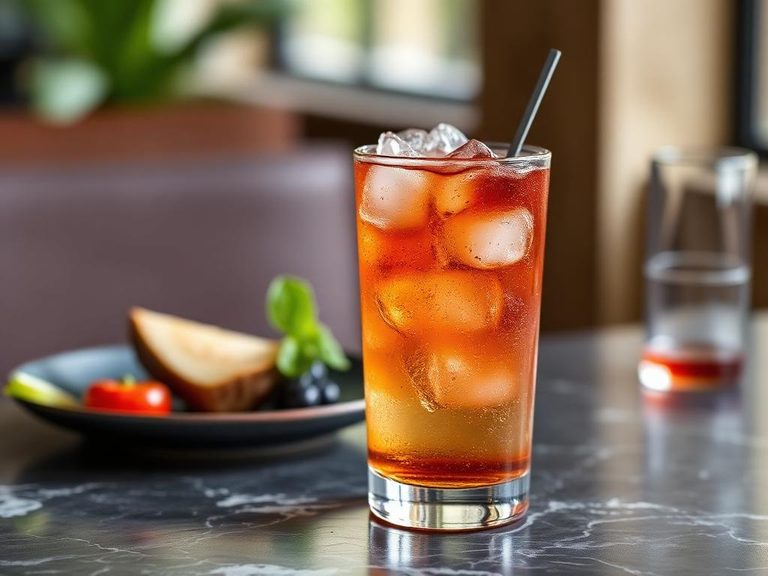
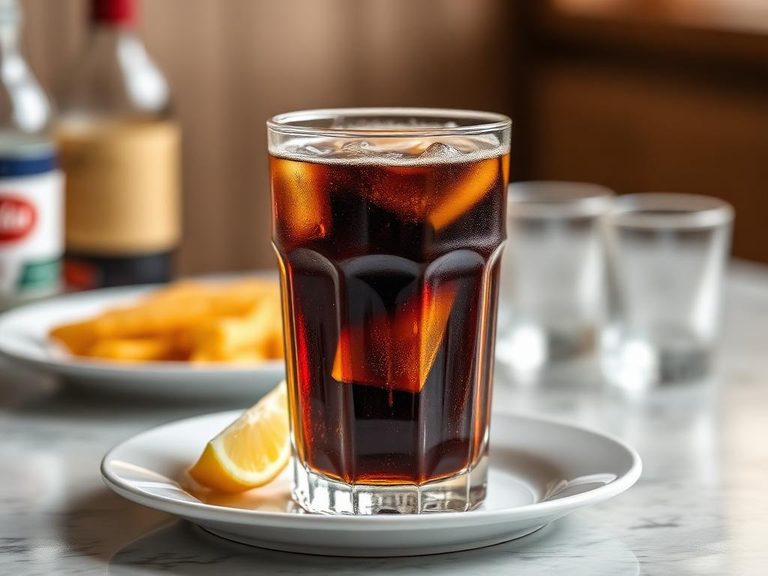
Vodka and cola is a classic highball cocktail that blends the clean, neutral bite of vodka with the sweet, caramel-vanilla fizz of cola. The result is a smooth, effervescent drink with a deep amber hue, offering a straightforward, refreshing taste with a mild alcoholic kick. Nutritionally, it's essentially liquid carbs and sugar, with negligible protein, fat, or fiber.
Calorie split: 0% protein · 95% carbs · 5% fat
↓ Full nutrition💚 Why it's loved
People love it for its effortless simplicity and the nostalgic, comforting combination of sweet and bubbly. It's a versatile, crowd-pleasing mixer that requires no special skill to enjoy.
⚠️ Watch-outs & how to enjoy it better
The high sugar content can lead to rapid blood-sugar spikes and subsequent crashes, and the empty calories offer little nutritional benefit. To counteract this, consider using a diet cola, limiting the portion to a single serving, or pairing the drink with a protein-rich snack to slow sugar absorption.
Key benefits
- Quick to prepare with just two ingredients
- Provides a quick source of energy from simple carbohydrates
- The carbonation can offer a refreshing, palate-cleansing sensation
- A familiar, low-fuss option at bars and social gatherings
🍽️ Popular dishes

🌍 Where it's eaten
💡 Did you know?
The 'Rum and Coke' is often credited as the precursor, but the 'Vodka and Coke' gained massive popularity in the 1970s and 80s, partly due to the global rise of vodka as a 'clean' spirit and the ubiquitous marketing of cola brands.
Full nutrition (USDA data · scales with serving)
| Water | 83.7 g |
| Energy | 89.0 kcal |
| Protein | 0.00 g |
| Total lipid (fat) | 0.19 g |
| Carbohydrate, by difference | 7.8 g |
| Fiber, total dietary | 0.00 g |
| Total Sugars | 7.5 g |
| Calcium, Ca | 1.0 mg |
| Iron, Fe | 0.02 mg |
| Magnesium, Mg | 0.00 mg |
| Phosphorus, P | 8.0 mg |
| Potassium, K | 4.0 mg |
| Sodium, Na | 3.0 mg |
| Zinc, Zn | 0.08 mg |
| Copper, Cu | 0.01 mg |
| Selenium, Se | 0.10 ug |
| Vitamin C, total ascorbic acid | 0.00 mg |
| Thiamin | 0.00 mg |
| Riboflavin | 0.00 mg |
| Niacin | 0.00 mg |
| Vitamin B-6 | 0.00 mg |
| Folate, total | 0.00 ug |
| Folic acid | 0.00 ug |
| Folate, food | 0.00 ug |
| Folate, DFE | 0.00 ug |
| Choline, total | 0.20 mg |
| Vitamin B-12 | 0.00 ug |
| Vitamin B-12, added | 0.00 ug |
| Vitamin A, RAE | 0.00 ug |
| Retinol | 0.00 ug |
| Carotene, beta | 0.00 ug |
| Carotene, alpha | 0.00 ug |
| Cryptoxanthin, beta | 0.00 ug |
| Lycopene | 0.00 ug |
| Lutein + zeaxanthin | 0.00 ug |
| Vitamin E (alpha-tocopherol) | 0.00 mg |
| Vitamin E, added | 0.00 mg |
| Vitamin D (D2 + D3) | 0.00 ug |
| Vitamin K (phylloquinone) | 0.00 ug |
| Alcohol, ethyl | 8.3 g |
| Caffeine | 7.0 mg |
| Theobromine | 0.00 mg |
Fat & fatty acid profile (per 100g)
| Fatty acids, total saturated | 0.00 g |
| SFA 4:0 | 0.00 g |
| SFA 6:0 | 0.00 g |
| SFA 8:0 | 0.00 g |
| SFA 10:0 | 0.00 g |
| SFA 12:0 | 0.00 g |
| SFA 14:0 | 0.00 g |
| SFA 16:0 | 0.00 g |
| SFA 18:0 | 0.00 g |
| Fatty acids, total monounsaturated | 0.00 g |
| MUFA 16:1 | 0.00 g |
| MUFA 18:1 | 0.00 g |
| MUFA 20:1 | 0.00 g |
| MUFA 22:1 | 0.00 g |
| Fatty acids, total polyunsaturated | 0.00 g |
| PUFA 18:2 | 0.00 g |
| PUFA 18:3 | 0.00 g |
| PUFA 18:4 | 0.00 g |
| PUFA 20:4 | 0.00 g |
| PUFA 20:5 n-3 (EPA) | 0.00 g |
| PUFA 22:5 n-3 (DPA) | 0.00 g |
| PUFA 22:6 n-3 (DHA) | 0.00 g |
| Cholesterol | 0.00 mg |
FAQ
Is vodka and cola gluten-free?
Most vodkas distilled from grains like wheat or barley are considered gluten-free after distillation, as the process removes gluten proteins. However, those with severe celiac disease may opt for vodka made from potatoes, grapes, or corn for absolute certainty. Cola is typically gluten-free.
How does the calorie count change with diet cola?
Using a diet or zero-sugar cola drastically reduces the calorie count from around 89 kcal per 100g to near zero for the mixer itself. The calories then come almost entirely from the vodka (approx. 64 kcal per 1.5 oz shot).
What's the best type of cola to use?
This is highly personal. Some prefer the sharper, more citrus-forward taste of Pepsi, while others favor the smoother, vanilla-cinnamon notes of Coca-Cola. For a less sweet, more complex flavor, some bartenders recommend using a craft cola with natural spices.
Nutrient density (calculated · NRF9.3)
Nutrient Rich Foods index: beneficial nutrients (protein, fiber, vitamins, minerals) minus saturated fat, added sugar & sodium, per 100 kcal.
NRF9.3 index — Fulgoni, Keast & Drewnowski, 2009. Computed from USDA nutrients.
Weight-loss friendliness (composite index)
Energy density 0.89 kcal/g · 0% calories from protein · 0.0 g fiber · 7.5 g sugar per 100 g.
Composite of energy density (Rolls et al., 1999), protein & fiber satiety, minus sugar. A calculated heuristic — ranks satiety-per-calorie, not a clinical measure.
Dietary load (calculated from USDA values)
Potential renal acid load. Positive = acid-forming, negative = alkaline-forming.
Sodium-to-potassium ratio: 0.75 (lower is better — aim for ≤ 1)
Sodium:potassium per WHO potassium guidance. Computed from USDA nutrients.