

Vodka and diet cola
Common food
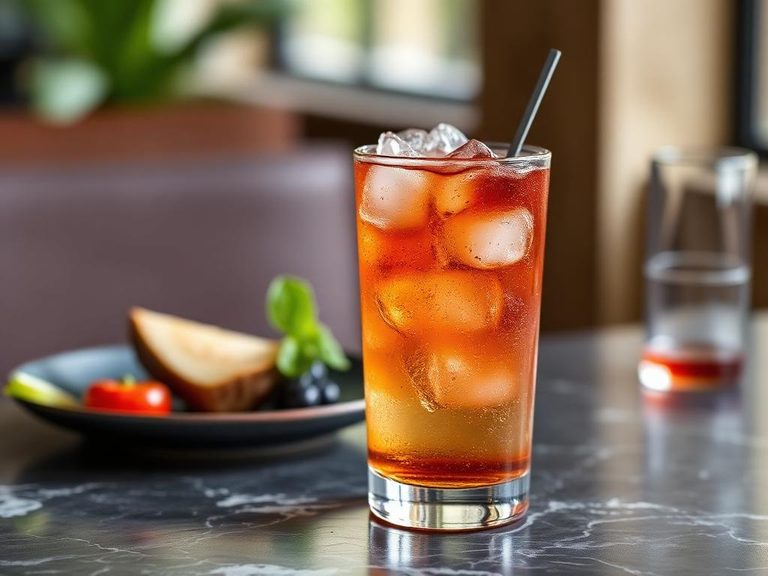
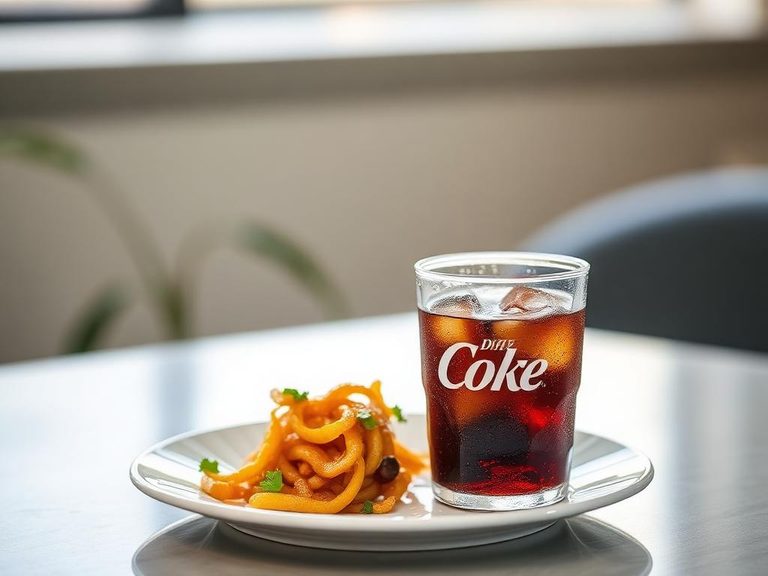
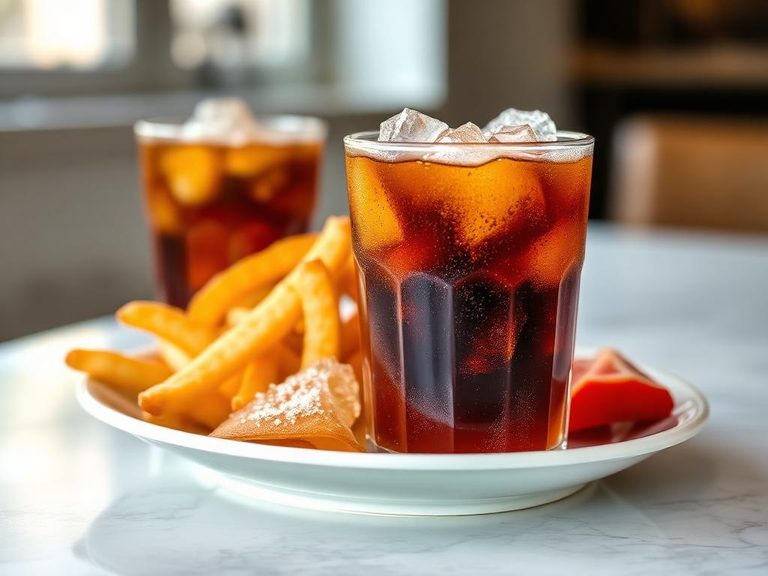
A crisp, effervescent highball that combines the clean, neutral bite of vodka with the sweet, caramel-kissed fizz of diet cola. It's a low-calorie, zero-sugar adult beverage that delivers a refreshing, bubbly kick with a smooth finish. Nutritionally, it's a lean choice at just 60 kcal per 100g, with negligible macros.
Calorie split: 23% protein · 64% carbs · 13% fat
↓ Full nutrition💚 Why it's loved
People love its simplicity and the satisfying contrast between the sharp spirit and the sweet, fizzy mixer. It's a go-to for those seeking a straightforward, low-calorie alcoholic drink that's easy to sip in social settings.
⚠️ Watch-outs & how to enjoy it better
The carbonation and acidity can be harsh on sensitive stomachs or contribute to bloating. For those monitoring blood sugar, while diet cola is sugar-free, the alcohol itself can affect glucose regulation. Tip: Sip slowly, consider alternating with water, and ensure you've eaten a balanced meal beforehand to mitigate digestive discomfort and alcohol's effects.
Key benefits
- Low in calories (60 kcal per 100g)
- Contains zero sugar and zero fat
- Quick to prepare and widely available
- Provides a refreshing, carbonated alternative to sugary cocktails
- Can be a lower-calorie option compared to full-sugar mixed drinks
🍽️ Popular dishes


🌍 Where it's eaten
💡 Did you know?
The 'Diet Coke and vodka' combination became a cultural phenomenon in the 1990s and early 2000s, often associated with the 'Cosmopolitan' crowd and popularized in TV shows like 'Sex and the City' as a chic, no-fuss cocktail.
Full nutrition (USDA data · scales with serving)
| Water | 91.2 g |
| Energy | 60.0 kcal |
| Protein | 0.08 g |
| Total lipid (fat) | 0.02 g |
| Carbohydrate, by difference | 0.22 g |
| Fiber, total dietary | 0.00 g |
| Total Sugars | 0.00 g |
| Calcium, Ca | 2.0 mg |
| Iron, Fe | 0.09 mg |
| Magnesium, Mg | 1.0 mg |
| Phosphorus, P | 8.0 mg |
| Potassium, K | 6.0 mg |
| Sodium, Na | 6.0 mg |
| Zinc, Zn | 0.02 mg |
| Copper, Cu | 0.01 mg |
| Selenium, Se | 0.00 ug |
| Vitamin C, total ascorbic acid | 0.00 mg |
| Thiamin | 0.01 mg |
| Riboflavin | 0.02 mg |
| Niacin | 0.00 mg |
| Vitamin B-6 | 0.00 mg |
| Folate, total | 0.00 ug |
| Folic acid | 0.00 ug |
| Folate, food | 0.00 ug |
| Folate, DFE | 0.00 ug |
| Choline, total | 0.00 mg |
| Vitamin B-12 | 0.00 ug |
| Vitamin B-12, added | 0.00 ug |
| Vitamin A, RAE | 0.00 ug |
| Retinol | 0.00 ug |
| Carotene, beta | 0.00 ug |
| Carotene, alpha | 0.00 ug |
| Cryptoxanthin, beta | 0.00 ug |
| Lycopene | 0.00 ug |
| Lutein + zeaxanthin | 0.00 ug |
| Vitamin E (alpha-tocopherol) | 0.00 mg |
| Vitamin E, added | 0.00 mg |
| Vitamin D (D2 + D3) | 0.00 ug |
| Vitamin K (phylloquinone) | 0.00 ug |
| Alcohol, ethyl | 8.5 g |
| Caffeine | 9.0 mg |
| Theobromine | 0.00 mg |
Fat & fatty acid profile (per 100g)
| Fatty acids, total saturated | 0.00 g |
| SFA 4:0 | 0.00 g |
| SFA 6:0 | 0.00 g |
| SFA 8:0 | 0.00 g |
| SFA 10:0 | 0.00 g |
| SFA 12:0 | 0.00 g |
| SFA 14:0 | 0.00 g |
| SFA 16:0 | 0.00 g |
| SFA 18:0 | 0.00 g |
| Fatty acids, total monounsaturated | 0.00 g |
| MUFA 16:1 | 0.00 g |
| MUFA 18:1 | 0.00 g |
| MUFA 20:1 | 0.00 g |
| MUFA 22:1 | 0.00 g |
| Fatty acids, total polyunsaturated | 0.00 g |
| PUFA 18:2 | 0.00 g |
| PUFA 18:3 | 0.00 g |
| PUFA 18:4 | 0.00 g |
| PUFA 20:4 | 0.00 g |
| PUFA 20:5 n-3 (EPA) | 0.00 g |
| PUFA 22:5 n-3 (DPA) | 0.00 g |
| PUFA 22:6 n-3 (DHA) | 0.00 g |
| Cholesterol | 0.00 mg |
FAQ
Is vodka and diet cola a keto-friendly drink?
Generally, yes. Vodka is a zero-carb spirit, and diet cola contains no sugar or carbs. However, individual responses to artificial sweeteners can vary, and alcohol can temporarily pause ketosis. It's considered a low-carb option within a ketogenic diet.
Why does my diet cola go flat so quickly in this drink?
The ice and the alcohol (vodka) both act as nucleation sites, causing the carbon dioxide in the soda to escape rapidly. To preserve fizz, chill all components thoroughly, pour the vodka first, add ice last, and top with the diet cola just before serving.
Are there any hidden calories or carbs in this drink?
The calories come almost entirely from the alcohol in the vodka. A standard 1.5 oz (44ml) shot of 80-proof vodka has about 97 calories and 0g carbs. Diet cola adds negligible calories and carbs. The total for a typical mixed drink is around 100-110 kcal.
Nutrient density (calculated · NRF9.3)
Nutrient Rich Foods index: beneficial nutrients (protein, fiber, vitamins, minerals) minus saturated fat, added sugar & sodium, per 100 kcal.
NRF9.3 index — Fulgoni, Keast & Drewnowski, 2009. Computed from USDA nutrients.
Weight-loss friendliness (composite index)
Energy density 0.60 kcal/g · 1% calories from protein · 0.0 g fiber · 0.0 g sugar per 100 g.
Composite of energy density (Rolls et al., 1999), protein & fiber satiety, minus sugar. A calculated heuristic — ranks satiety-per-calorie, not a clinical measure.
Dietary load (calculated from USDA values)
Potential renal acid load. Positive = acid-forming, negative = alkaline-forming.
Sodium-to-potassium ratio: 1.00 (lower is better — aim for ≤ 1)
Sodium:potassium per WHO potassium guidance. Computed from USDA nutrients.