

Swiss steak
Common food

Photo: Wikipedia
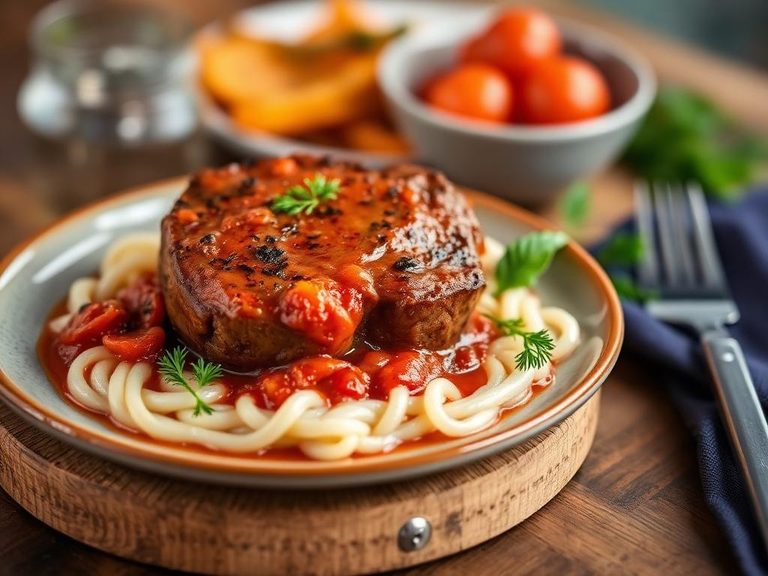
Swiss steak is a classic American comfort dish where tough cuts of beef are tenderized through mechanical pounding or scoring, then braised slowly in a rich tomato-based gravy with onions, celery, and often bell peppers. The long, moist cooking process transforms the meat into a fork-tender, savory meal with a deep, savory flavor profile and a hearty, melt-in-your-mouth texture. Nutritionally, it's a protein powerhouse, delivering over 15 grams of high-quality protein per 100 grams with a moderate calorie count, making it a satisfying centerpiece for a meal.
Calorie split: 53% protein · 13% carbs · 34% fat
↓ Full nutrition💚 Why it's loved
People love Swiss steak for its profound comfort-food appeal and the magic of turning a humble, tough cut of meat into something incredibly tender and flavorful. It's a versatile one-pot meal that's deeply embedded in American home cooking traditions, evoking nostalgia and satisfying cravings for a hearty, savory dinner.
⚠️ Watch-outs & how to enjoy it better
The traditional preparation can be high in sodium, especially if using canned tomatoes and pre-made sauces, which is a consideration for those monitoring blood pressure. The dish is also typically made with tougher, fattier cuts of beef, which increases the saturated fat content. To counteract this, use low-sodium tomatoes and broth, trim excess fat from the meat before cooking, and consider a leaner cut like round steak. Pairing it with a large portion of steamed or roasted non-starchy vegetables can balance the meal nutritionally.
Key benefits
- Excellent source of high-quality protein for muscle maintenance and repair.
- Rich in iron and B vitamins, particularly B12, from the beef.
- Low in carbohydrates, making it suitable for low-carb dietary patterns.
- The slow-braising method can help break down connective tissue, potentially aiding digestibility.
- Provides a good base for adding nutrient-dense vegetables like tomatoes, onions, and peppers.
🍽️ Popular dishes
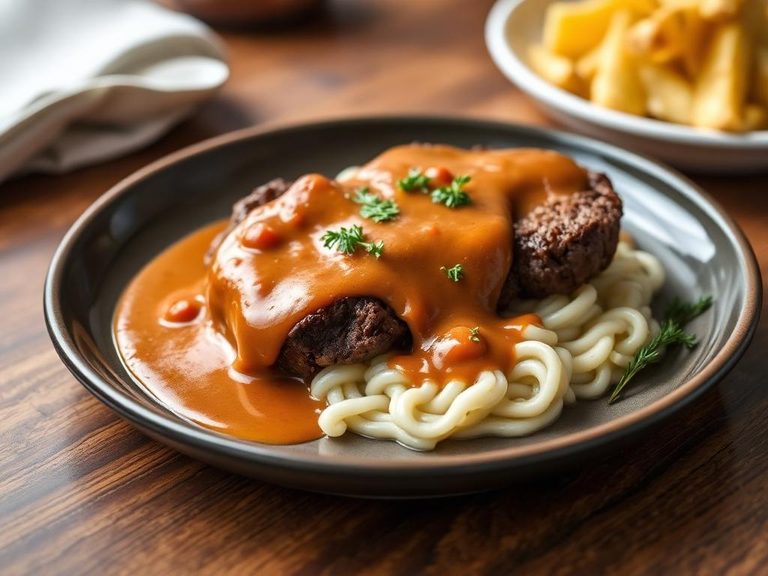
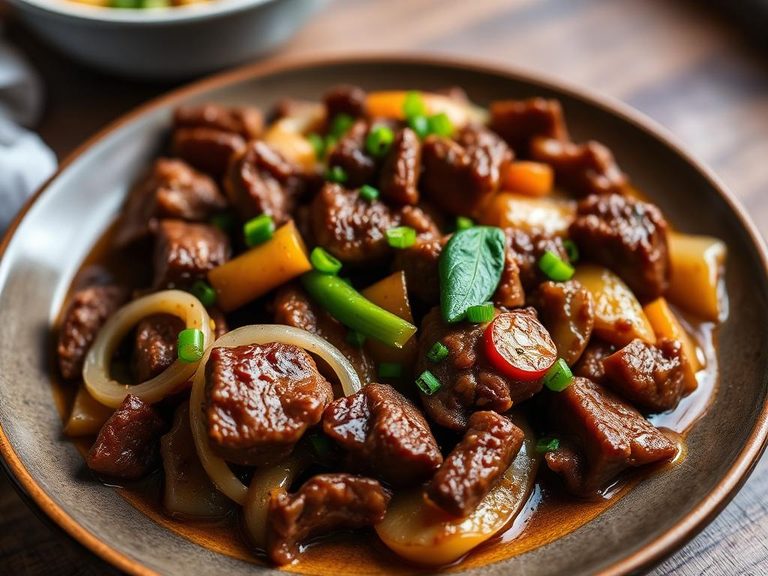
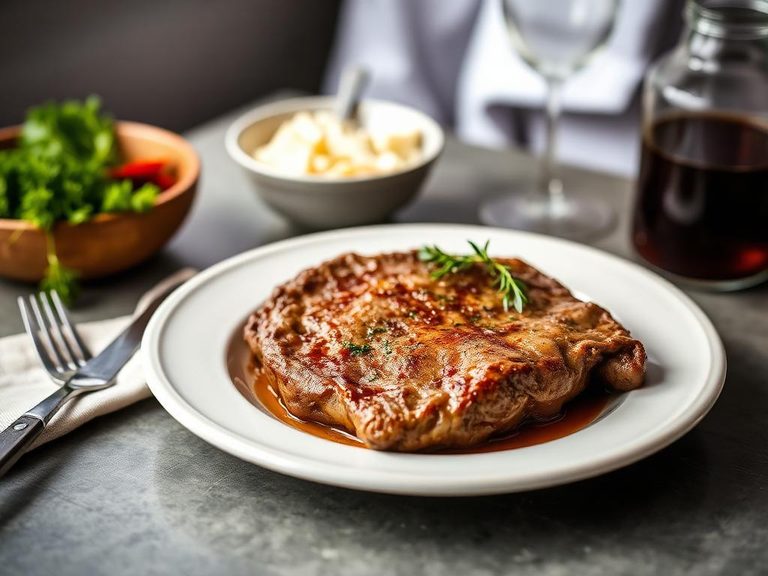
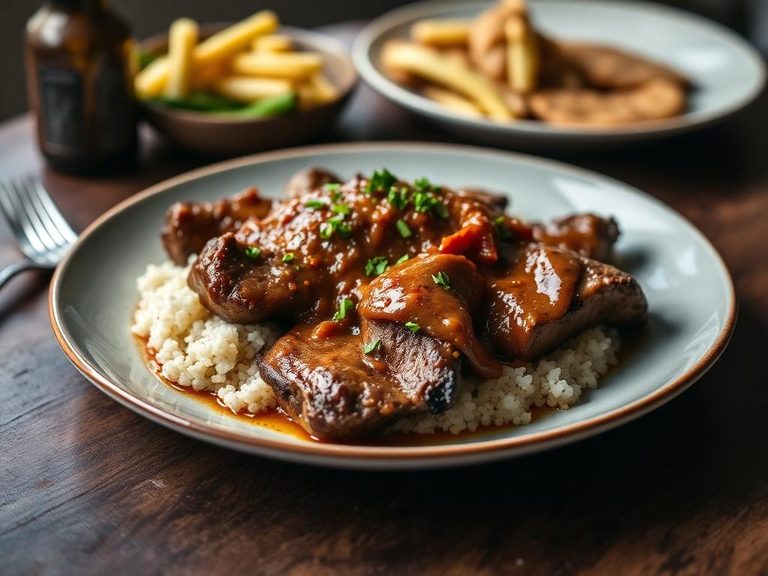
🌍 Where it's eaten
💡 Did you know?
Despite its name, Swiss steak has no direct connection to Switzerland; the 'Swiss' likely refers to the 'swissing' process of tenderizing meat by pounding it, a technique once associated with Swiss-style mechanical tenderizers.
Full nutrition (USDA data · scales with serving)
| Water | 75.1 g |
| Energy | 115 kcal |
| Protein | 15.5 g |
| Total lipid (fat) | 4.4 g |
| Carbohydrate, by difference | 3.7 g |
| Fiber, total dietary | 0.90 g |
| Total Sugars | 1.2 g |
| Calcium, Ca | 24.0 mg |
| Iron, Fe | 1.8 mg |
| Magnesium, Mg | 13.0 mg |
| Phosphorus, P | 146 mg |
| Potassium, K | 284 mg |
| Sodium, Na | 250 mg |
| Zinc, Zn | 2.3 mg |
| Copper, Cu | 0.06 mg |
| Selenium, Se | 14.1 ug |
| Vitamin C, total ascorbic acid | 4.4 mg |
| Thiamin | 0.24 mg |
| Riboflavin | 0.18 mg |
| Niacin | 4.4 mg |
| Vitamin B-6 | 0.41 mg |
| Folate, total | 10.0 ug |
| Folic acid | 2.0 ug |
| Folate, food | 8.0 ug |
| Folate, DFE | 11.0 ug |
| Choline, total | 38.6 mg |
| Vitamin B-12 | 0.96 ug |
| Vitamin B-12, added | 0.00 ug |
| Vitamin A, RAE | 43.0 ug |
| Retinol | 2.0 ug |
| Carotene, beta | 419 ug |
| Carotene, alpha | 138 ug |
| Cryptoxanthin, beta | 0.00 ug |
| Lycopene | 800 ug |
| Lutein + zeaxanthin | 48.0 ug |
| Vitamin E (alpha-tocopherol) | 0.77 mg |
| Vitamin E, added | 0.00 mg |
| Vitamin D (D2 + D3) | 0.00 ug |
| Vitamin K (phylloquinone) | 5.8 ug |
| Alcohol, ethyl | 0.00 g |
| Caffeine | 0.00 mg |
| Theobromine | 0.00 mg |
Fat & fatty acid profile (per 100g)
| Fatty acids, total saturated | 1.1 g |
| SFA 4:0 | 0.00 g |
| SFA 6:0 | 0.00 g |
| SFA 8:0 | 0.00 g |
| SFA 10:0 | 0.00 g |
| SFA 12:0 | 0.00 g |
| SFA 14:0 | 0.05 g |
| SFA 16:0 | 0.69 g |
| SFA 18:0 | 0.33 g |
| Fatty acids, total monounsaturated | 1.8 g |
| MUFA 16:1 | 0.08 g |
| MUFA 18:1 | 1.7 g |
| MUFA 20:1 | 0.02 g |
| MUFA 22:1 | 0.00 g |
| Fatty acids, total polyunsaturated | 0.99 g |
| PUFA 18:2 | 0.85 g |
| PUFA 18:3 | 0.09 g |
| PUFA 18:4 | 0.00 g |
| PUFA 20:4 | 0.02 g |
| PUFA 20:5 n-3 (EPA) | 0.00 g |
| PUFA 22:5 n-3 (DPA) | 0.01 g |
| PUFA 22:6 n-3 (DHA) | 0.00 g |
| Cholesterol | 38.0 mg |
FAQ
What cut of beef is best for Swiss steak?
Traditionally, tougher, well-marbled cuts with connective tissue are used, such as top round, bottom round, chuck, or rump roast. The long braising time is essential to break down the collagen and tenderize these economical cuts.
Why is it called 'Swiss' steak?
The name is a verb, not a nationality. It comes from the process of 'swissing,' which means to tenderize meat by pounding it with a mallet or using a mechanical tenderizer. This mechanical tenderizing was sometimes done by a machine called a 'Swiss' tenderizer.
Can I make Swiss steak in a slow cooker?
Yes, it's an ideal slow cooker recipe. After browning the meat and sautéing the vegetables, transfer everything to the slow cooker and cook on low for 6-8 hours or on high for 3-4 hours until the meat is fork-tender.
Nutrient density (calculated · NRF9.3)
Nutrient Rich Foods index: beneficial nutrients (protein, fiber, vitamins, minerals) minus saturated fat, added sugar & sodium, per 100 kcal.
NRF9.3 index — Fulgoni, Keast & Drewnowski, 2009. Computed from USDA nutrients.
Weight-loss friendliness (composite index)
Energy density 1.15 kcal/g · 54% calories from protein · 0.9 g fiber · 1.2 g sugar per 100 g.
Composite of energy density (Rolls et al., 1999), protein & fiber satiety, minus sugar. A calculated heuristic — ranks satiety-per-calorie, not a clinical measure.
Dietary load (calculated from USDA values)
Potential renal acid load. Positive = acid-forming, negative = alkaline-forming.
Sodium-to-potassium ratio: 0.88 (lower is better — aim for ≤ 1)
Sodium:potassium per WHO potassium guidance. Computed from USDA nutrients.