

Sushi, topped with egg
Common food

Photo: Wikipedia
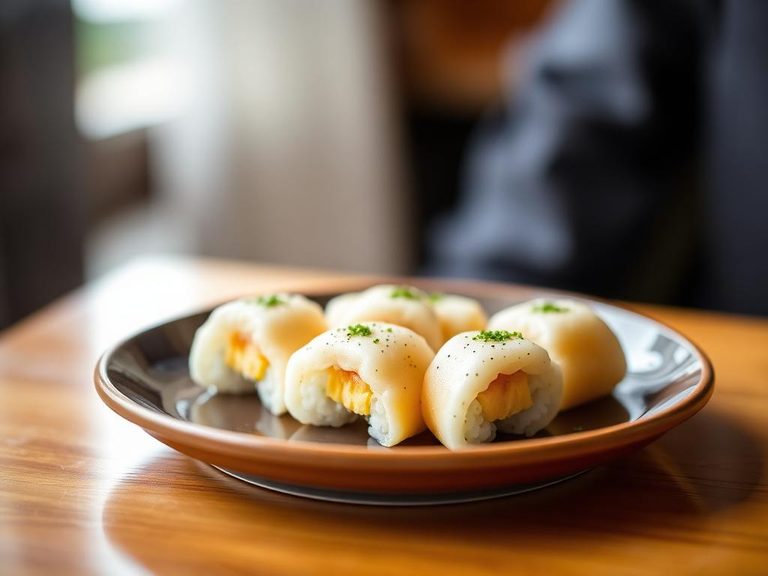
Tamago sushi is a classic nigiri piece featuring a sweet, layered Japanese omelet (tamagoyaki) draped over a small, vinegared rice ball. The egg offers a soft, custardy texture with a subtle sweetness, contrasting the slightly sticky rice. Nutritionally, it's a lighter sushi option, providing quality protein with moderate calories and carbs.
Calorie split: 25% protein · 35% carbs · 40% fat
↓ Full nutrition💚 Why it's loved
People love tamago sushi for its comforting, sweet-savory balance and the skillful layering of the egg, which showcases a fundamental sushi chef technique. It's a versatile, mild-flavored staple that appeals to both sushi newcomers and purists.
⚠️ Watch-outs & how to enjoy it better
The sweetened egg and vinegared rice can cause a quicker blood sugar rise compared to sashimi. Those monitoring sodium should note the soy sauce typically used for dipping. To counteract, pair with a side of edamame or seaweed salad for fiber and protein, and use low-sodium soy sauce or dip sparingly.
Key benefits
- Good source of complete protein for muscle maintenance
- Provides essential nutrients like vitamin B12 and selenium
- Lower in fat than many fried or mayo-based sushi rolls
- Contains choline from egg yolk, important for brain health
- A relatively simple, whole-food based sushi choice
🍽️ Popular dishes


🌍 Where it's eaten
💡 Did you know?
The skill of making tamagoyaki is a traditional test for sushi chefs apprentices, who must master the precise heat control and rolling technique to create the perfect, seamless layers.
Full nutrition (USDA data · scales with serving)
| Water | 75.8 g |
| Energy | 119 kcal |
| Protein | 7.3 g |
| Total lipid (fat) | 5.2 g |
| Carbohydrate, by difference | 10.3 g |
| Fiber, total dietary | 0.40 g |
| Total Sugars | 0.69 g |
| Calcium, Ca | 27.0 mg |
| Iron, Fe | 0.94 mg |
| Magnesium, Mg | 8.0 mg |
| Phosphorus, P | 99.0 mg |
| Potassium, K | 75.0 mg |
| Sodium, Na | 338 mg |
| Zinc, Zn | 0.83 mg |
| Copper, Cu | 0.02 mg |
| Selenium, Se | 18.5 ug |
| Vitamin C, total ascorbic acid | 0.30 mg |
| Thiamin | 0.04 mg |
| Riboflavin | 0.21 mg |
| Niacin | 0.14 mg |
| Vitamin B-6 | 0.04 mg |
| Folate, total | 29.0 ug |
| Folic acid | 0.00 ug |
| Folate, food | 29.0 ug |
| Folate, DFE | 29.0 ug |
| Choline, total | 139 mg |
| Vitamin B-12 | 0.42 ug |
| Vitamin B-12, added | 0.00 ug |
| Vitamin A, RAE | 95.0 ug |
| Retinol | 92.0 ug |
| Carotene, beta | 24.0 ug |
| Carotene, alpha | 0.00 ug |
| Cryptoxanthin, beta | 7.0 ug |
| Lycopene | 0.00 ug |
| Lutein + zeaxanthin | 260 ug |
| Vitamin E (alpha-tocopherol) | 0.57 mg |
| Vitamin E, added | 0.00 mg |
| Vitamin D (D2 + D3) | 1.3 ug |
| Vitamin K (phylloquinone) | 0.20 ug |
| Alcohol, ethyl | 0.00 g |
| Caffeine | 0.00 mg |
| Theobromine | 0.00 mg |
Fat & fatty acid profile (per 100g)
| Fatty acids, total saturated | 1.7 g |
| SFA 4:0 | 0.00 g |
| SFA 6:0 | 0.00 g |
| SFA 8:0 | 0.00 g |
| SFA 10:0 | 0.00 g |
| SFA 12:0 | 0.00 g |
| SFA 14:0 | 0.02 g |
| SFA 16:0 | 1.2 g |
| SFA 18:0 | 0.42 g |
| Fatty acids, total monounsaturated | 1.9 g |
| MUFA 16:1 | 0.12 g |
| MUFA 18:1 | 1.8 g |
| MUFA 20:1 | 0.00 g |
| MUFA 22:1 | 0.00 g |
| Fatty acids, total polyunsaturated | 0.97 g |
| PUFA 18:2 | 0.78 g |
| PUFA 18:3 | 0.01 g |
| PUFA 18:4 | 0.00 g |
| PUFA 20:4 | 0.00 g |
| PUFA 20:5 n-3 (EPA) | 0.00 g |
| PUFA 22:5 n-3 (DPA) | 0.00 g |
| PUFA 22:6 n-3 (DHA) | 0.00 g |
| Cholesterol | 212 mg |
FAQ
Is tamago sushi raw egg?
No, the egg is fully cooked into a layered omelet called tamagoyaki, which is a key difference from some other cuisines.
Why is tamago sushi sweet?
The egg mixture is traditionally seasoned with sugar, mirin, and soy sauce, giving it a distinctive sweet and savory flavor profile.
Is tamago sushi vegetarian?
While the egg itself is not vegan, it is a common vegetarian (lacto-ovo) option in sushi, as it contains no meat or fish.
Nutrient density (calculated · NRF9.3)
Nutrient Rich Foods index: beneficial nutrients (protein, fiber, vitamins, minerals) minus saturated fat, added sugar & sodium, per 100 kcal.
NRF9.3 index — Fulgoni, Keast & Drewnowski, 2009. Computed from USDA nutrients.
Weight-loss friendliness (composite index)
Energy density 1.19 kcal/g · 25% calories from protein · 0.4 g fiber · 0.7 g sugar per 100 g.
Composite of energy density (Rolls et al., 1999), protein & fiber satiety, minus sugar. A calculated heuristic — ranks satiety-per-calorie, not a clinical measure.
Dietary load (calculated from USDA values)
Potential renal acid load. Positive = acid-forming, negative = alkaline-forming.
Sodium-to-potassium ratio: 4.51 (lower is better — aim for ≤ 1)
Sodium:potassium per WHO potassium guidance. Computed from USDA nutrients.