

Sports drink (Gatorade G)
Common food
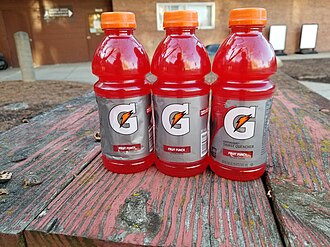
Photo: Wikipedia
A brightly colored, sweet-tart electrolyte beverage designed for rapid rehydration during intense physical activity. It has a thin, watery texture and a distinct, sugary fruit flavor that's instantly recognizable. Its core nutrition is a quick hit of simple carbohydrates (sugars) with zero fat or protein.
Calorie split: 0% protein · 100% carbs · 0% fat
↓ Full nutrition💚 Why it's loved
People love it for its bold, nostalgic flavors and its proven ability to combat dehydration and fatigue during sports or in hot weather. It's a cultural staple at sporting events, from high school games to the Olympics.
⚠️ Watch-outs & how to enjoy it better
The high sugar content can cause blood-sugar spikes and crashes, making it a poor choice for sedentary individuals or those with insulin resistance. To mitigate, use it only during prolonged, intense exercise (over 60 minutes) or dilute it with water. Those monitoring sodium intake should be cautious.
Key benefits
- Rapidly replenishes fluids and electrolytes lost through sweat.
- Provides quick-access energy from simple carbohydrates.
- Enhances palatability to encourage greater fluid intake.
- Contains sodium to aid fluid retention and prevent hyponatremia.
- Widely available and standardized for consistent performance.
🍽️ Popular dishes


🌍 Where it's eaten
💡 Did you know?
Gatorade was originally developed in 1965 by researchers at the University of Florida for the school's football team, the Gators, to combat heat-related illness.
Full nutrition (USDA data · scales with serving)
| Water | 93.4 g |
| Energy | 26.0 kcal |
| Protein | 0.00 g |
| Total lipid (fat) | 0.00 g |
| Carbohydrate, by difference | 6.4 g |
| Fiber, total dietary | 0.00 g |
| Total Sugars | 5.2 g |
| Calcium, Ca | 1.0 mg |
| Iron, Fe | 0.05 mg |
| Magnesium, Mg | 0.00 mg |
| Phosphorus, P | 10.0 mg |
| Potassium, K | 15.0 mg |
| Sodium, Na | 39.0 mg |
| Zinc, Zn | 0.01 mg |
| Copper, Cu | 0.01 mg |
| Selenium, Se | 0.00 ug |
| Vitamin C, total ascorbic acid | 0.40 mg |
| Thiamin | 0.01 mg |
| Riboflavin | 0.00 mg |
| Niacin | 0.22 mg |
| Vitamin B-6 | 0.02 mg |
| Folate, total | 0.00 ug |
| Folic acid | 0.00 ug |
| Folate, food | 0.00 ug |
| Folate, DFE | 0.00 ug |
| Choline, total | 0.00 mg |
| Vitamin B-12 | 0.00 ug |
| Vitamin B-12, added | 0.00 ug |
| Vitamin A, RAE | 0.00 ug |
| Retinol | 0.00 ug |
| Carotene, beta | 0.00 ug |
| Carotene, alpha | 0.00 ug |
| Cryptoxanthin, beta | 0.00 ug |
| Lycopene | 0.00 ug |
| Lutein + zeaxanthin | 0.00 ug |
| Vitamin E (alpha-tocopherol) | 0.00 mg |
| Vitamin E, added | 0.00 mg |
| Vitamin D (D2 + D3) | 0.00 ug |
| Vitamin K (phylloquinone) | 0.20 ug |
| Alcohol, ethyl | 0.00 g |
| Caffeine | 0.00 mg |
| Theobromine | 0.00 mg |
Fat & fatty acid profile (per 100g)
| Fatty acids, total saturated | 0.00 g |
| SFA 4:0 | 0.00 g |
| SFA 6:0 | 0.00 g |
| SFA 8:0 | 0.00 g |
| SFA 10:0 | 0.00 g |
| SFA 12:0 | 0.00 g |
| SFA 14:0 | 0.00 g |
| SFA 16:0 | 0.00 g |
| SFA 18:0 | 0.00 g |
| Fatty acids, total monounsaturated | 0.00 g |
| MUFA 16:1 | 0.00 g |
| MUFA 18:1 | 0.00 g |
| MUFA 20:1 | 0.00 g |
| MUFA 22:1 | 0.00 g |
| Fatty acids, total polyunsaturated | 0.00 g |
| PUFA 18:2 | 0.00 g |
| PUFA 18:3 | 0.00 g |
| PUFA 18:4 | 0.00 g |
| PUFA 20:4 | 0.00 g |
| PUFA 20:5 n-3 (EPA) | 0.00 g |
| PUFA 22:5 n-3 (DPA) | 0.00 g |
| PUFA 22:6 n-3 (DHA) | 0.00 g |
| Cholesterol | 0.00 mg |
FAQ
Is it better than water for hydration?
For intense exercise lasting over 60 minutes, yes. The electrolytes and carbohydrates improve fluid absorption and provide energy. For light activity or daily hydration, water is sufficient and healthier.
Can I drink it if I'm not exercising?
It's not recommended. The high sugar content provides empty calories that can contribute to weight gain and blood sugar issues without the need for rapid energy replenishment.
Does it help with hangovers?
It may help replace electrolytes lost due to alcohol's diuretic effect, but it doesn't address the root causes of a hangover like dehydration, inflammation, or toxin buildup. Water and food are generally better.
Nutrient density (calculated · NRF9.3)
Nutrient Rich Foods index: beneficial nutrients (protein, fiber, vitamins, minerals) minus saturated fat, added sugar & sodium, per 100 kcal.
NRF9.3 index — Fulgoni, Keast & Drewnowski, 2009. Computed from USDA nutrients.
Weight-loss friendliness (composite index)
Energy density 0.26 kcal/g · 0% calories from protein · 0.0 g fiber · 5.2 g sugar per 100 g.
Composite of energy density (Rolls et al., 1999), protein & fiber satiety, minus sugar. A calculated heuristic — ranks satiety-per-calorie, not a clinical measure.
Dietary load (calculated from USDA values)
Potential renal acid load. Positive = acid-forming, negative = alkaline-forming.
Sodium-to-potassium ratio: 2.60 (lower is better — aim for ≤ 1)
Sodium:potassium per WHO potassium guidance. Computed from USDA nutrients.