

Soup, bean with ham, canned, chunky, ready-to-serve
Whole food · Soups, Sauces, and Gravies

Photo: Wikipedia
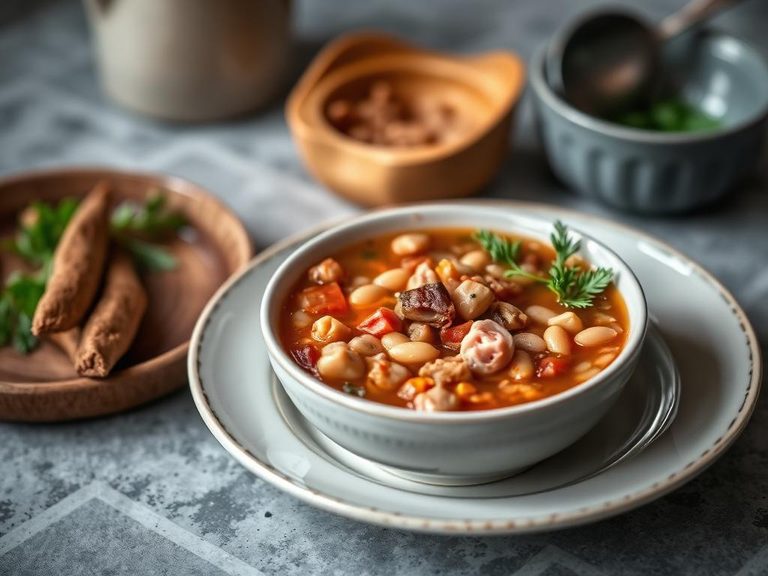
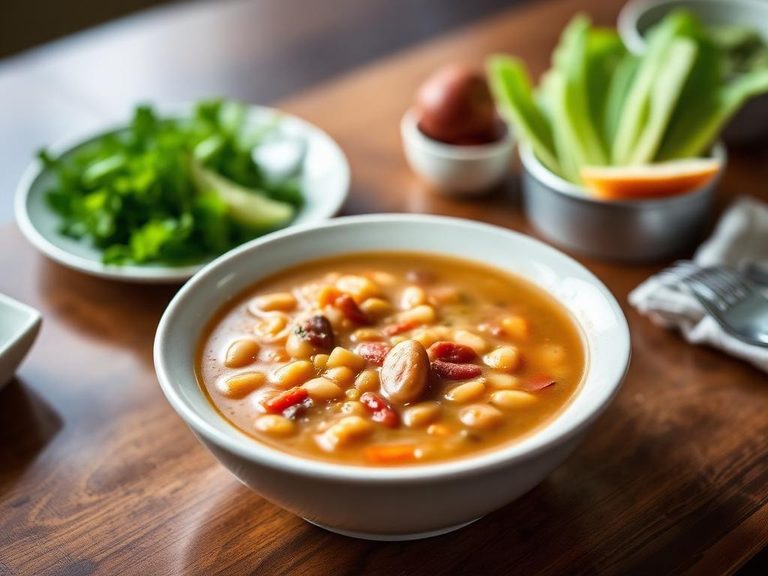
This is a hearty, ready-to-eat canned soup featuring tender beans and savory ham in a rich, seasoned broth. Its texture is chunky and satisfying, with a smoky, salty depth from the ham that complements the earthy beans. Nutritionally, it's a solid source of plant-based protein and fiber, making it a filling, low-calorie meal option.
Calorie split: 21% protein · 46% carbs · 33% fat
↓ Full nutrition💚 Why it's loved
People love it for its comforting, smoky flavor and the satisfying, chunky texture that feels like a complete meal in a bowl. It's a classic, versatile staple that can be enjoyed on its own, with bread, or as a base for other dishes.
⚠️ Watch-outs & how to enjoy it better
The primary concern is often high sodium content from the canning process and ham, which can be problematic for blood pressure. To counteract this, look for low-sodium versions, rinse the contents lightly if possible, or pair it with a potassium-rich side like a banana or a salad to help balance electrolytes. Those watching blood sugar should be aware that while the fiber helps, the carbohydrate count is significant; pairing it with extra protein or fat can moderate the glycemic response.
Key benefits
- Good source of plant-based protein (5.19g per 100g)
- High in dietary fiber (4.6g per 100g)
- Low in calories (95 kcal per 100g)
- Convenient, shelf-stable, ready-to-serve meal
- Provides complex carbohydrates for sustained energy
🍽️ Popular dishes
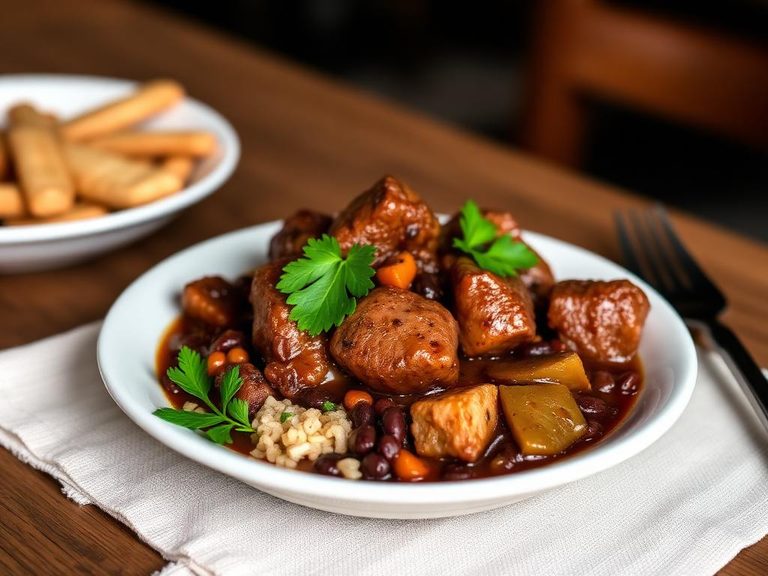
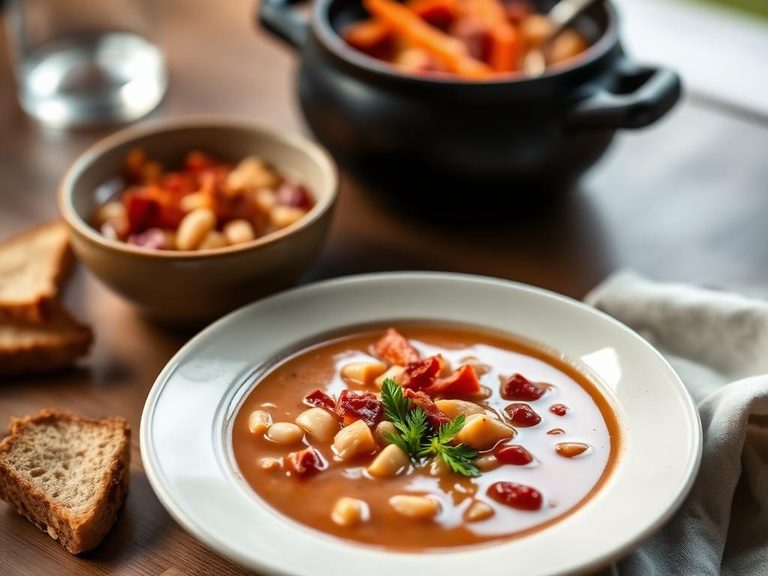
🌍 Where it's eaten
💡 Did you know?
The iconic U.S. Senate Bean Soup, a staple in the Senate dining room since at least 1901, is traditionally made with cured ham hocks and is mandated by Senate rules to always be on the menu.
Full nutrition (USDA data · scales with serving)
| Water | 78.6 g |
| Energy | 95.0 kcal |
| Energy | 397 kj |
| Protein | 5.2 g |
| Total lipid (fat) | 3.5 g |
| Ash | 1.5 g |
| Carbohydrate, by difference | 11.2 g |
| Fiber, total dietary | 4.6 g |
| Calcium, Ca | 32.0 mg |
| Iron, Fe | 1.3 mg |
| Magnesium, Mg | 19.0 mg |
| Phosphorus, P | 59.0 mg |
| Potassium, K | 175 mg |
| Sodium, Na | 400 mg |
| Zinc, Zn | 0.44 mg |
| Copper, Cu | 0.16 mg |
| Manganese, Mn | 0.29 mg |
| Selenium, Se | 6.9 ug |
| Vitamin C, total ascorbic acid | 1.8 mg |
| Thiamin | 0.06 mg |
| Riboflavin | 0.06 mg |
| Niacin | 0.70 mg |
| Pantothenic acid | 0.04 mg |
| Vitamin B-6 | 0.05 mg |
| Folate, total | 12.0 ug |
| Folic acid | 0.00 ug |
| Folate, food | 12.0 ug |
| Folate, DFE | 12.0 ug |
| Vitamin B-12 | 0.03 ug |
| Vitamin A, RAE | 81.0 ug |
| Retinol | 0.00 ug |
| Vitamin A, IU | 1626 iu |
Fat & fatty acid profile (per 100g)
| Fatty acids, total saturated | 1.4 g |
| SFA 10:0 | 0.00 g |
| SFA 12:0 | 0.01 g |
| SFA 14:0 | 0.05 g |
| SFA 16:0 | 0.83 g |
| SFA 18:0 | 0.47 g |
| Fatty acids, total monounsaturated | 1.6 g |
| MUFA 16:1 | 0.09 g |
| MUFA 18:1 | 1.4 g |
| MUFA 20:1 | 0.04 g |
| Fatty acids, total polyunsaturated | 0.39 g |
| PUFA 18:2 | 0.36 g |
| PUFA 18:3 | 0.04 g |
| Cholesterol | 9.0 mg |
Amino acid profile (per 100g)
Estimated from Soup, bean with pork, canned, condensed — USDA does not publish this profile for Soup.
| Tryptophan | 0.06 g |
| Threonine | 0.24 g |
| Isoleucine | 0.29 g |
| Leucine | 0.48 g |
| Lysine | 0.40 g |
| Methionine | 0.07 g |
| Cystine | 0.07 g |
| Phenylalanine | 0.33 g |
| Tyrosine | 0.18 g |
| Valine | 0.32 g |
| Arginine | 0.31 g |
| Histidine | 0.15 g |
| Alanine | 0.29 g |
| Aspartic acid | 0.66 g |
| Glutamic acid | 1.1 g |
| Glycine | 0.28 g |
| Proline | 0.27 g |
| Serine | 0.29 g |
FAQ
Is canned bean and ham soup healthy?
It can be a nutritious part of a balanced diet. It's a good source of protein and fiber, but can be high in sodium. Choosing low-sodium varieties and pairing it with fresh vegetables or whole grains makes it a healthier choice.
How long does canned soup last after opening?
Once opened, you should transfer any unused soup to an airtight container in the refrigerator. It will typically keep for 3-4 days. It's not recommended to freeze canned soups after opening due to texture changes.
Can I use this soup as a base for other recipes?
Absolutely! It's an excellent shortcut base. You can add extra vegetables, herbs, a splash of vinegar or cream, or use it as a flavorful liquid for cooking grains like rice or quinoa.
Nutrient density (calculated · NRF9.3)
Nutrient Rich Foods index: beneficial nutrients (protein, fiber, vitamins, minerals) minus saturated fat, added sugar & sodium, per 100 kcal.
NRF9.3 index — Fulgoni, Keast & Drewnowski, 2009. Computed from USDA nutrients.
Weight-loss friendliness (composite index)
Energy density 0.95 kcal/g · 22% calories from protein · 4.6 g fiber · 0.0 g sugar per 100 g.
Composite of energy density (Rolls et al., 1999), protein & fiber satiety, minus sugar. A calculated heuristic — ranks satiety-per-calorie, not a clinical measure.
Dietary load (calculated from USDA values)
Potential renal acid load. Positive = acid-forming, negative = alkaline-forming.
Sodium-to-potassium ratio: 2.29 (lower is better — aim for ≤ 1)
Sodium:potassium per WHO potassium guidance. Computed from USDA nutrients.